This exhibition of early printed and rare books is an exploration into the wide variety of materials that can be found in All Souls College Library, and the issues that such materials present librarians who are charged with their care. From precious silk bindings to books with lots of metal adornments on the cover; from hungry rats and bookworms to humans who hold a flame too close to the page; and from illustrations ripped in two to book spines that are barely hanging on, the items selected for this exhibition showcase how the 'city of dreaming spires' could also be considered the 'city of broken spines', and its library collections are all the more fascinating for it.
From silk to silver and from paper to parchment; from elaborate professional leather inlaid bindings to amateurish embellishments and repairs; each item is unique and presents unique challenges to library curators and conservators.
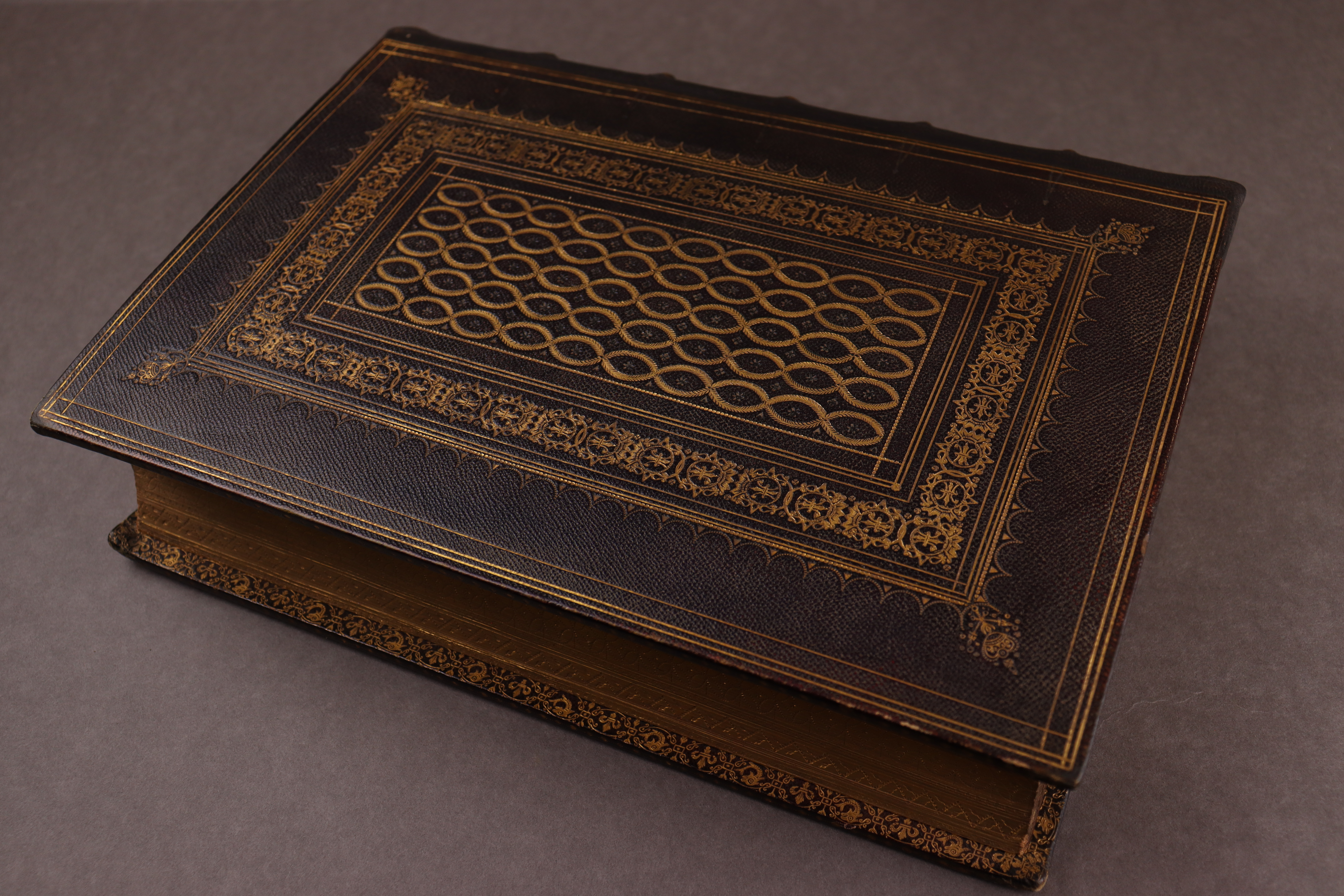
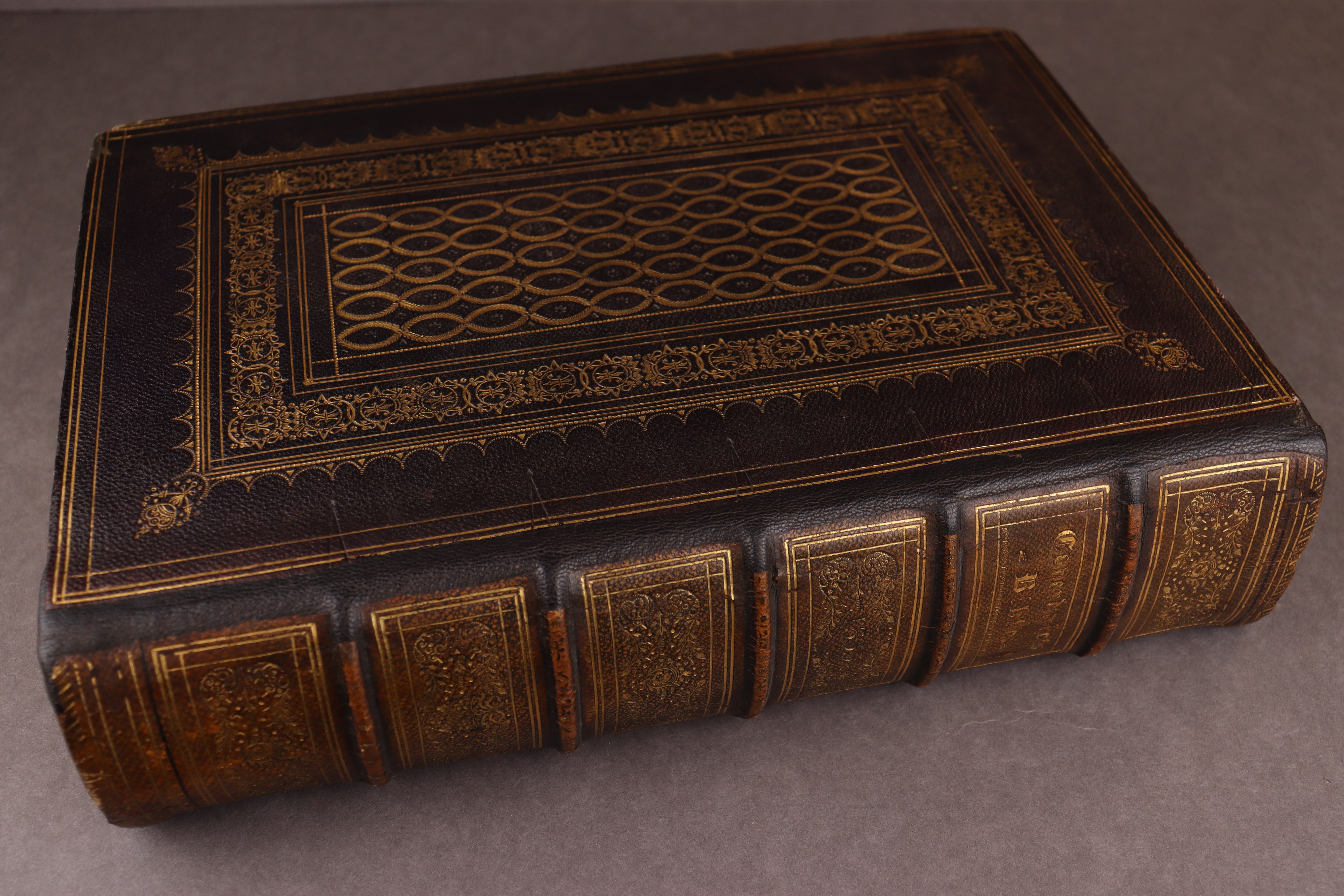
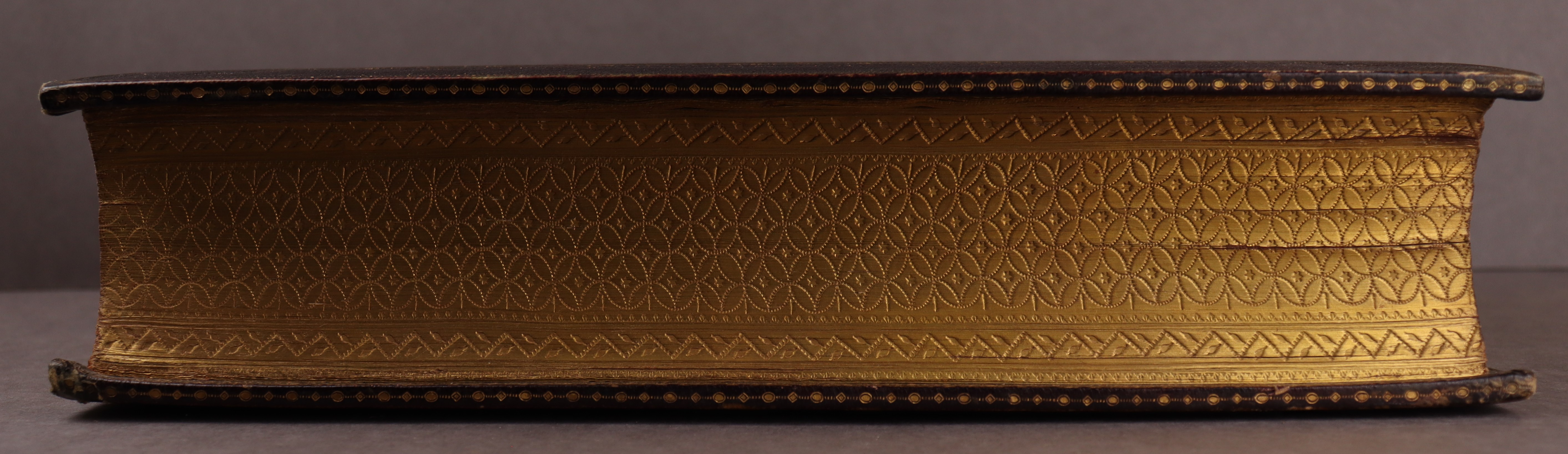
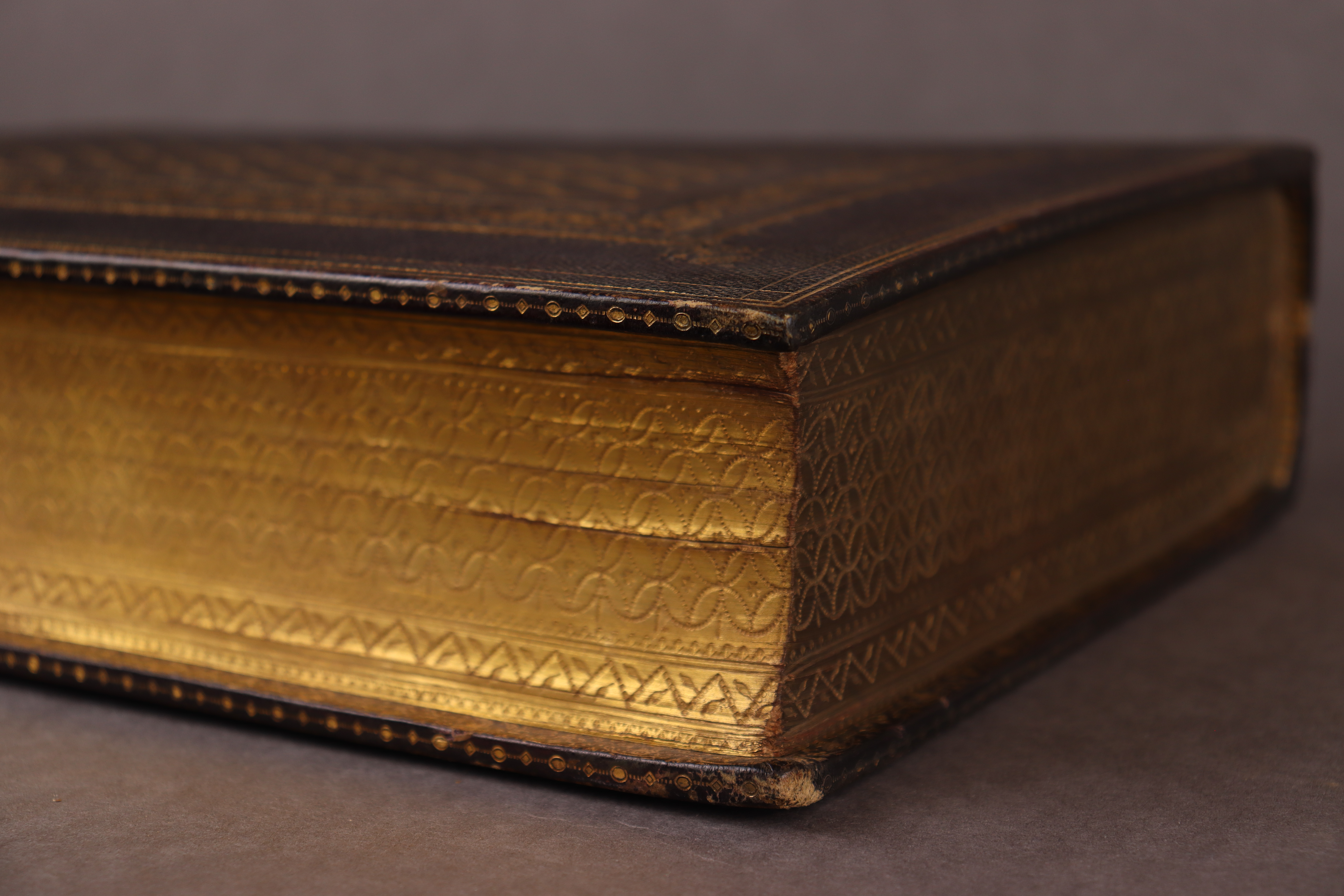
An early copy of the Coverdale Bible with a particularly sumptuous binding, likely dating from the 18th century. Covered in dark burgundy morocco (high-quality goatskin), the upper and lower boards showcase gilt-tooled fillets, rolls and corner fleurons (flower ornament), with additional gilt-tooled decoration on the spine and an All Souls College armorial device gilt-stamped at the tail of the spine. Nevertheless, the most remarkable feature of this binding is undoubtedly the gilded textblock edges, which have also been gauffered, that is, decorated by the impression of heated tools in a delicate and beautiful pattern. Bindings of this kind are quite striking and generally reserved for works valued by their owners. Such works must be handled with care, and minimal contact with the decorative textblock edges is preferable in order to preserve the integrity of the decoration.
Biblia : the Byble: that is, the holy Scrypture of the Olde and New Testament, faythfully translated in to Englyshe. ([Cologne? [and Southwark]] : [Printed by E. Cervicornus and J. Soter? [and J. Nicolson]], M.D.XXXV. [1535 (4 Oct.)])
Shelfmark: LR.4.b.24
Full bibliographic record

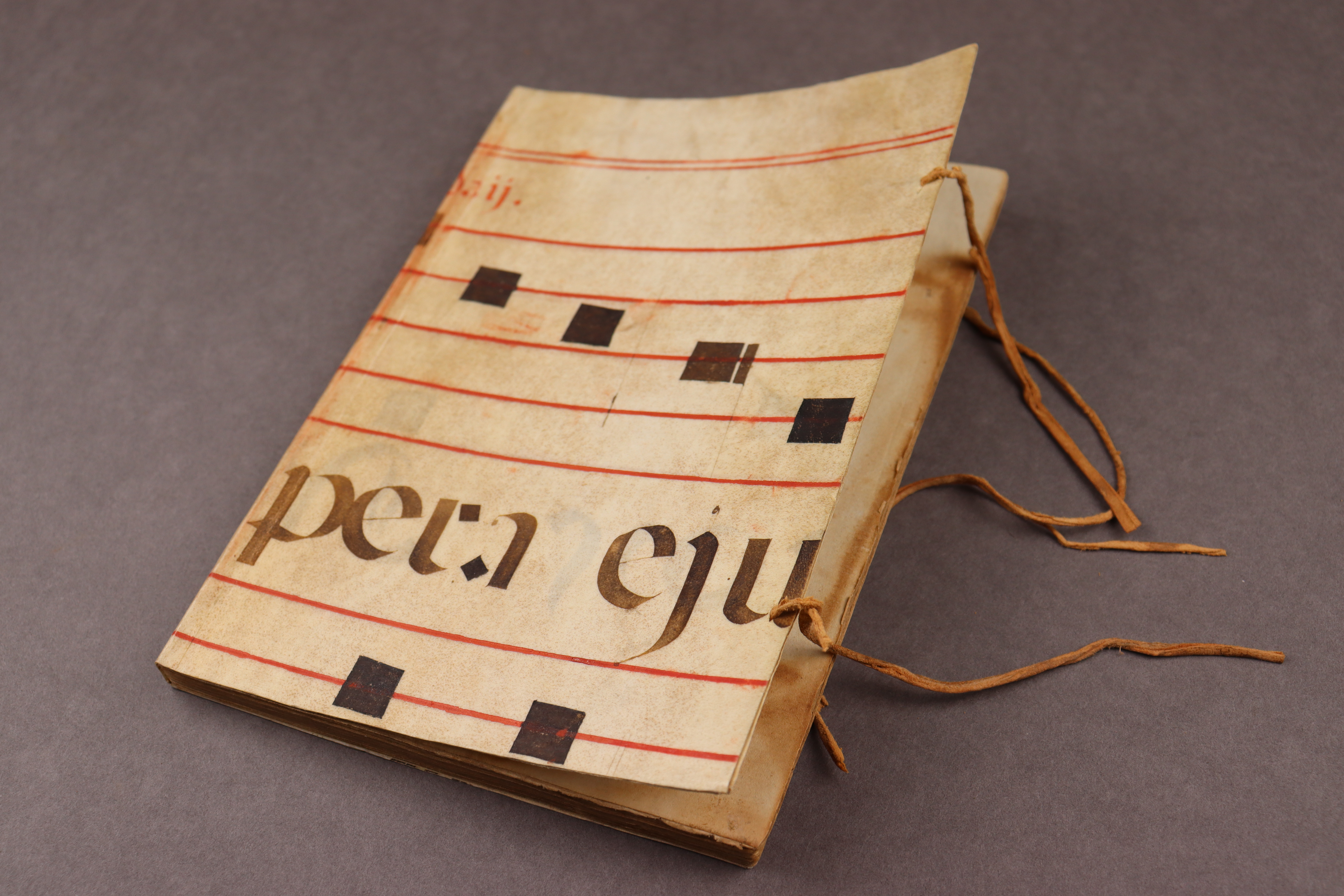
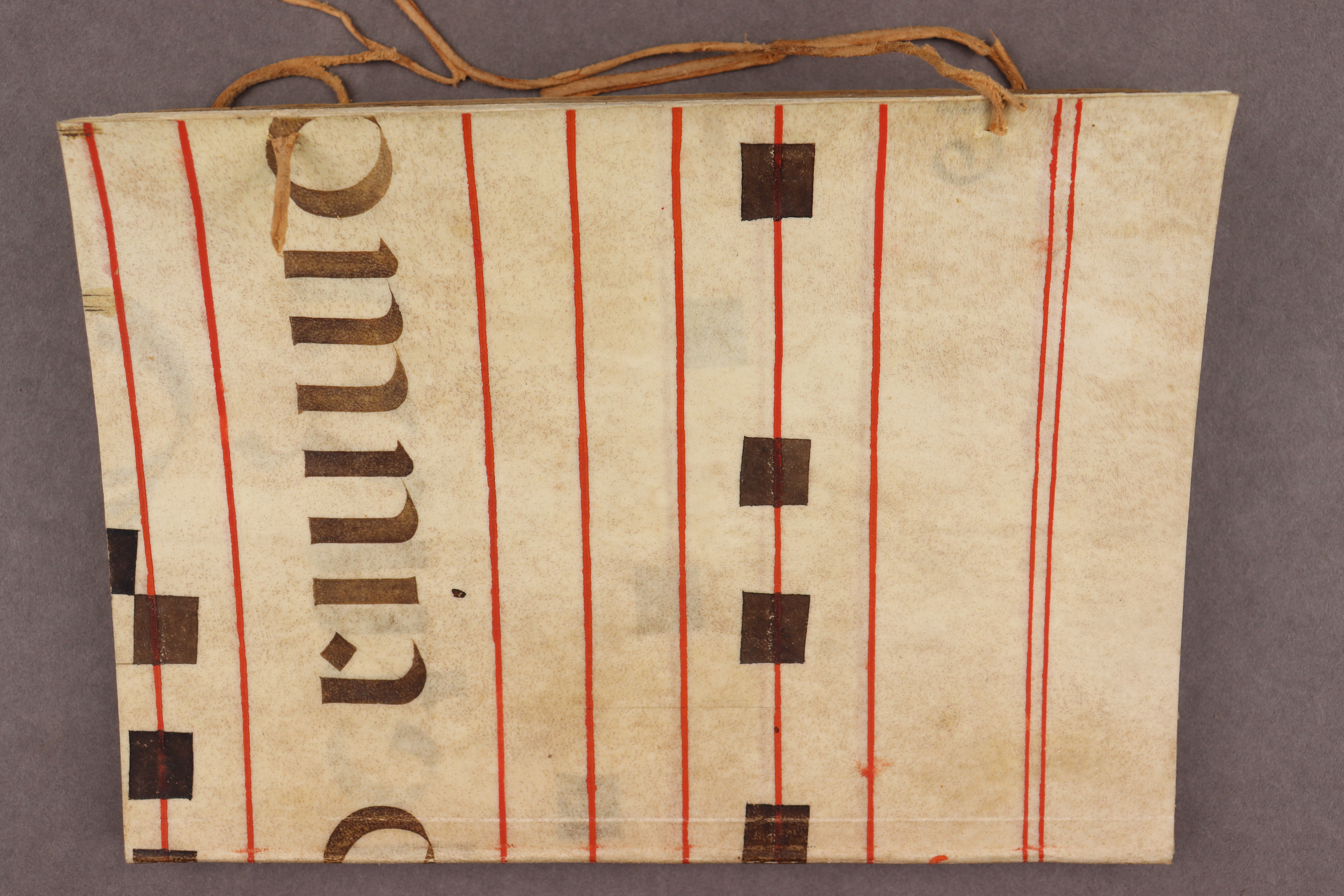
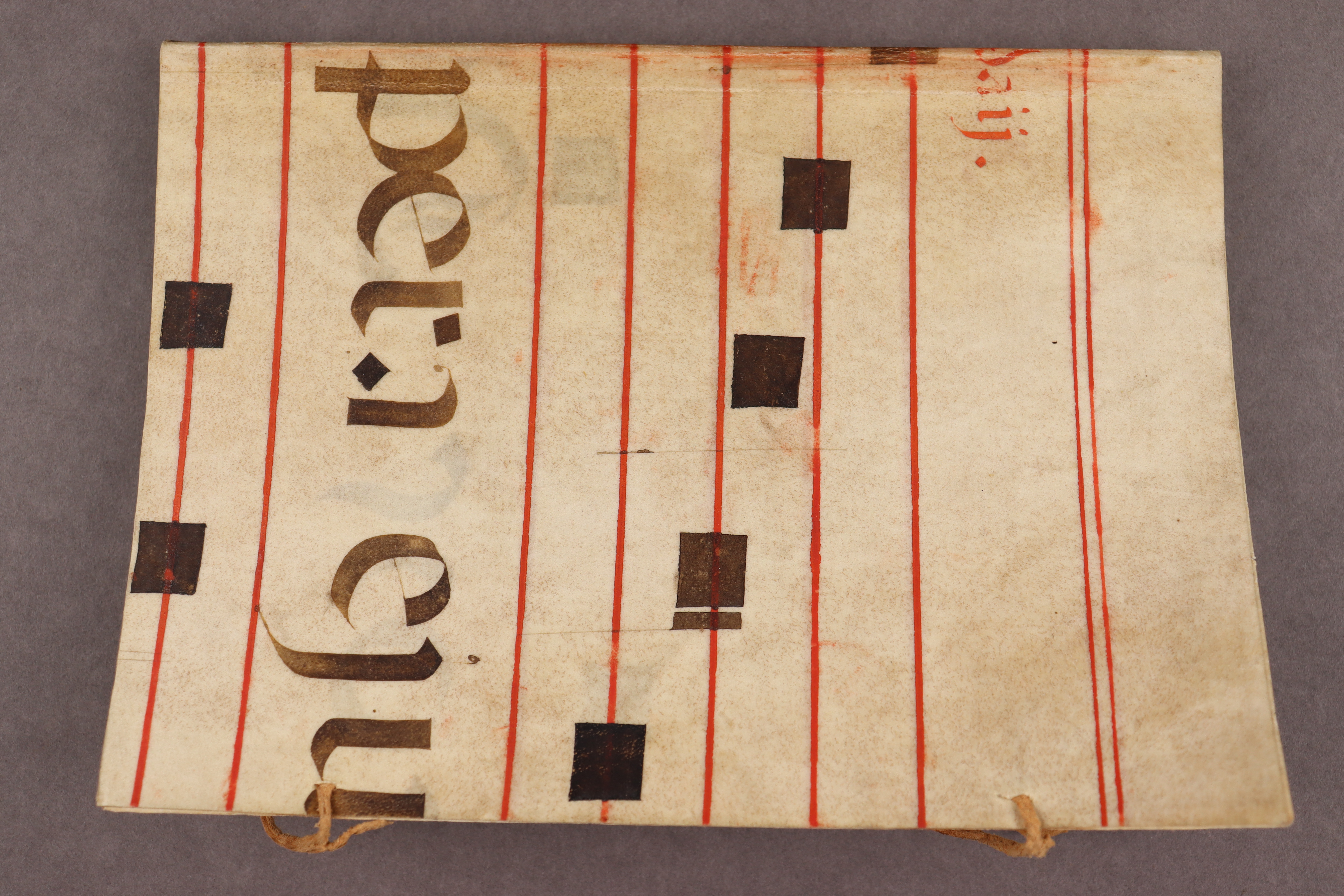
This volume, a celebratory poem in honour of Gonzalo Fernández de Córdoba (a Spanish general famous for having led the battle of Cerignola, Italy, in 1503), was temporarily bound using a scrap of parchment, and never rebound. Books used to be sold unbound, and each owner would then bind them according to their personal taste and their finances. Bookbinders collected old or discarded material to use for temporary wrappers; in this case, the book has been bound with a section of a sheet of parchment, backed with paper, from a large manuscript of plainchant (liturgical chant music), possibly from Psalm 32:4 (Exultate, justi). Although this remnant of the past is fascinating and informative, its care is complex: parchment tends to warp and become brittle in hot and dry conditions, which are increasingly frequent due to climate change, and ink can transfer to other books or discolour easily. This item should therefore be stored in tightly controlled environmental conditions, in a custom-made, acid-free archival sleeve.
The battle of Cerignola in 1503 was the first battle in history won by gunpowder small arms (arquebuses).
The parchment scrap presents five-line staves in manuscript red ink, and neumes in manuscript blank ink, with text in Latin in black manuscript ink, 2 cm high: "... omnia opera eju[s] ...". The book itself was kept closed with leather ties at the foredges, which are still visible today.
Cantalicio, Giovanni Battista. Cantalycii, Pinnensis atque Adriensis Episcopi, De Parthenope bis recepta, Gonsaluia. : Libri quattuor.. (Argentorati, : ex ædibus Schürerianis., mense Iunio, anno M. D. XIII. regnante imperatore Caes. Maximili. P.F. Aug, P.P. [1513])
Shelfmark: Sparrow E.377
Full bibliographic record
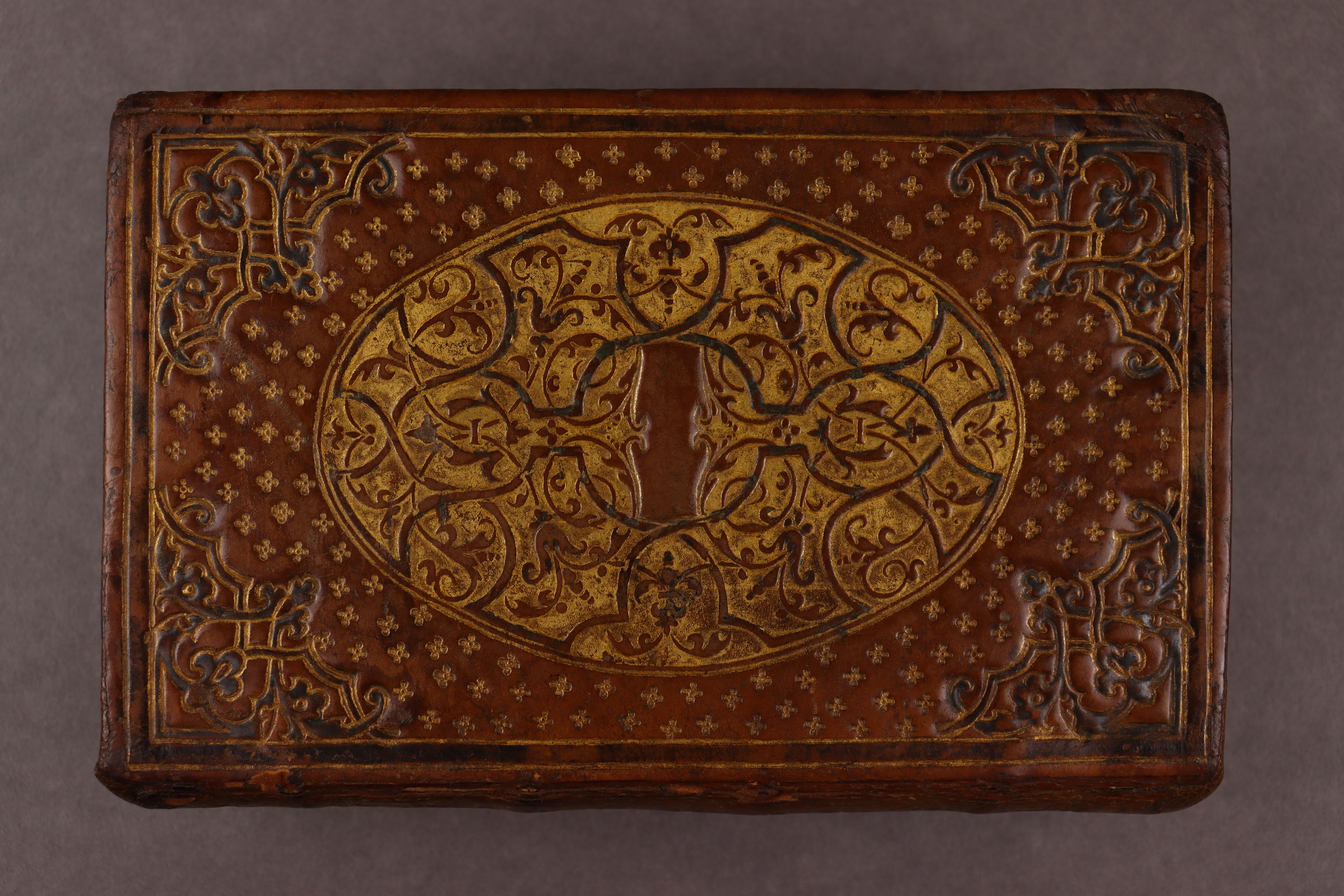
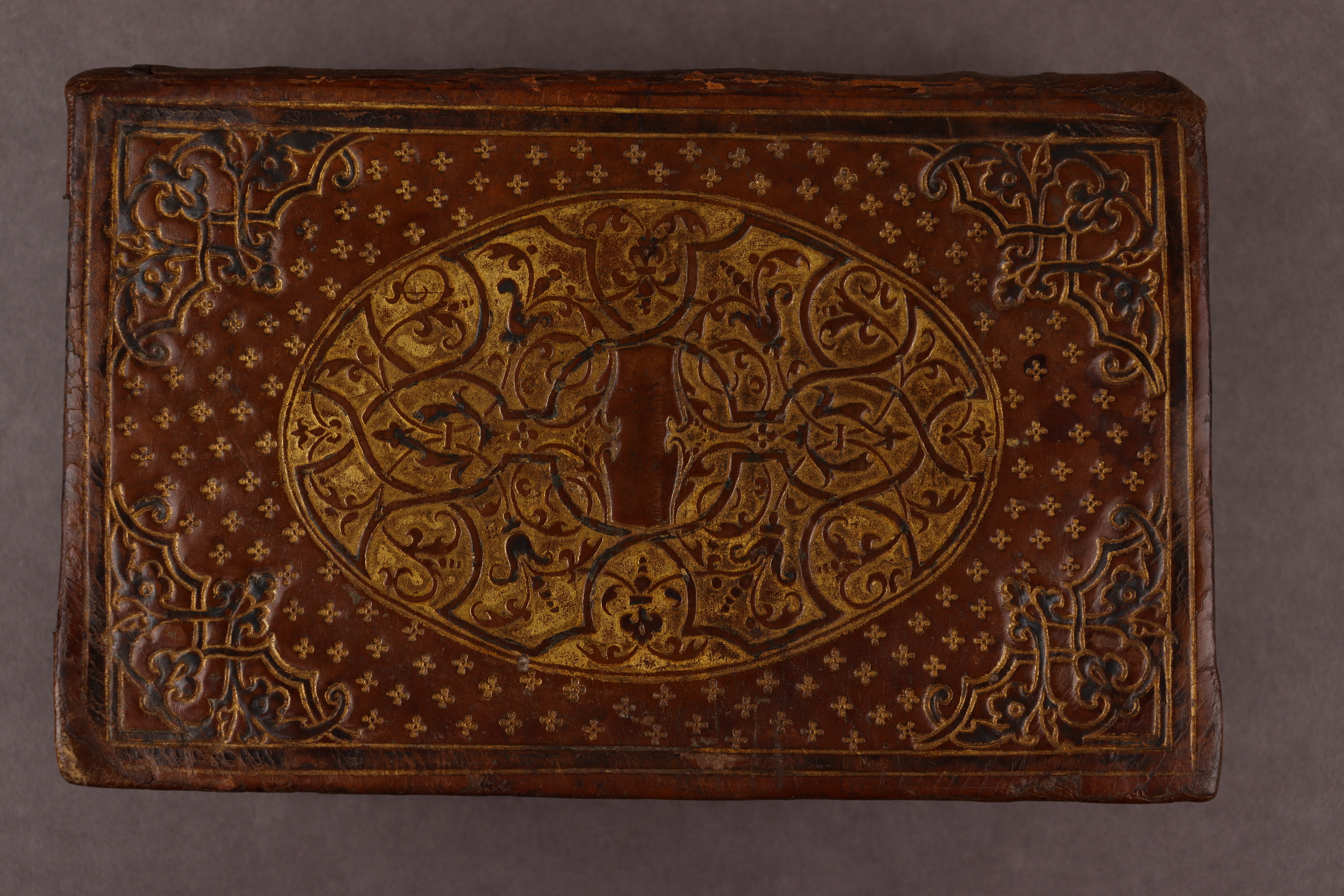
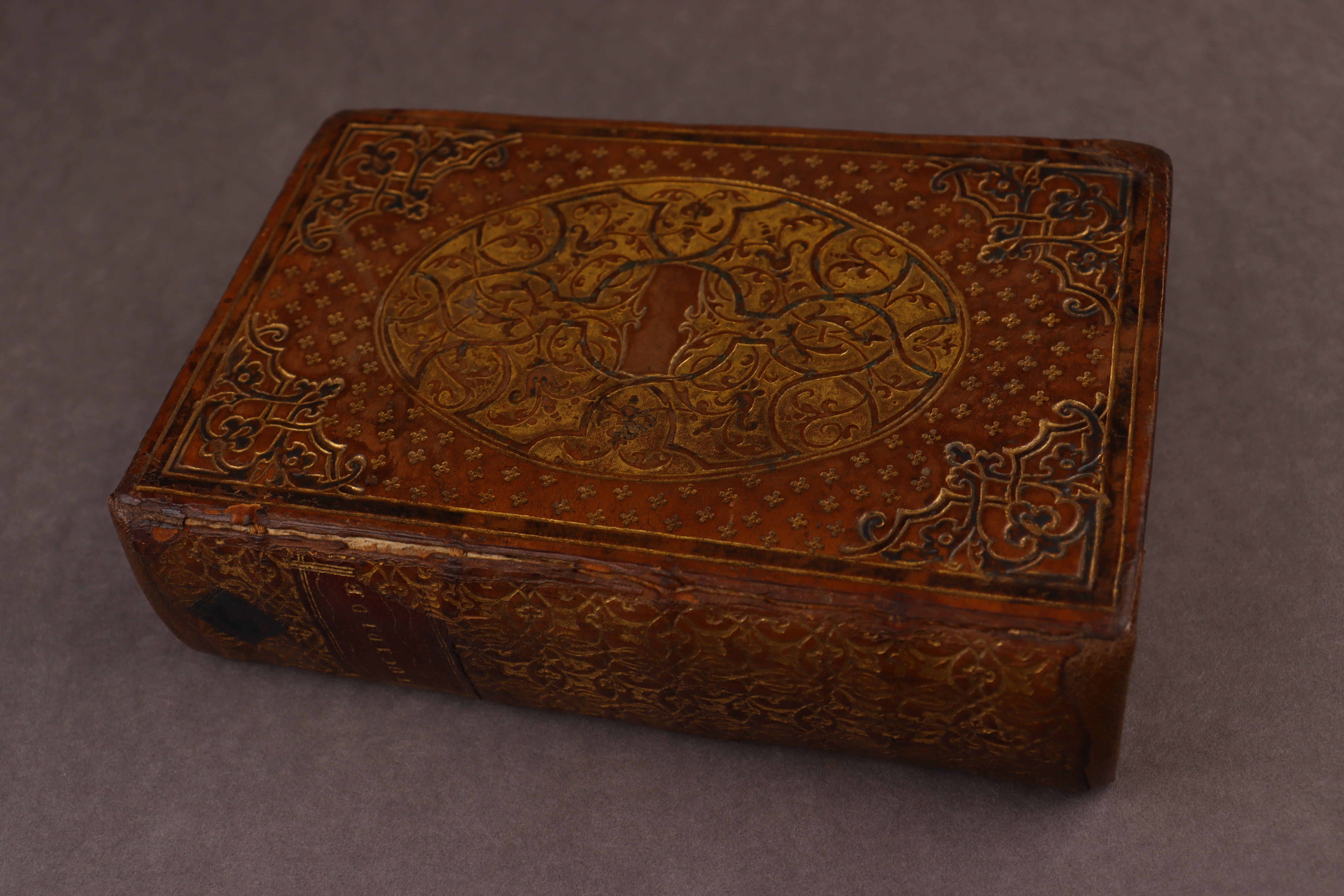
Another high-end item in our collection, this French translation of Thucydides' History of the Peloponnesian Wars boasts a 16th-century calf over pasteboard binding, with a large gilt-stamped oval centrepiece on a background completely covered in gilt-stamped fleurons. Of particular interest are the double rows of gilt fillets toward the outer edges of the upper and lower boards, and the gilt-stamped corner pieces, which are filled in with ink, now slightly faded, to create what would have been a visually striking appearance, complemented by the gilt textblock edges. This volume was well-used, and the spine has been repaired.
L'histoire de Thucidide Athenien, : contenant les guerres qui ont esté entre les Peloponesiens & les Atheniens ... Tra[n]slaté en langue francoise, par feu messire Claude de Seyssel lors euesque de Marseille, & depuis archeuesque de Turin. Reueu & corrigé outre les precedentes impressions.. (A Paris, : Par Charles l'Angelier libraire iuré de l'Vniuersité de Paris ..., 1555)
Shelfmark: 8:SR.9.t.12
Full bibliographic record
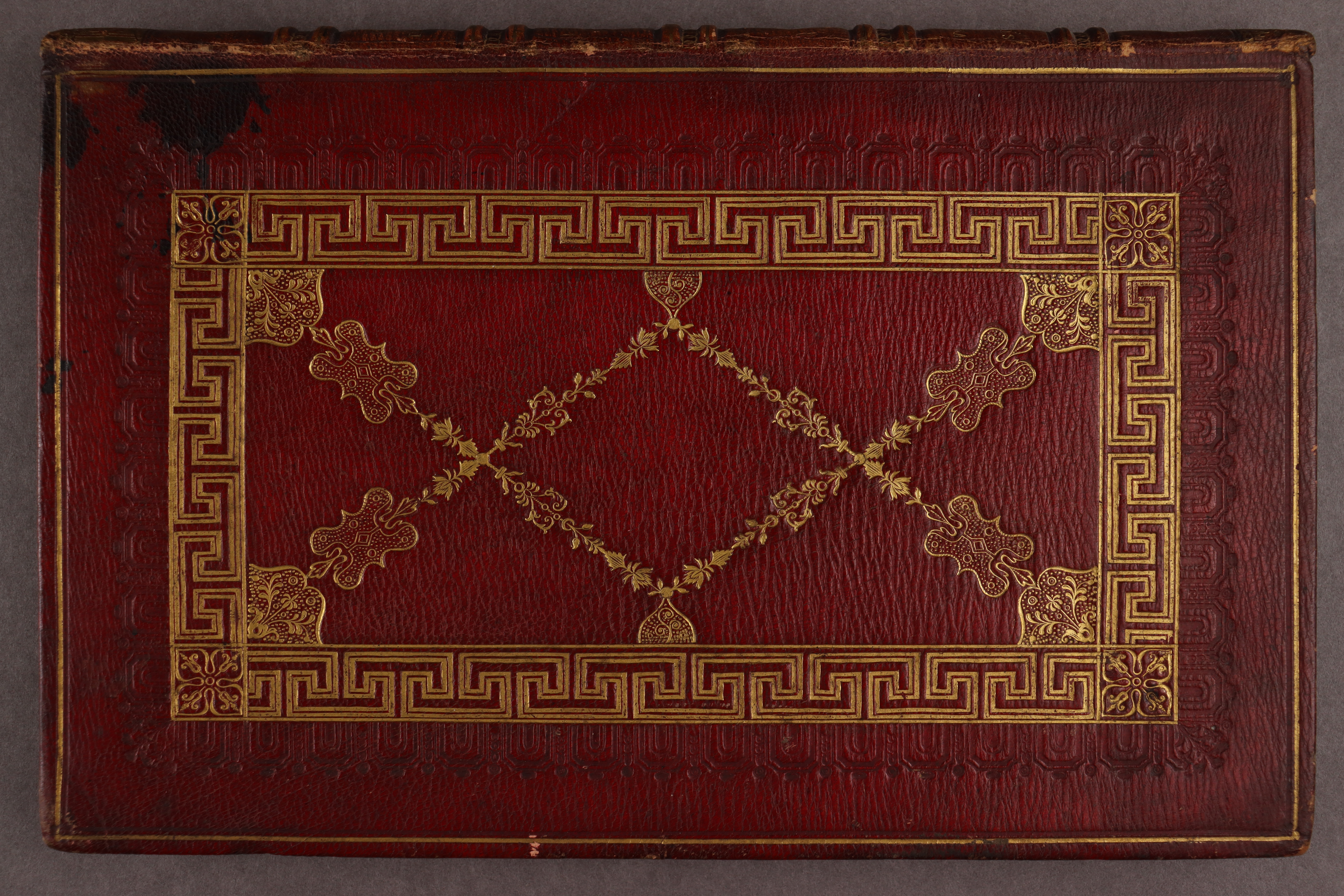
Where ink was applied intentionally for embellishment in the previous item, here its presence was caused by an accident, and the ink stain mars an otherwise very pretty binding. Made of 19th century straight-grained red morocco (goat skin treated to give it an artificial pattern of irregular parallel lines), this binding demonstrates the careful application of a variety of materials and techniques. It has been sewn onto five supports to make it stronger, and the gilt- and blind-tooled decoration in a neoclassical design (perimeter frame of single fillet, enclosing frames of geometric and Greek key rolls, or meanders, and a lattice of floral ornaments) showcases the skill of this binder. Even the edges of the boards were blind-tooled in a pattern known as hatching, and there is a gilt floral roll on the turn-ins, that is, the small amount of binding leather visible inside the book, not covered by the paste-downs. In this volume, the pastedowns themselves are not made of paper but of green silk, as are the free endleaves.
Jodrell, Richard Paul. Carmina selecta, tum graeca, tum latina. (Londini: : Typis R. Taylor et Socii., M.DCCC.X. [1810])
Shelfmark: Sparrow C.272
Full bibliographic record
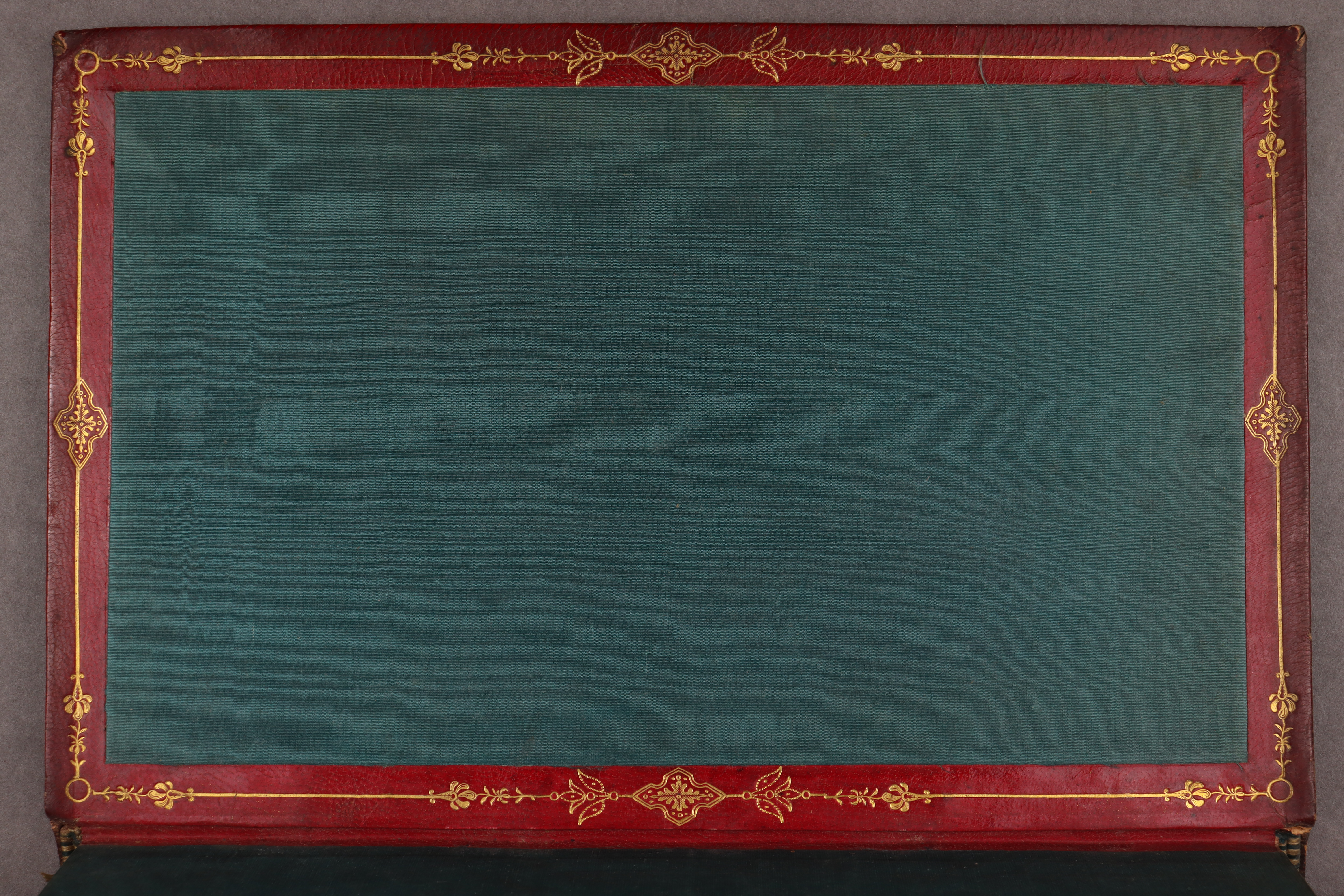
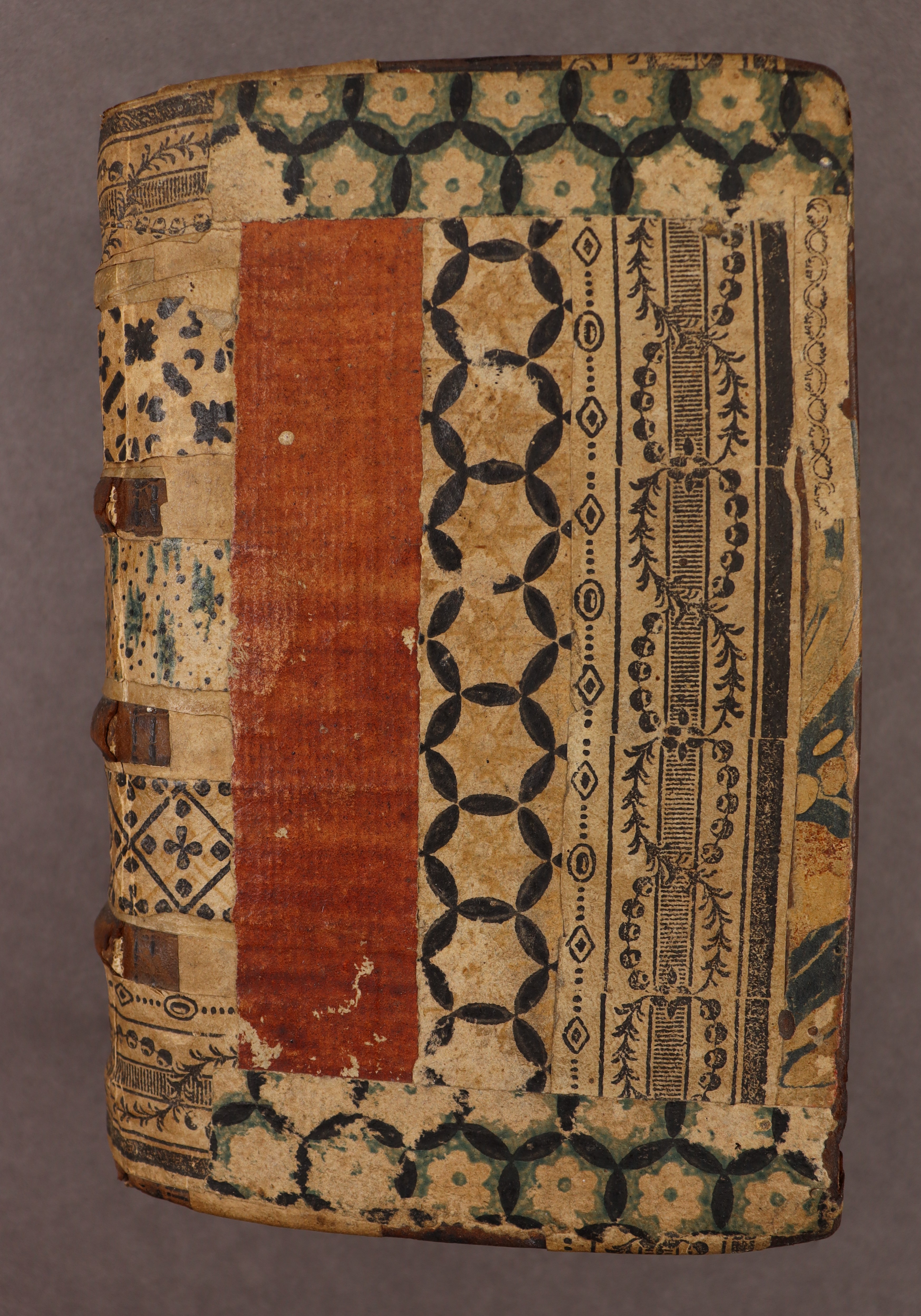
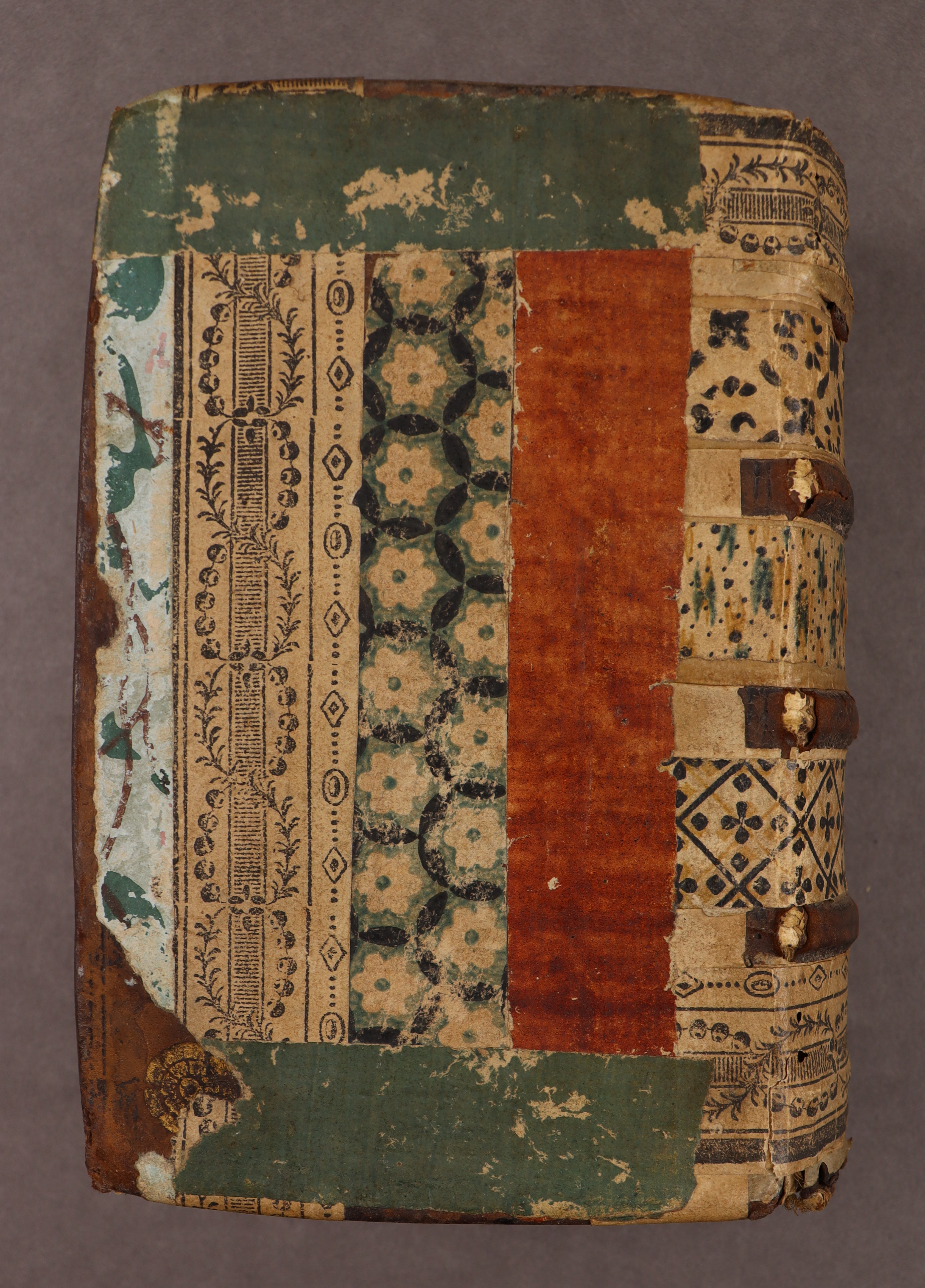
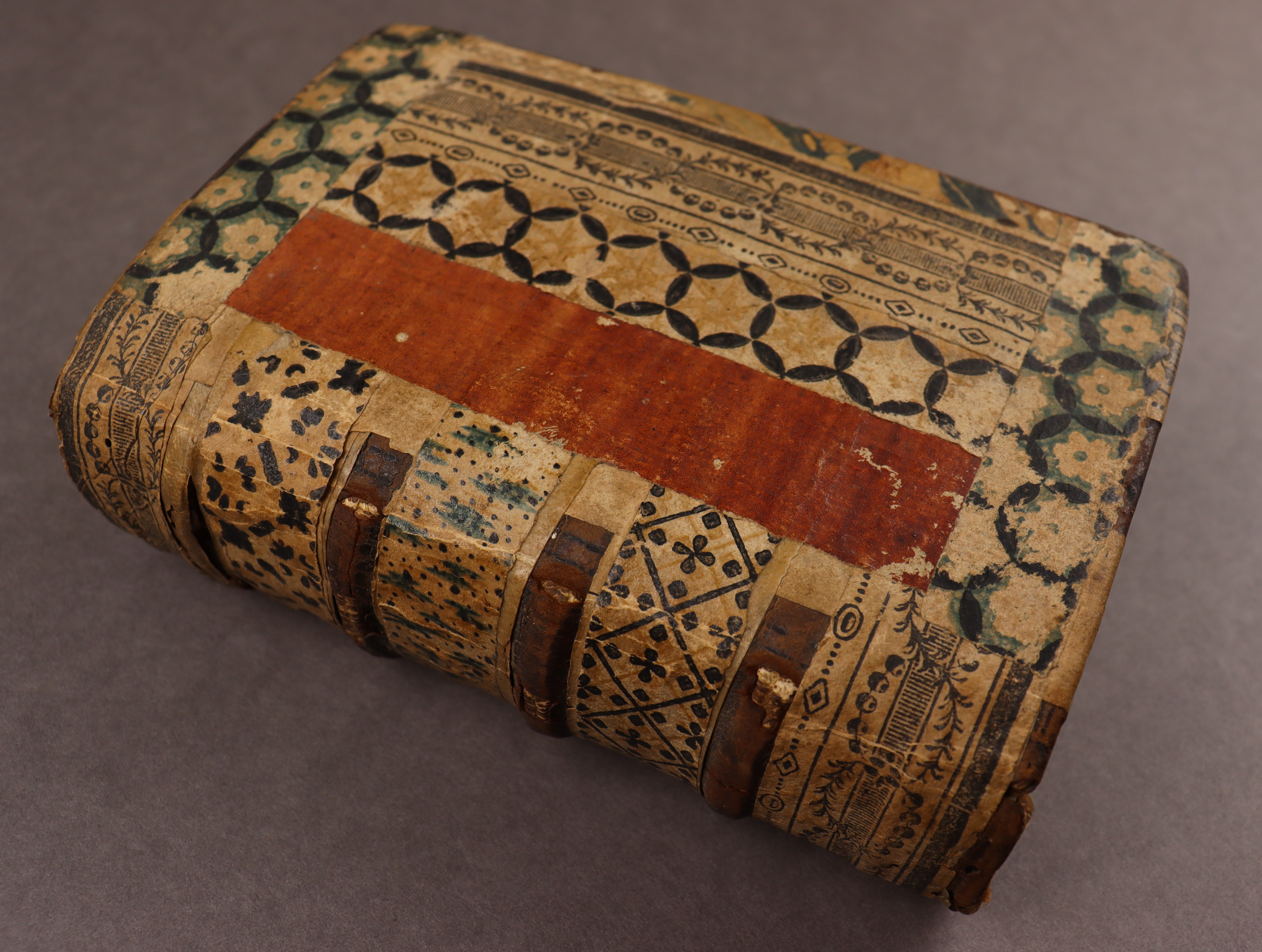
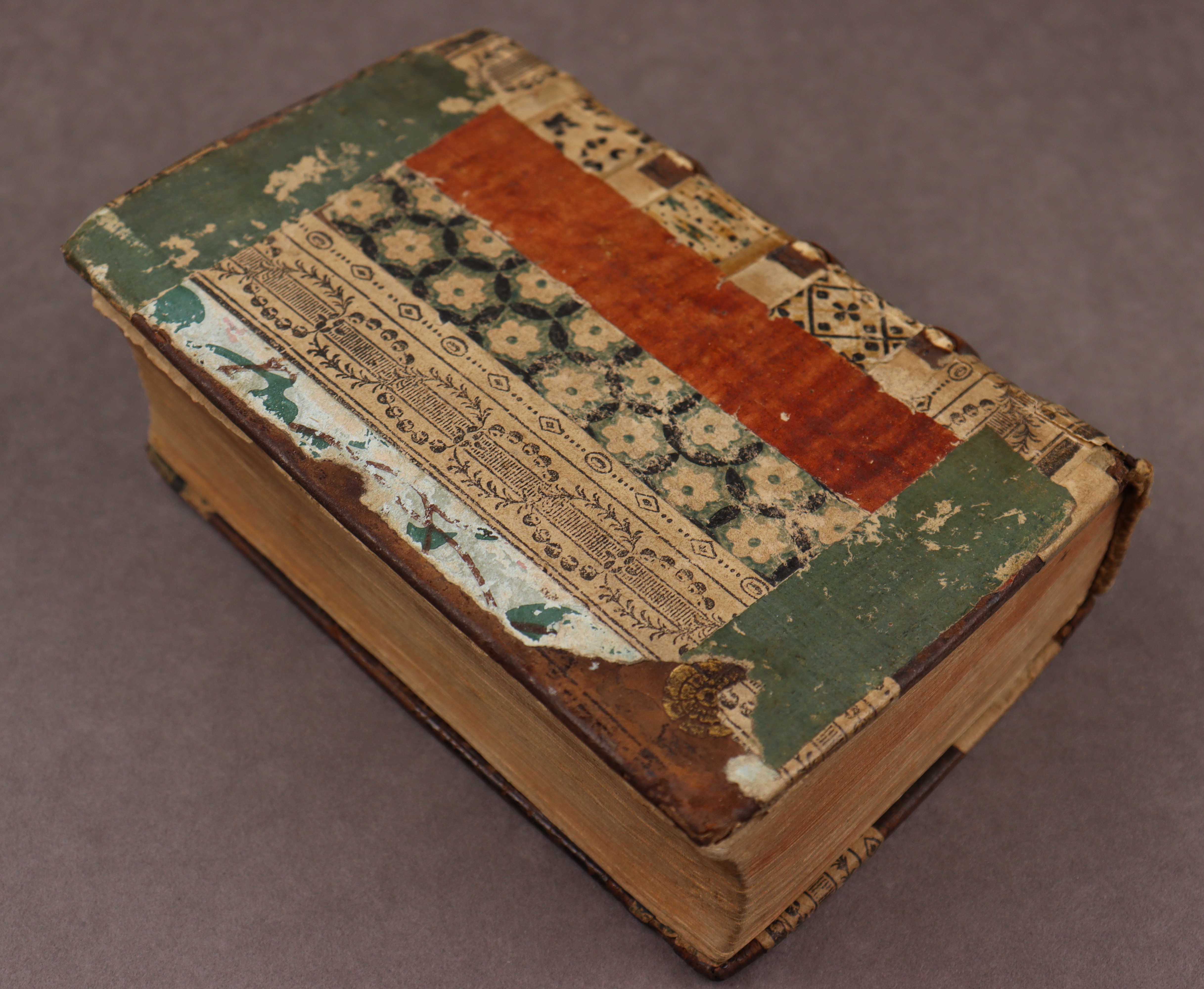
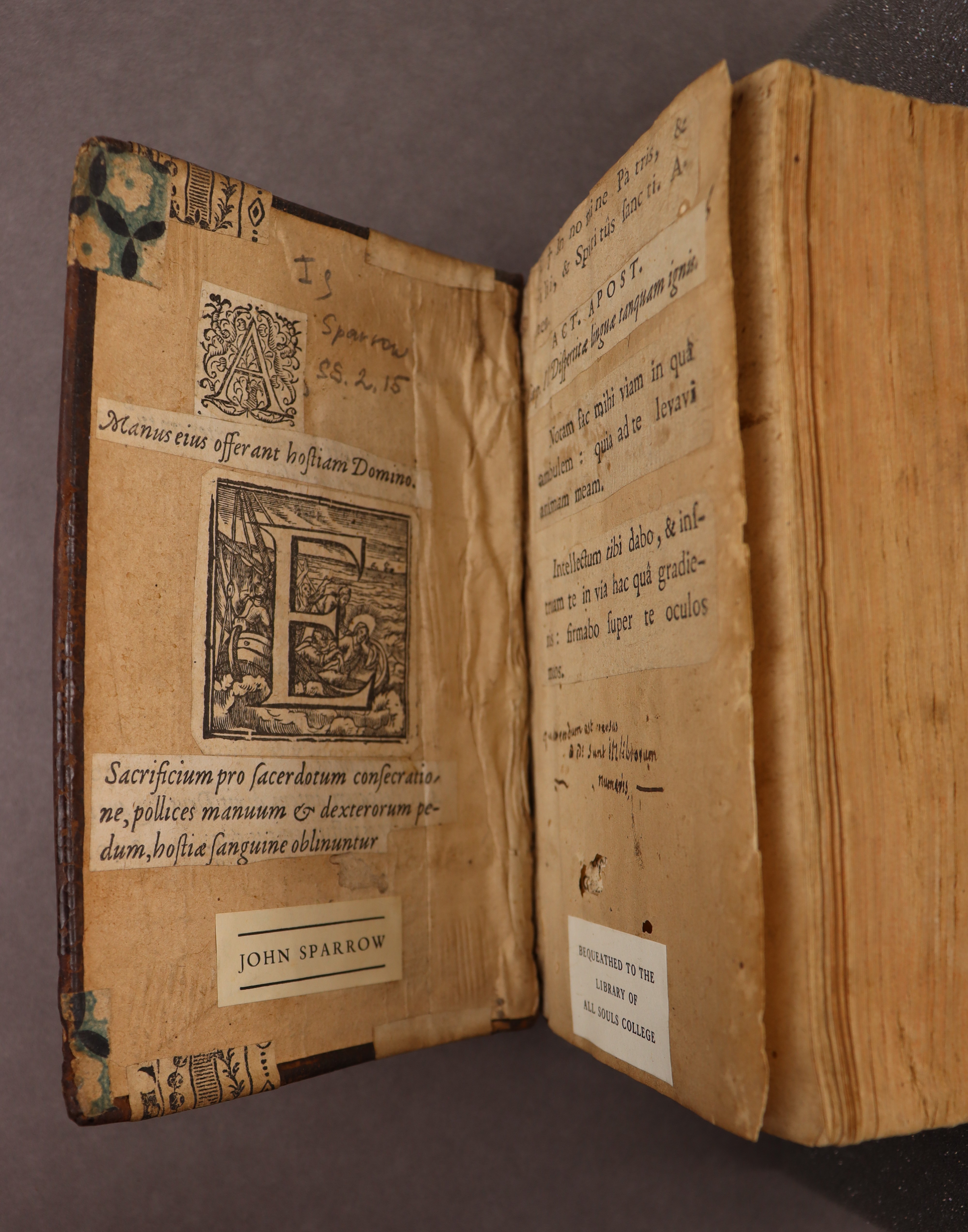
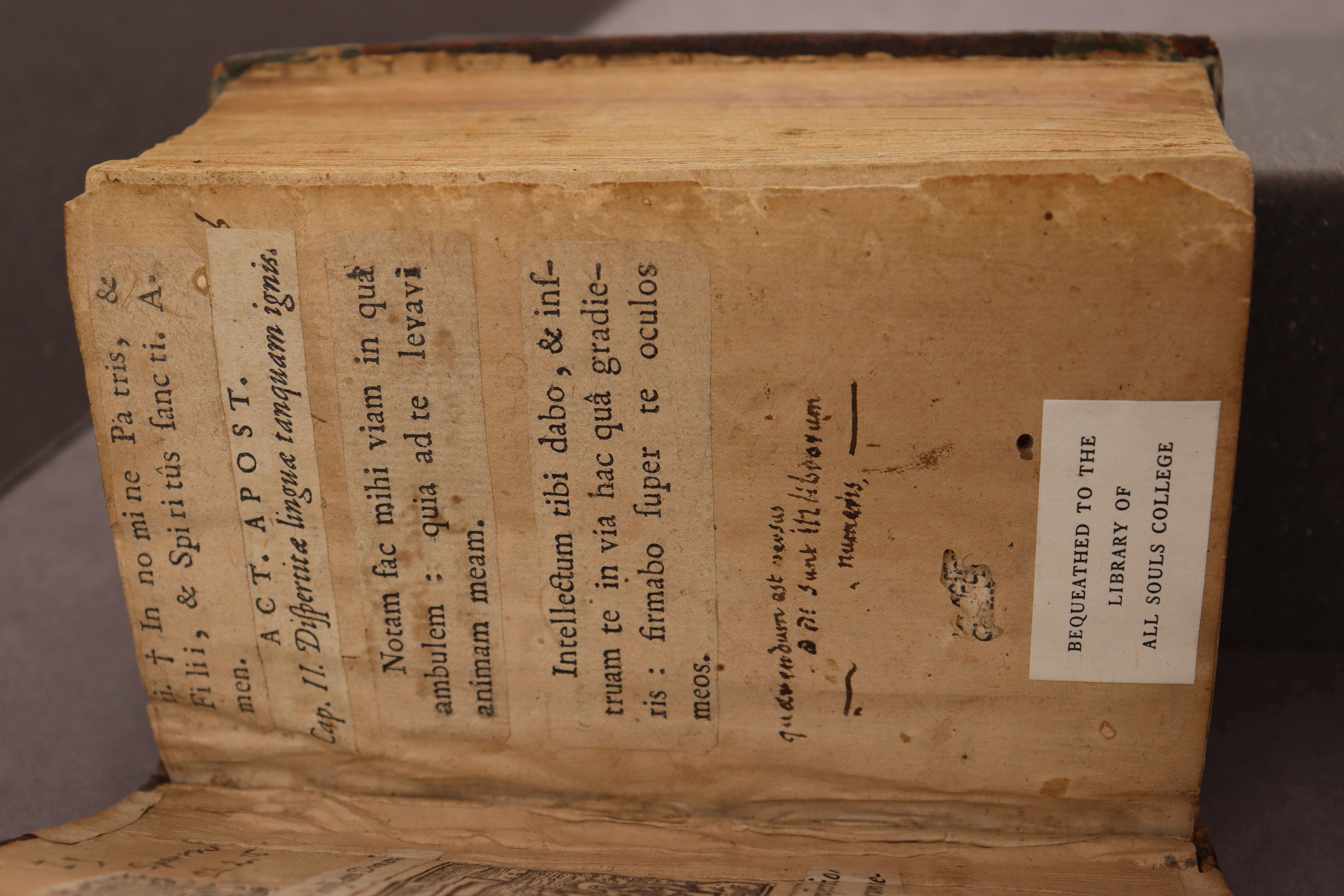
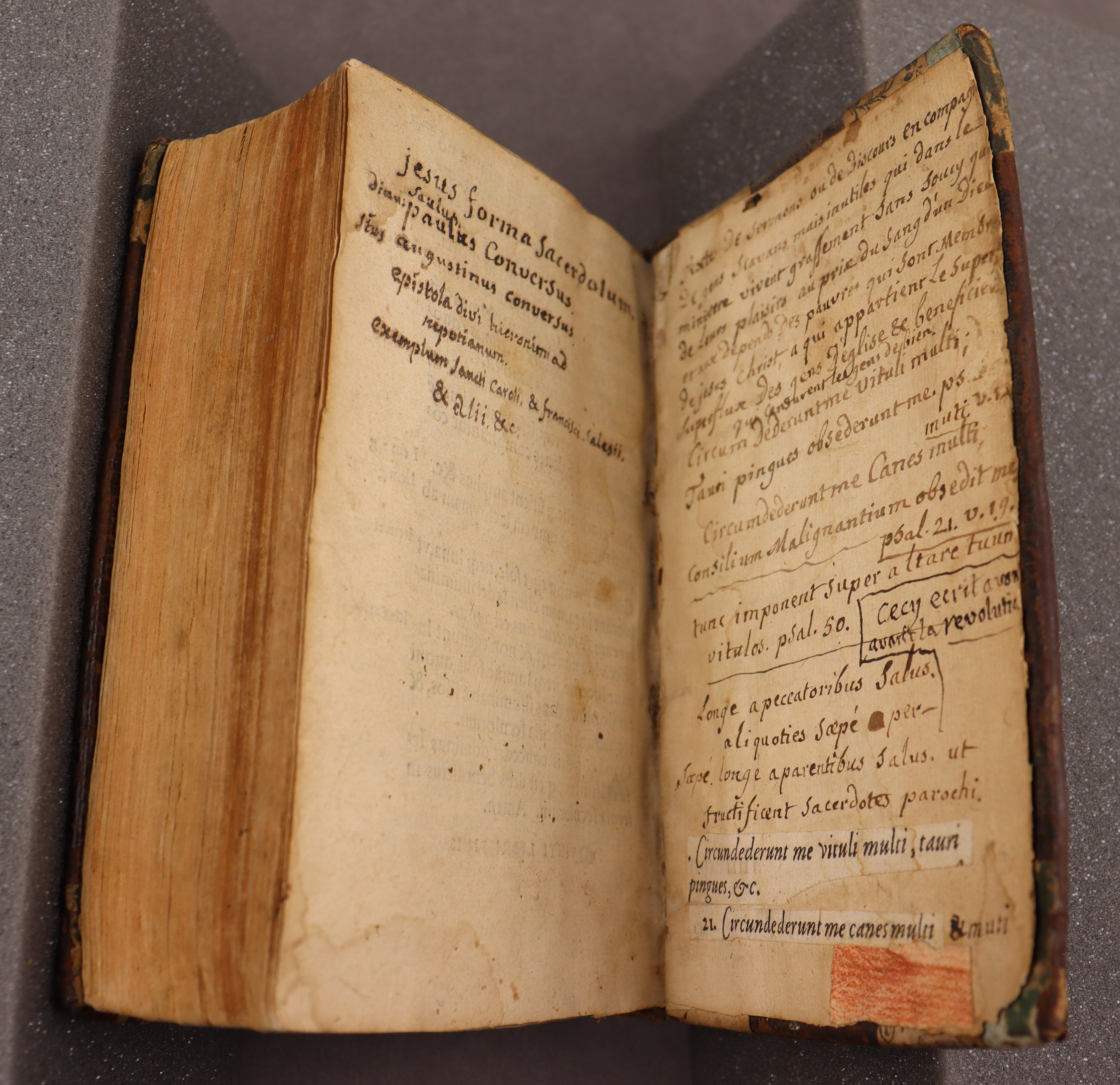
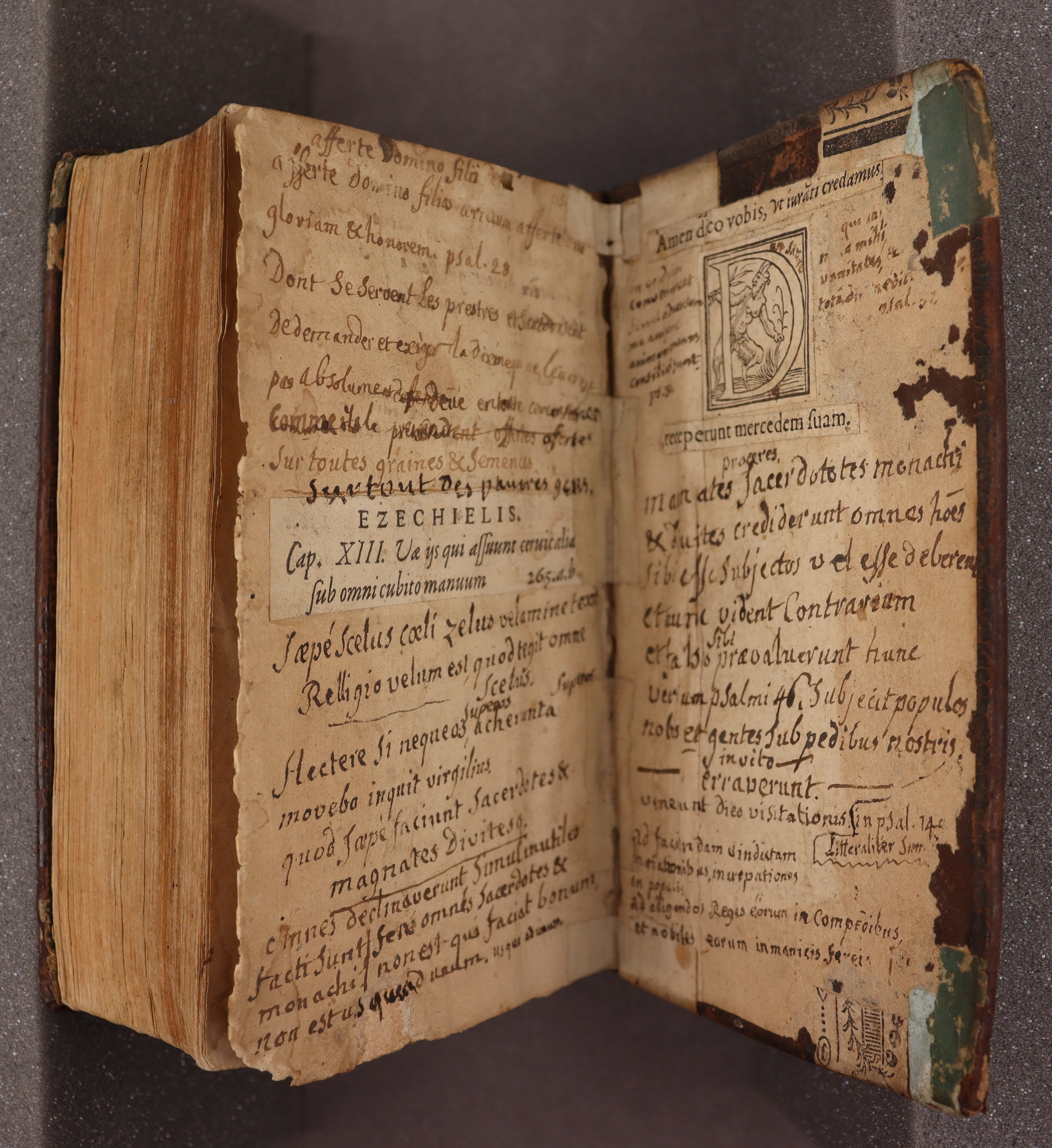
This volume is one of the quirkiest in the library. The printed work is a collection of sentences from the Bible, selected by John Peckham (circa 1230-1292), a British Franciscan friar and official lecturer at the universities of Paris and Oxford and in the Vatican, who became Archbishop of Canterbury in 1279. To his text, one or more previous owners have added their own selections in Latin and French, scribbling sentences and biblical verses, and pasting cuttings of similar material on any available space, making it into a veritable religious scrapbook. Still not happy, they also decorated the already gilt-tooled binding with strips of colourful paper. They obviously put a lot of time and effort into creating this item, which is worthy of being studied in detail, but the mixed materials and the presence of an adhesive (likely to be either animal glue or flour or starch paste, both appealing to pests) creates potential problems for preservation and conservation.
Peckham, John. Collectaneum Bibliorum quin[que] libris sententias diuinæ scripturæ ad certos titulos, seu locos communes redigens, autore Iohanne Pechano Cantuariensis ecclesiæ Archipræsule: : Nunc à mendis quibus scatebat repurgatum.. (Coloniae, : ex officina Melchioris Nouesiani, anno a Christo nato,, M. D. XLI. [1541])
Shelfmark [temporary]: Sparrow ss.2.15
Full bibliographic record
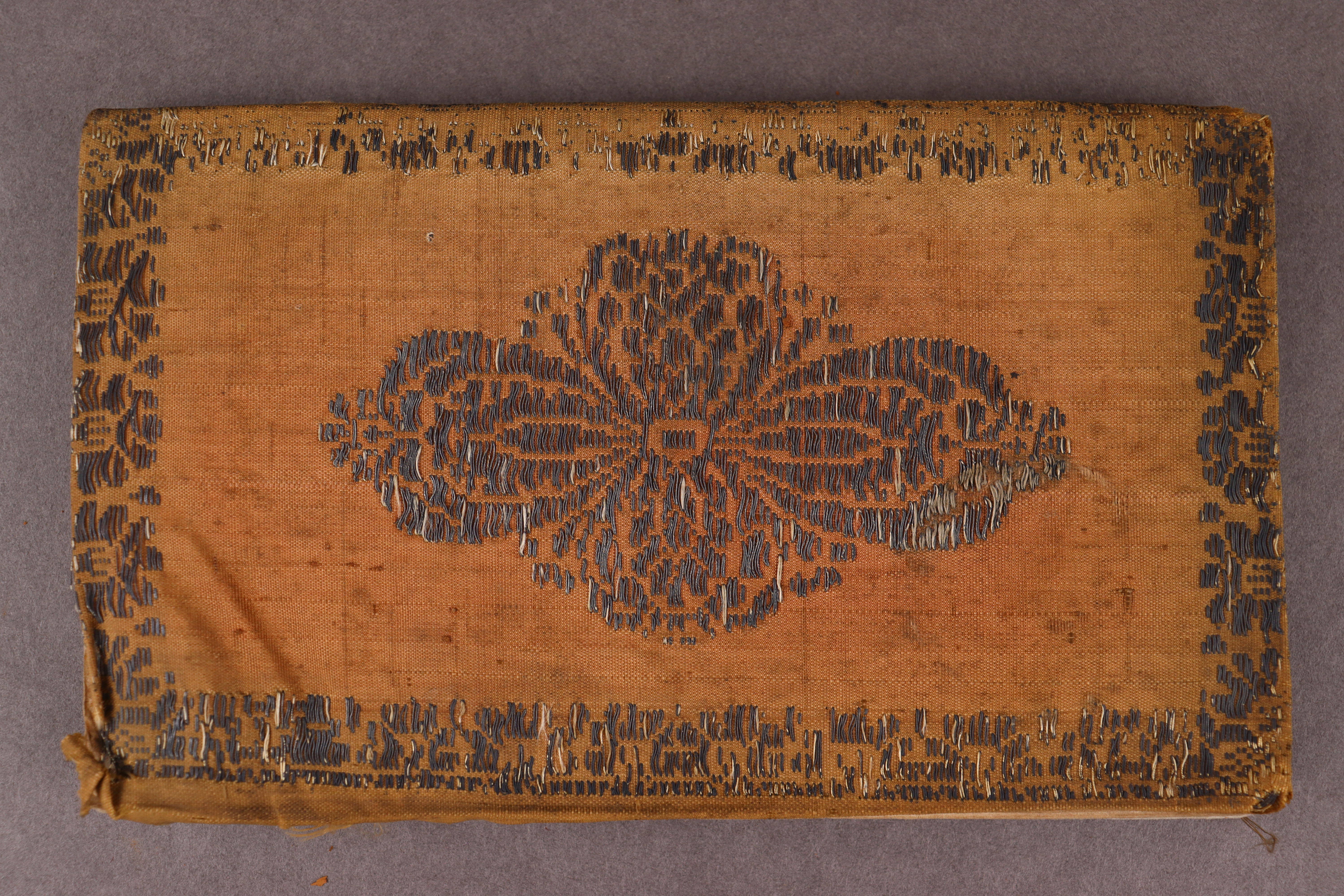
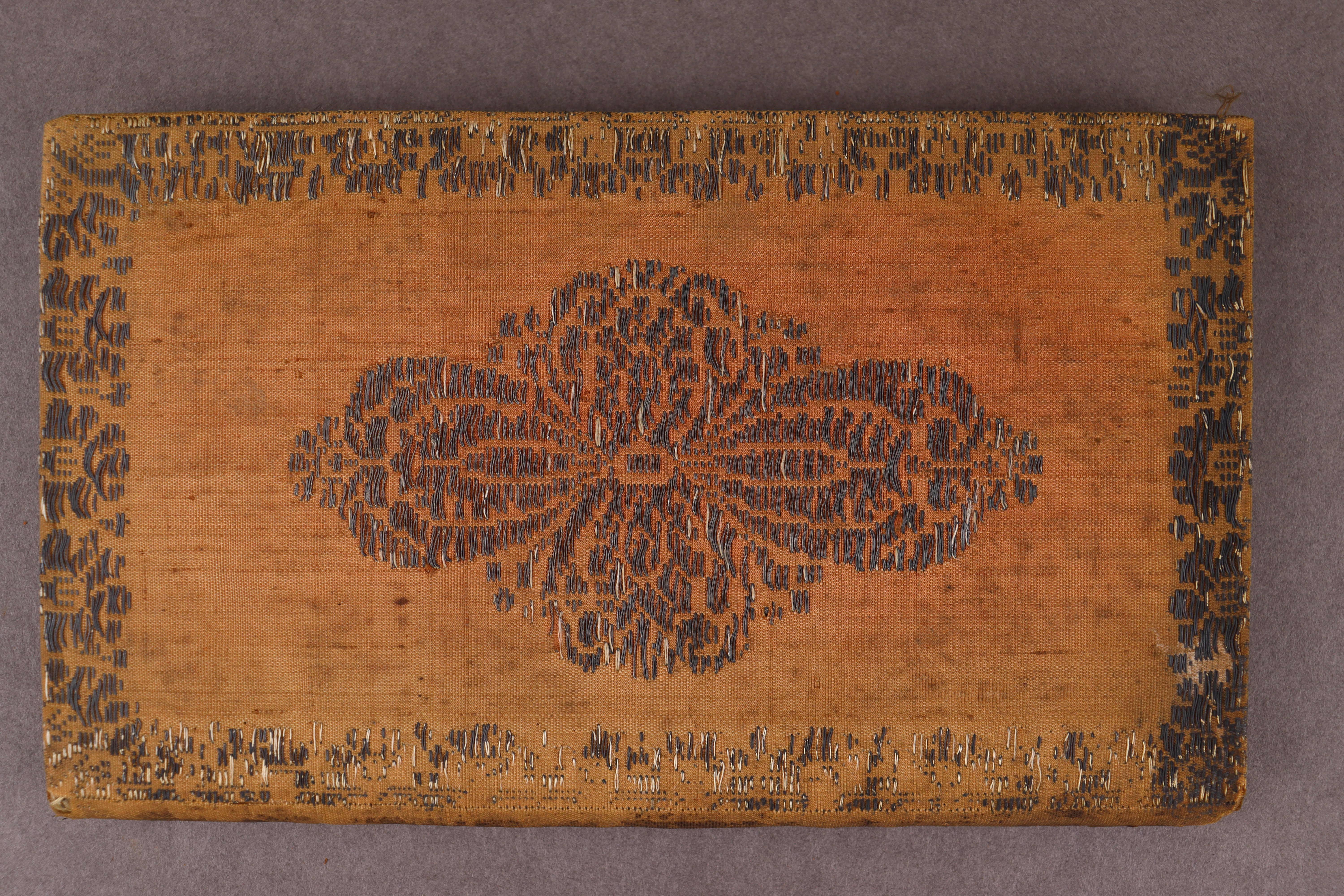
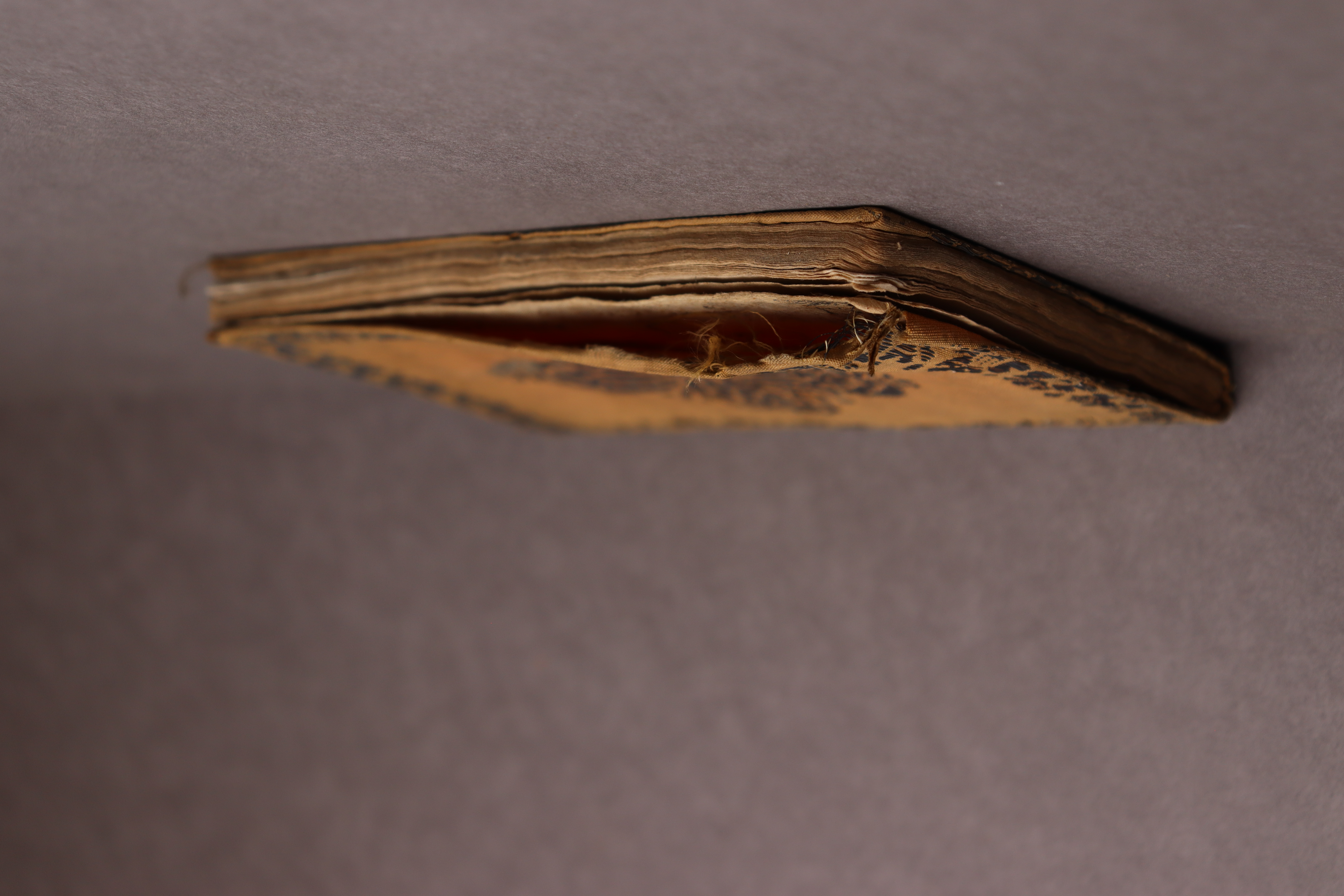
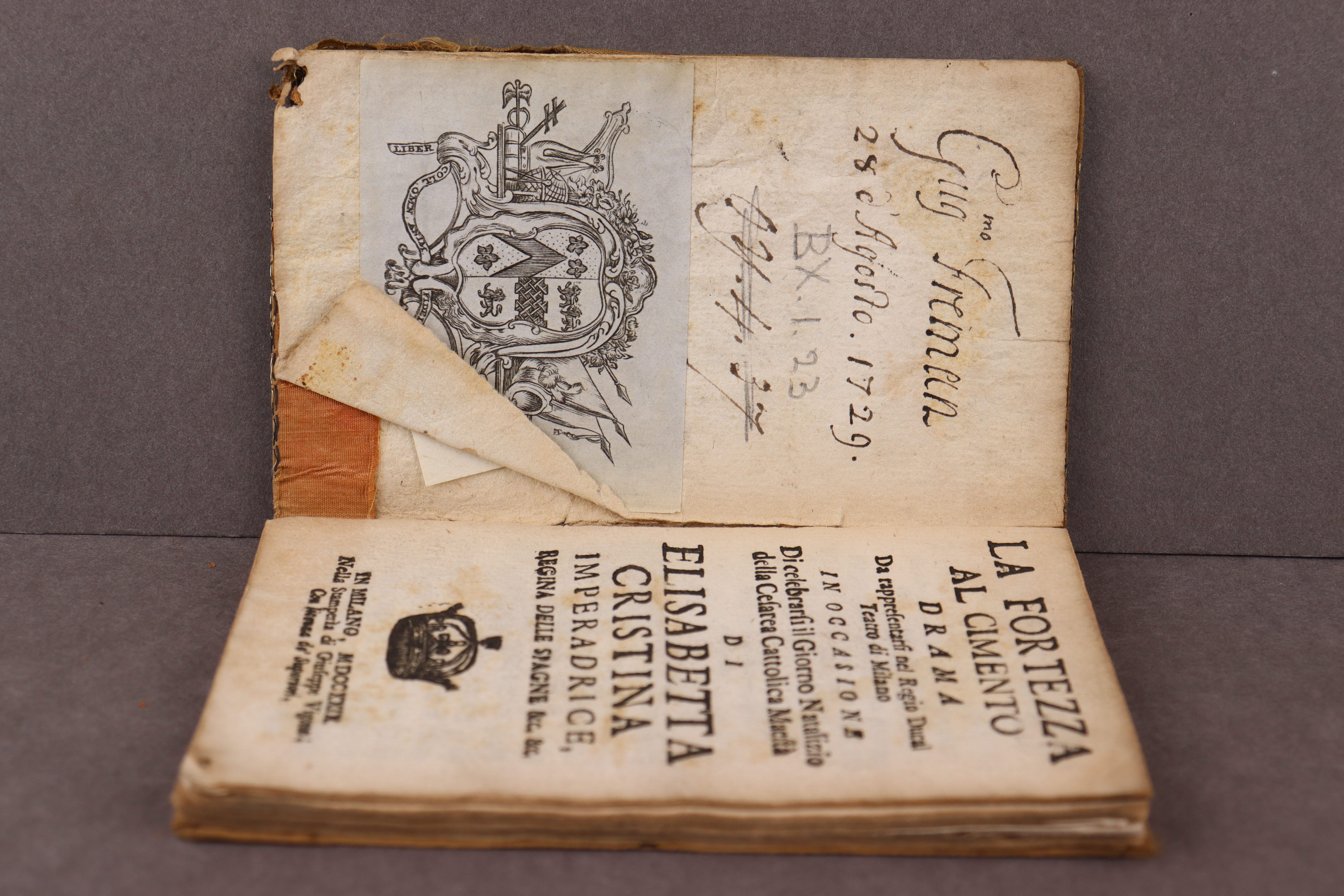
This text, whose title La fortezza al cimento roughly translates as "Fortitude put to the test", is one of the several works inspired by the figure of the Roman Emperor Nero, revisited in a Christian perspective. Our copy is bound in thick paper covered in silk and delicately embroidered with silver thread. The silk was originally a lovely apricot/tan shade, but it has now faded due to prolonged exposure to light. Light exposure, and the subsequent damage it can cause to fragile items such as this book, are one of the many challenges librarians face when caring for their collections. As a preservation method, bespoke archival grade boxes are made to better house such items, an example of which is displayed next to this book. Another risk to this binding comes from humans, and the naturally occurring oils on our hands. Even the smallest amount of oil can cause irreversible damage to both the silk and the silver thread, and consequently handling these types of bindings is one of the rare times librarians will wear nitrile or latex gloves (standard practice is actually using clean, dry hands, not cotton gloves – don't believe everything you see on TV!)
This text is a libretto for an opera or musical drama, to be performed on the occasion of the 38th birthday of Elisabeth Christine of Brunswick-Wolfenbüttel, Queen of Spain and Holy Roman Empress, on the 28th of August 1729. The text was written by Francesco Silvani in 1699, and first performed in Venice in the same year on music by Giuseppe Antonio Vincenzo Aldrovandini. The work went through several iterations, and was set to music by several composers, including Antonio Vivaldi (in Prague, for the carnival in 1726, under the title "La Tirannia Gastigata"). This performance used the version by Tommaso Albinoni, with dances choreographed by Giuseppe Castellani. An inscription on the verso of the first leaf reads: "Gug-mo Freman, 28 d'Agosto. 1729.", suggesting that William Freman, brother of Ralph Freman, a Fellow of All Souls and a donor to the All Souls College Library, might have been present at the performance, although we currently have no further evidence to support this claim.
Silvani, Francesco. La fortezza al cimento : drama da rappresentarsi nel Regio Ducal teatro di Milano in occasione di celebrarsi il giorno natalizio della Cesarea Cattolica Maestà di Elisabetta Cristina imperadrice, regina delle Spagne &c. &c.. (In Milano, : nella stamperìa di Giuseppe Vigone., MDCCXXIX (1729)
Shelfmark: BX.1.23
Full bibliographic record
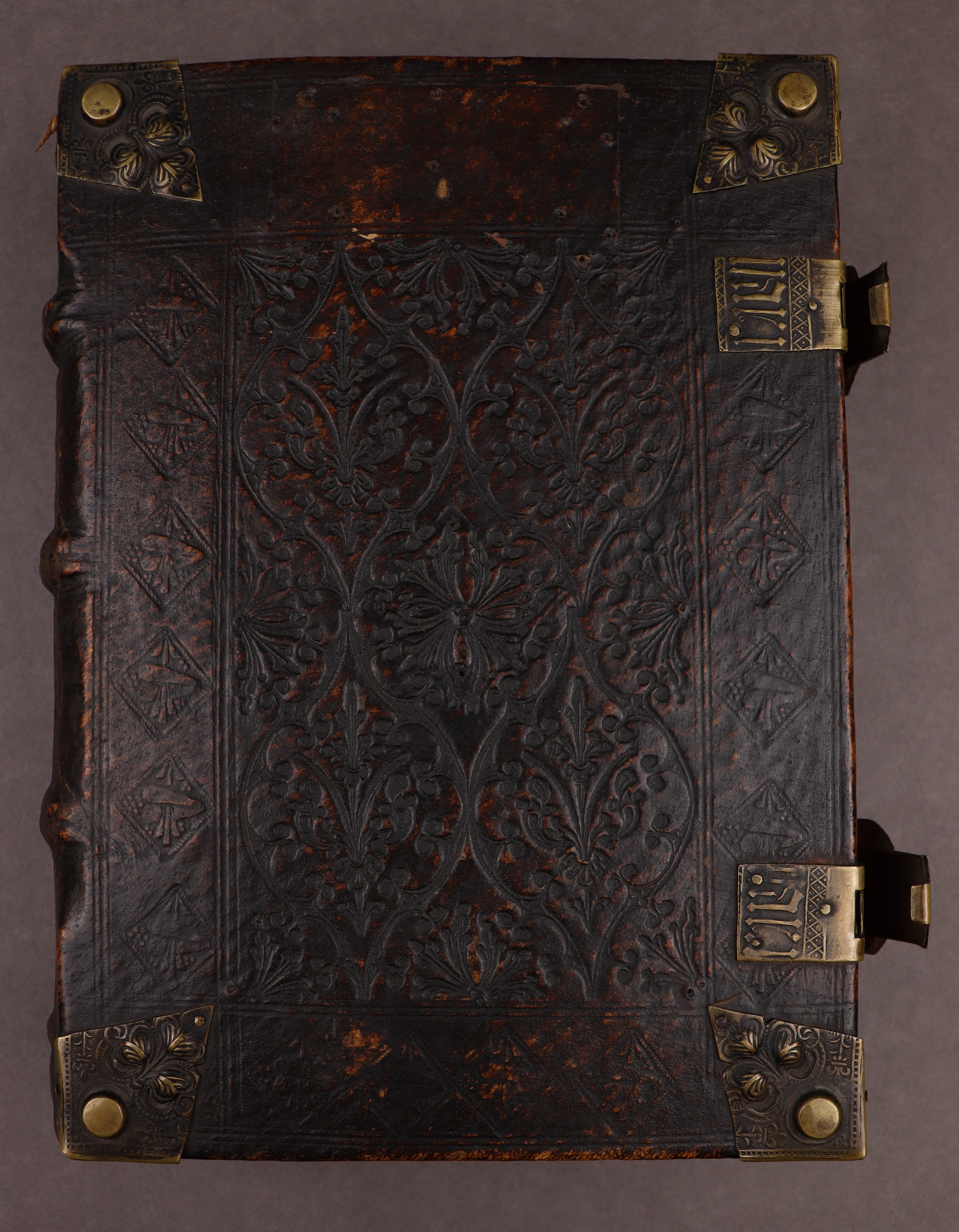
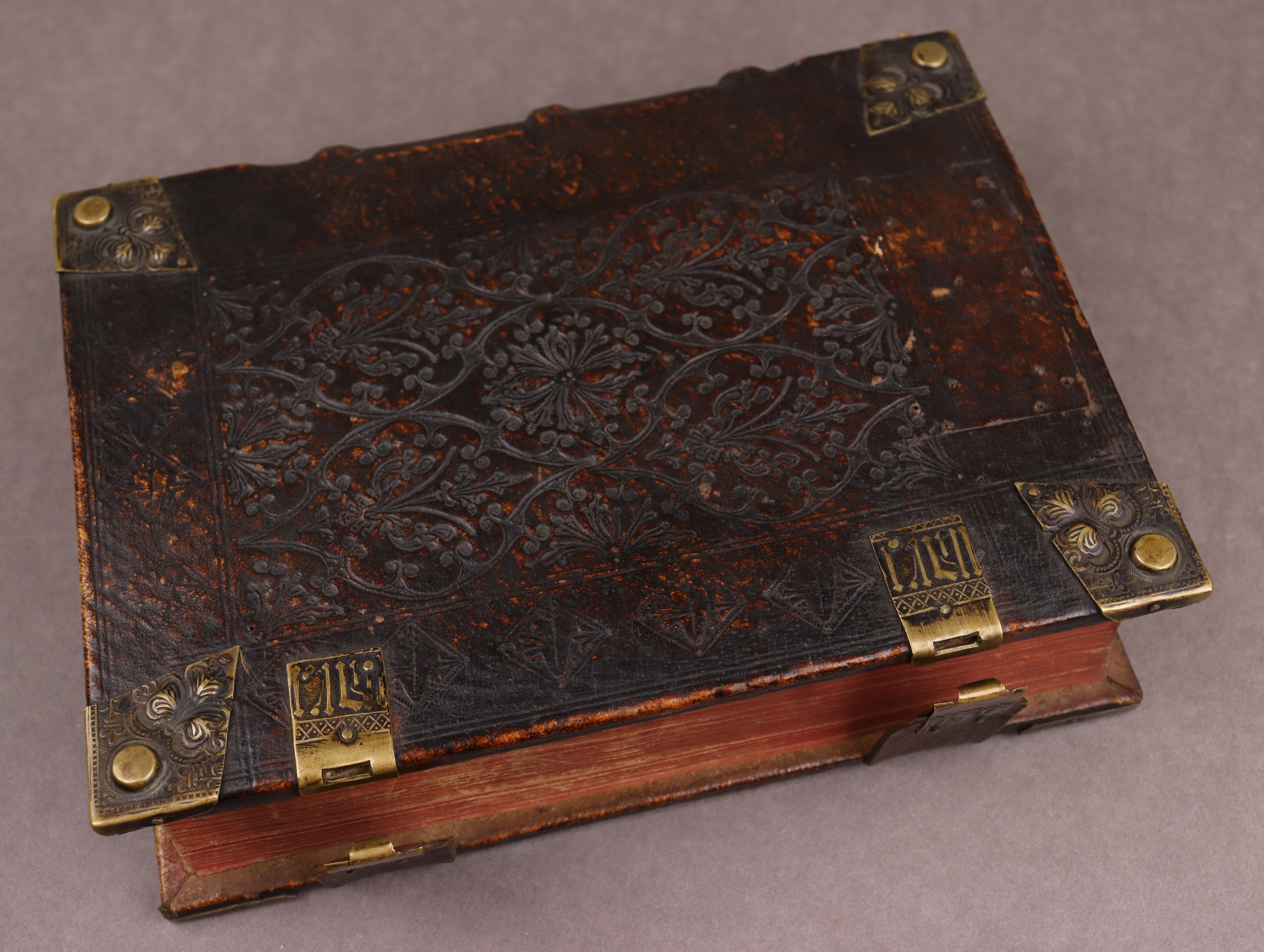
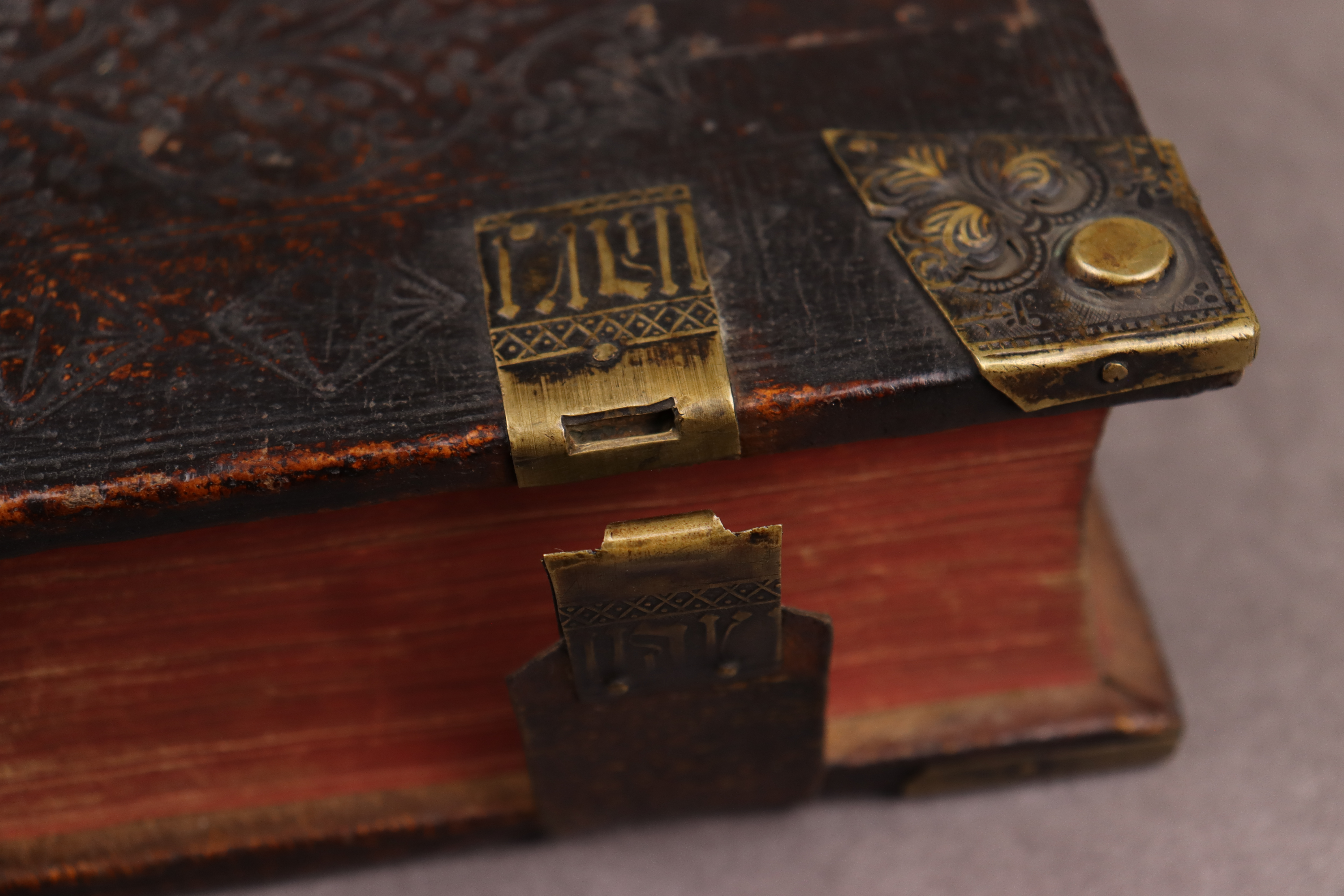
The oldest book on display today, this important work by the Italian mathematical astronomer Giovanni Bianchini boasts a very elaborate binding. Made of 15th- or early 16th-century German leather (possibly stained pigskin) over wooden boards, both the upper and lower covers have intricate blind-tooled decoration, and the textblock edges are a striking red (although the colour has somewhat faded now). The most interesting aspect of this binding, however, is the use of metal adornments for added decoration. Both covers have raised bosses in each corner, in addition to metal and leather clasps at the foredges of the boards. These metal clasps and protective corner pieces can damage the nearby books on the shelf if the volume is not boxed in a protective case, and can themselves be damaged by oxidisation. Like with the silver-embroidered binding above, handling this book is another example of one of the rare occasions that librarians would don their gloves.
This text presents astronomical tables by the first European scientist to use decimal positional fractions and possibly also the decimal point.
Leaf A2 of this text has an alum tawed skin tab attached to it, which would have been used as a bookmark by readers in the past.
Bianchini, Giovanni. Tabularum Ioannis Blanchini canones. ([Venice] : Impressu[m] itaq[ue] Solertia [et] cura no[n] mediocri Symo[n]is Biuilaque papie[n]sis an[n]o 1495 die io Junii. Venetiis.)
Shelfmark: LR.4.b.16
Full bibliographic record
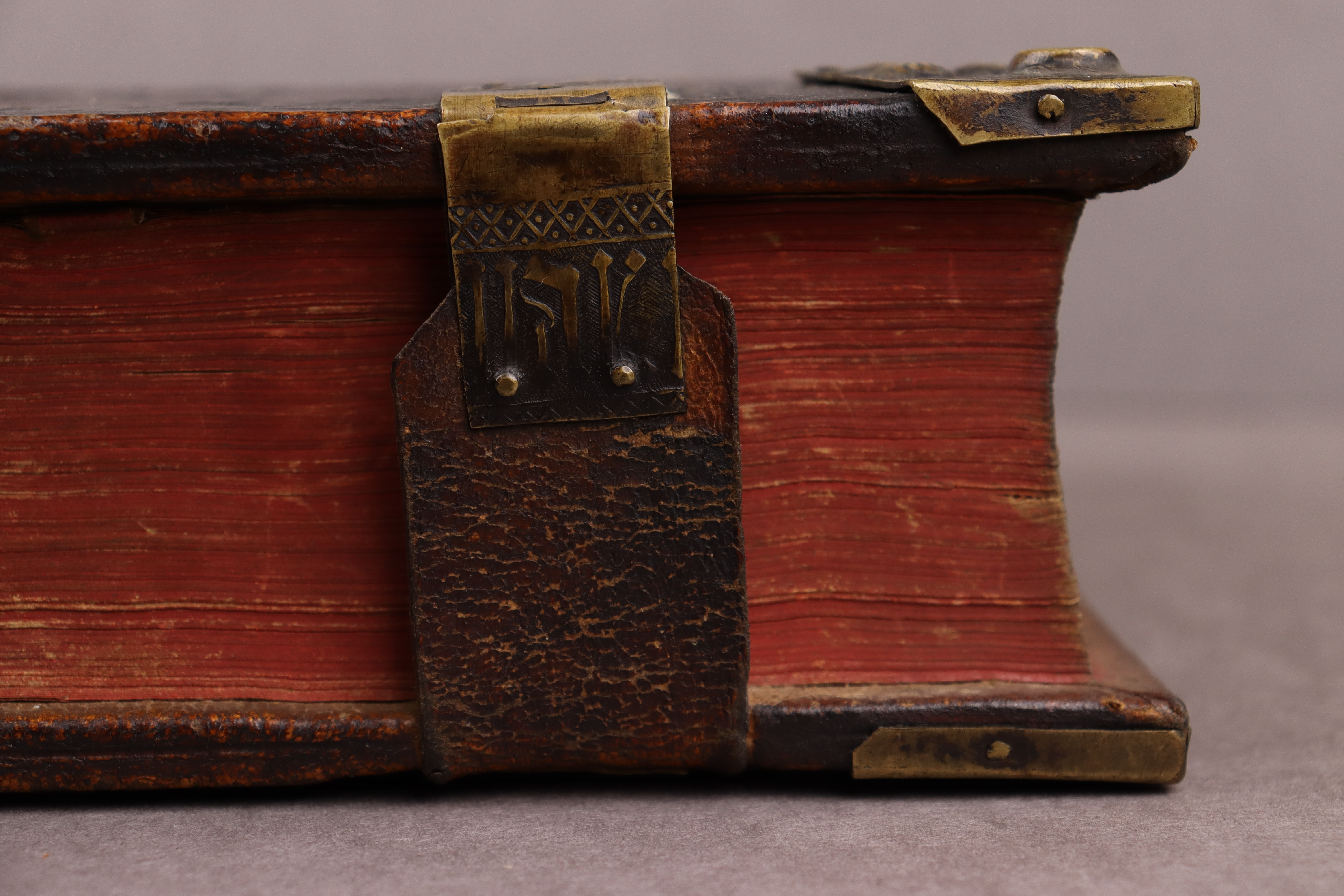
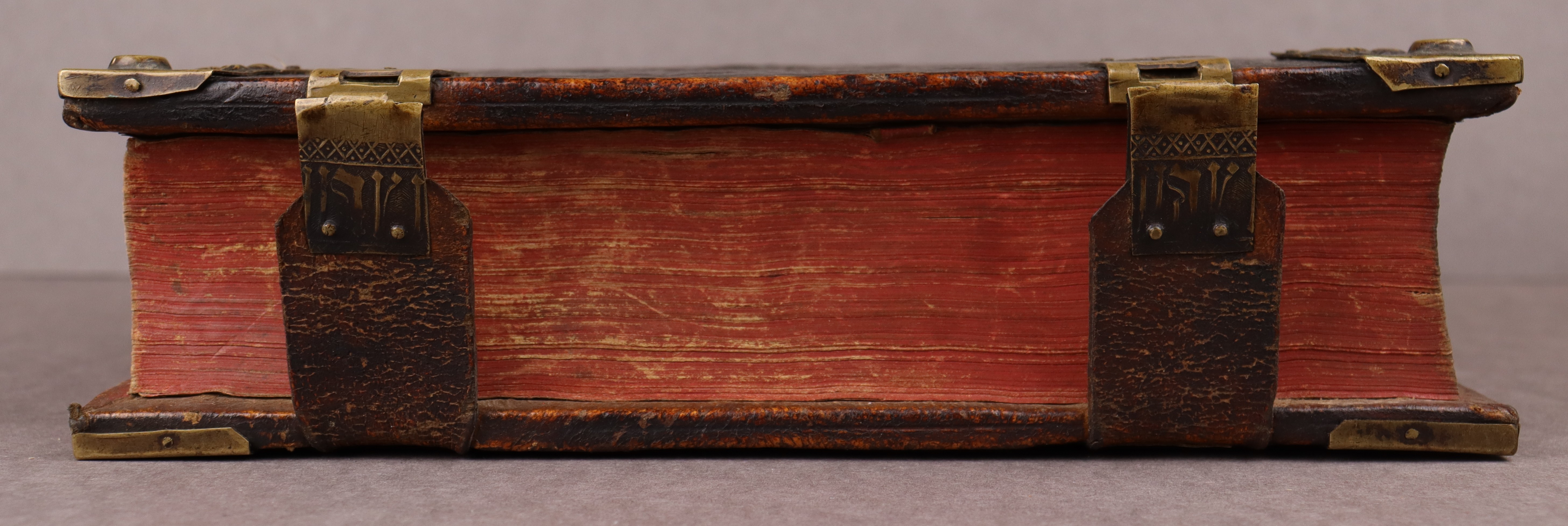
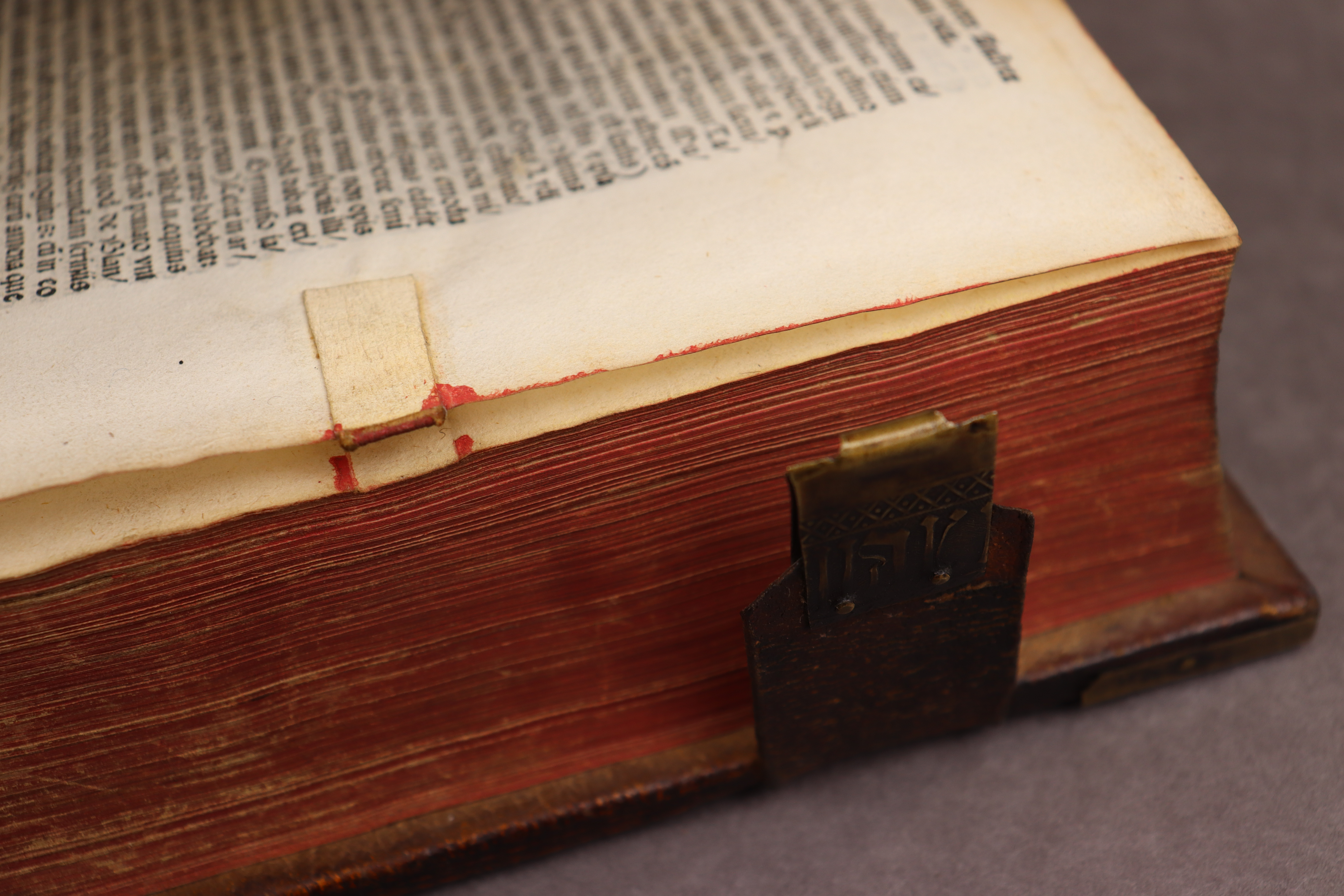
Taking care of rare books does not mean locking them away: books are for use, and libraries are for readers. Inevitably books get damaged, whether because of structural weaknesses or intensive usage. Balancing the need for conservation with budgetary constraints and the necessity of preserving historical evidence is one of our daily tasks.
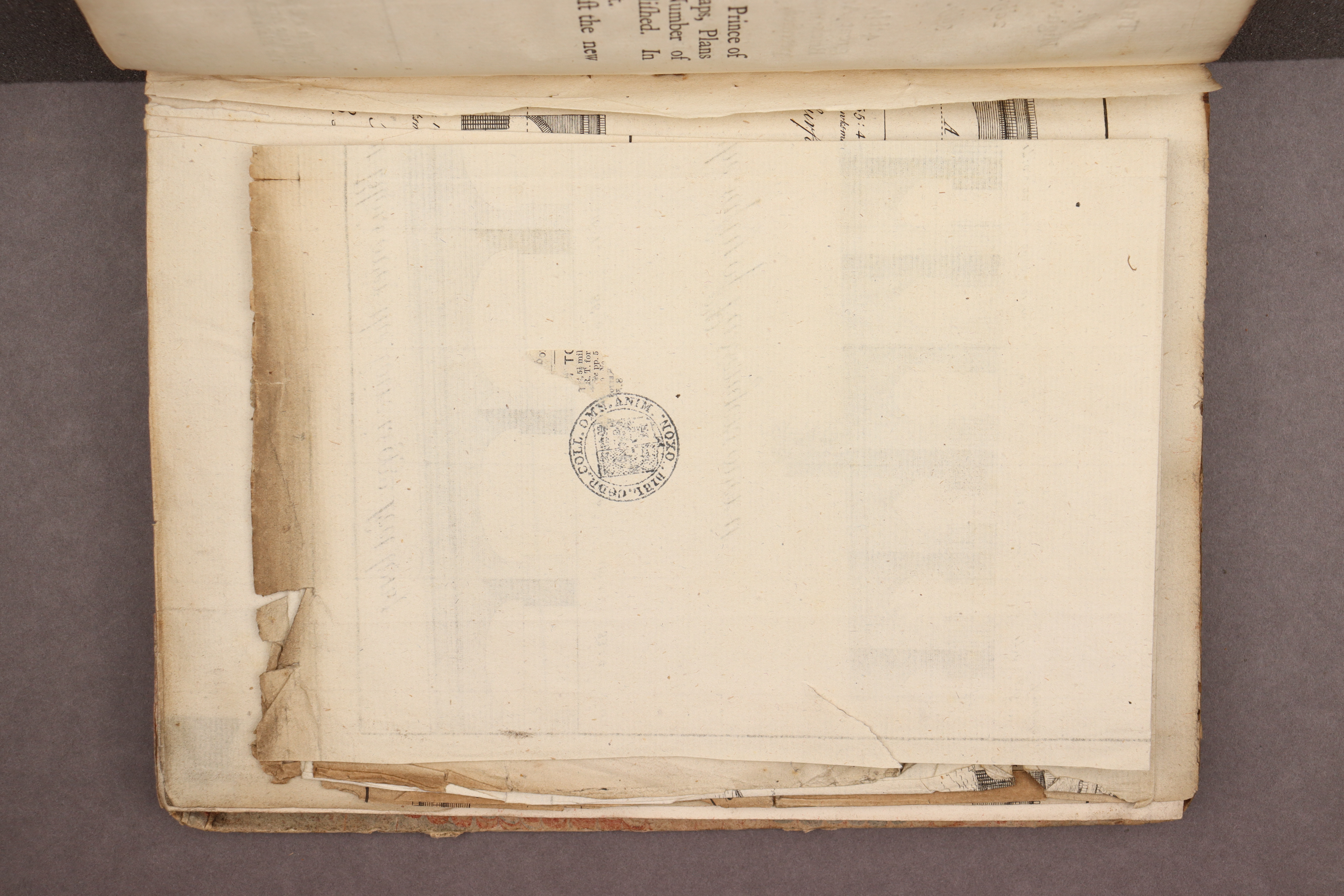
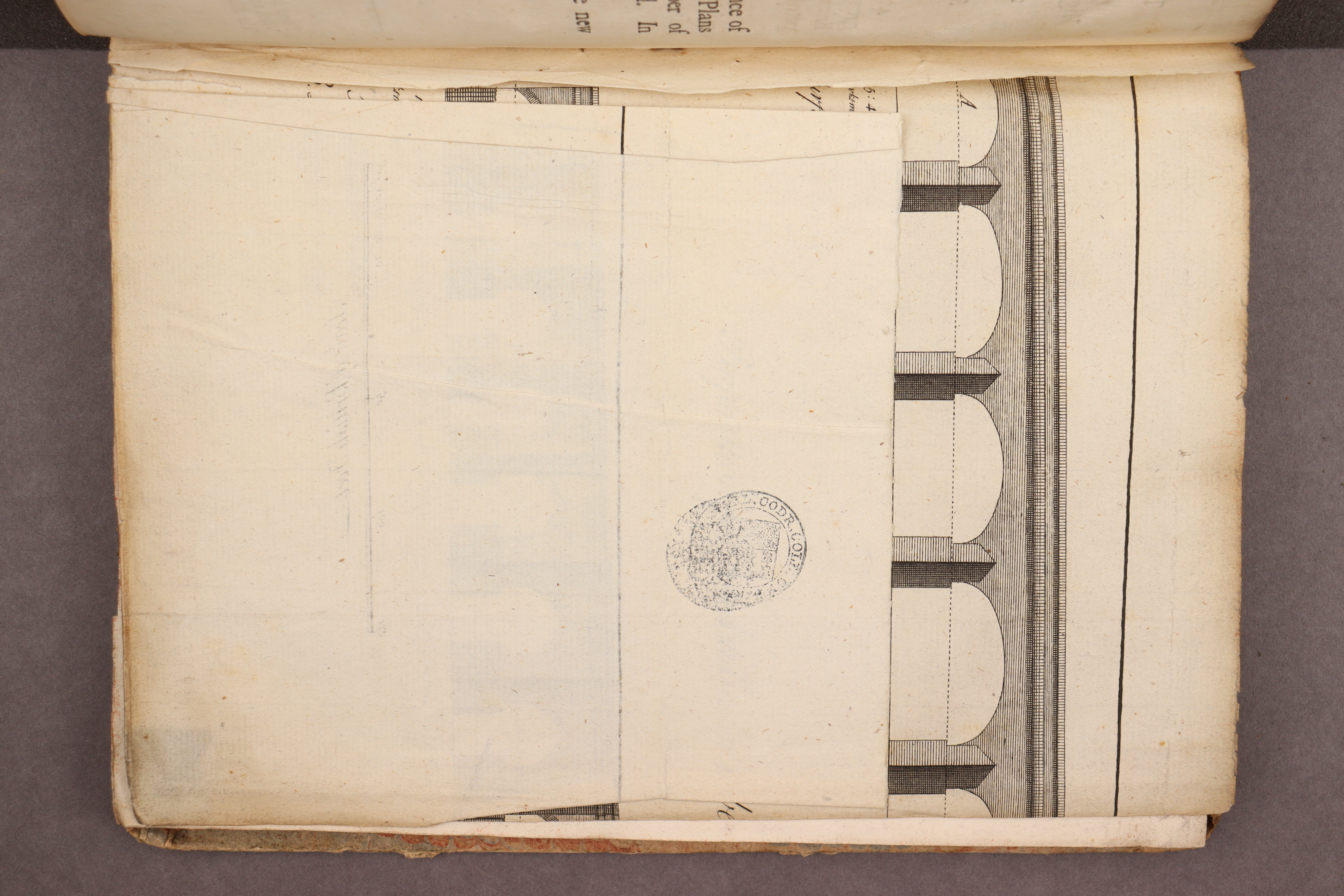
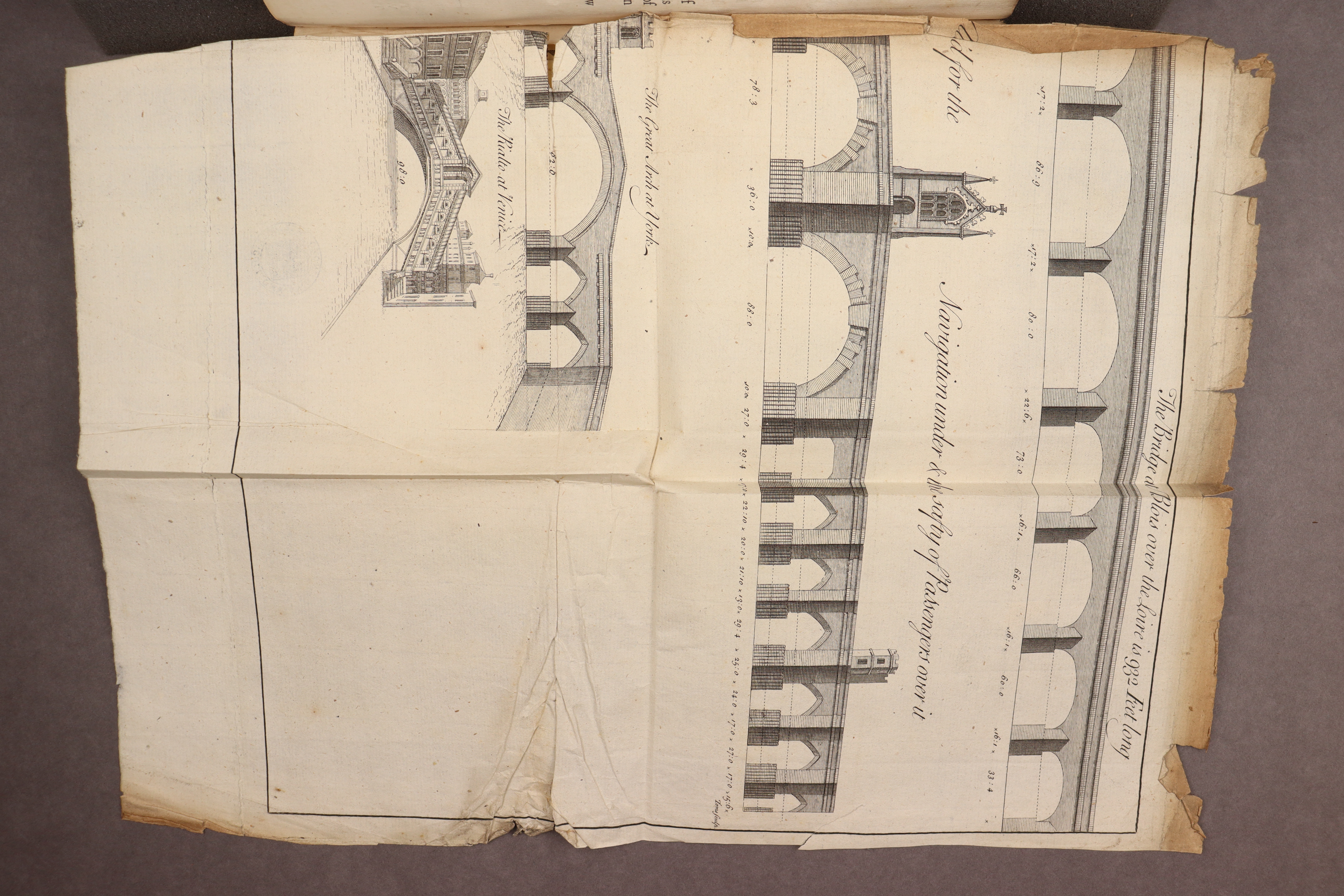
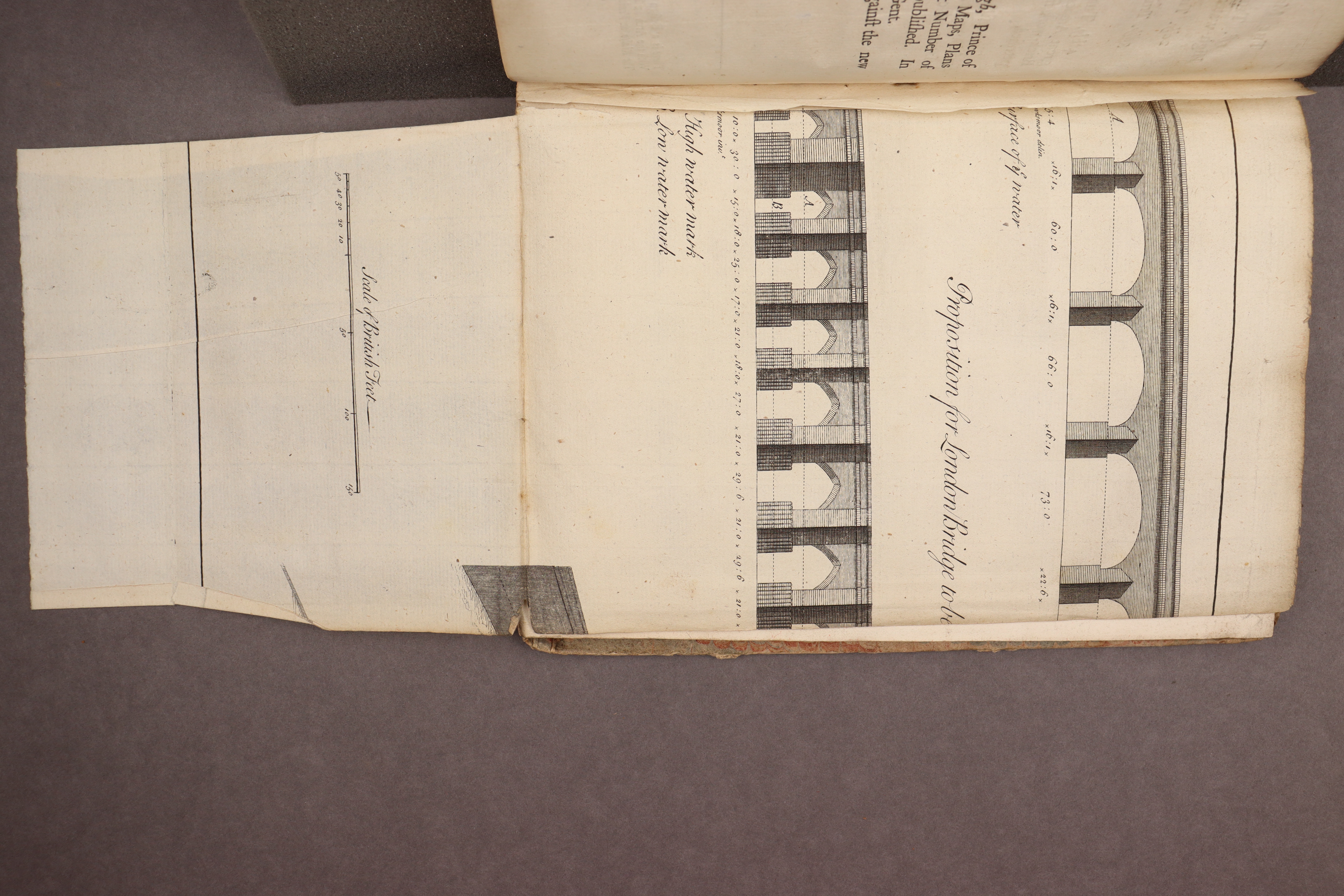
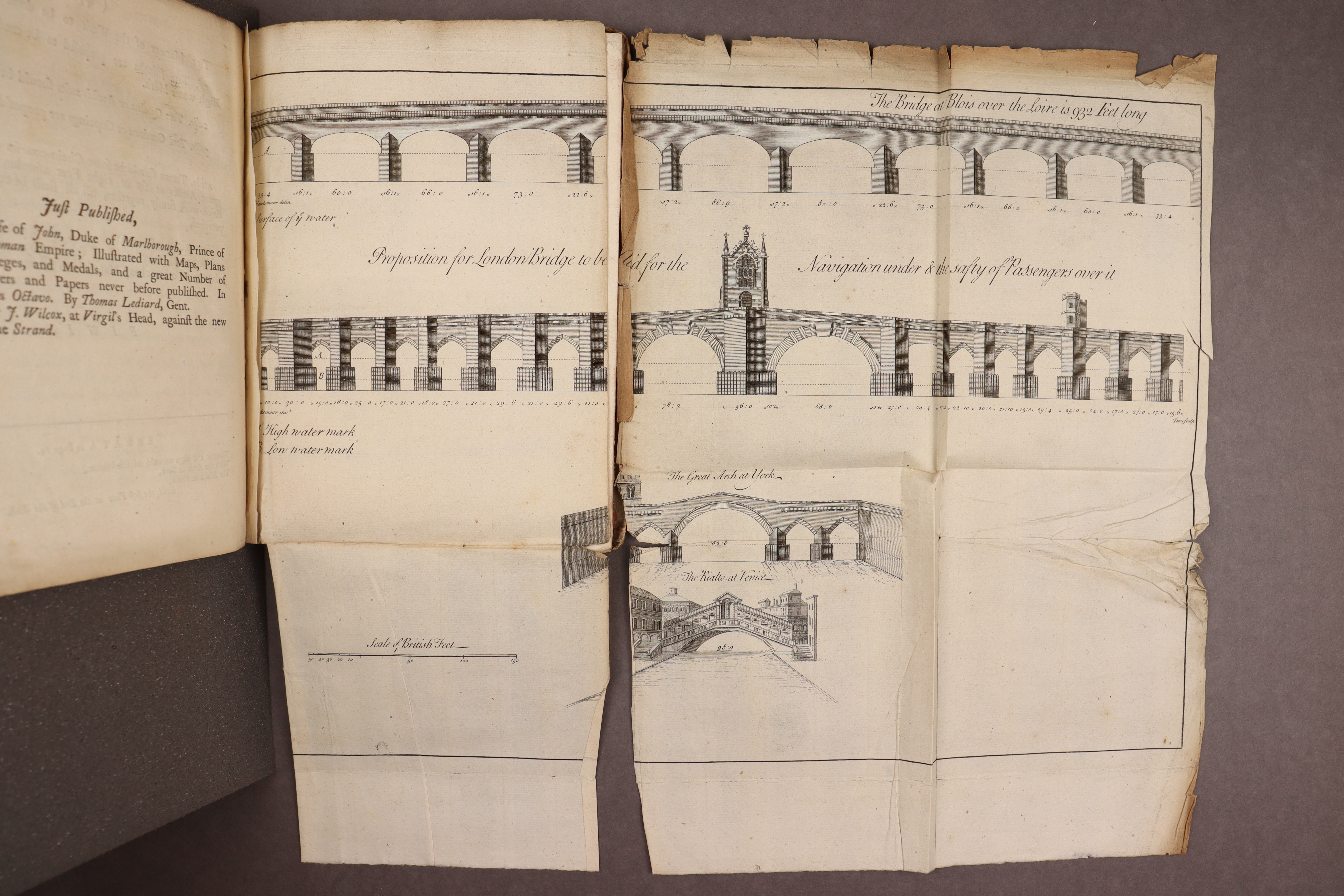
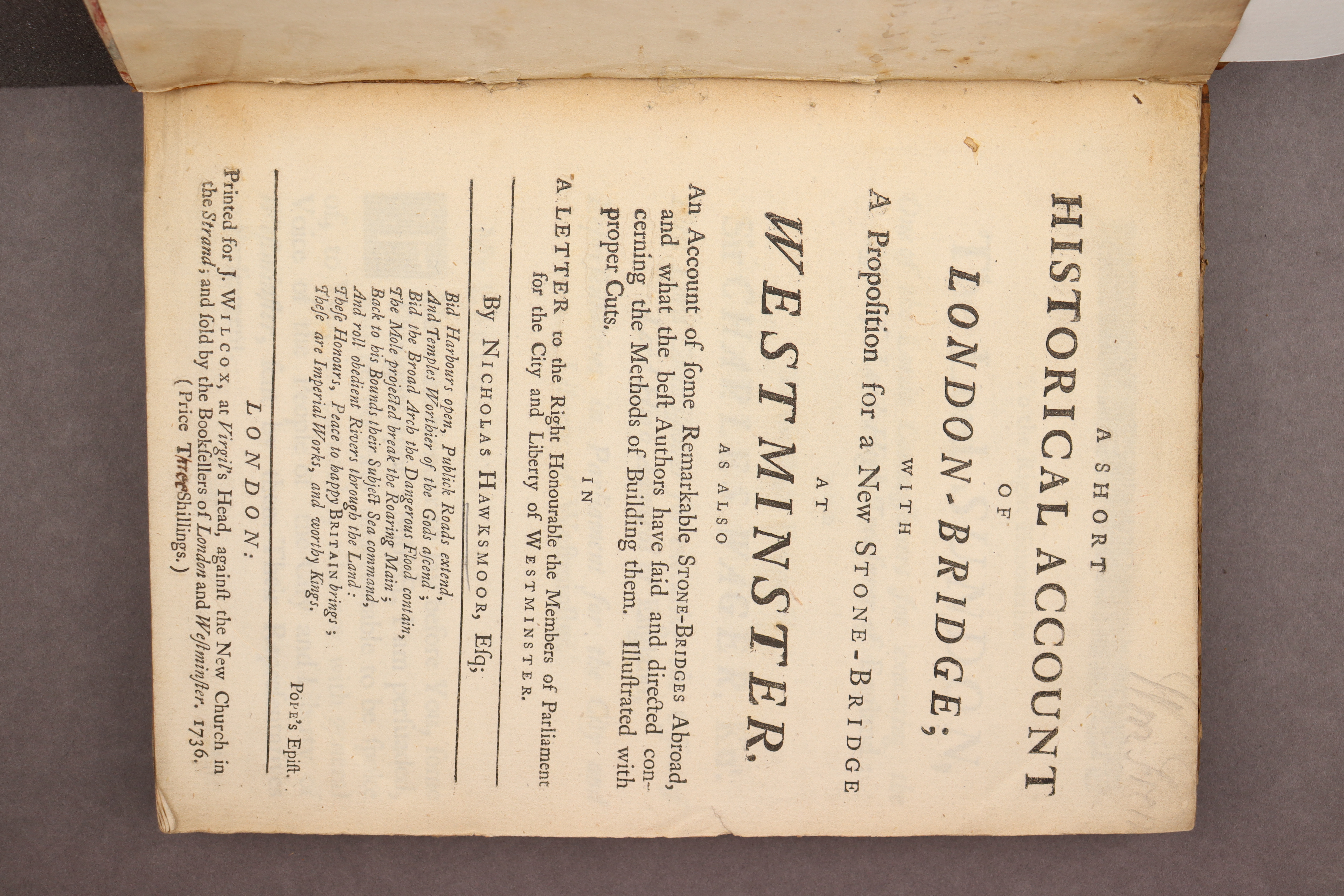
In early printed books, illustrations were either printed directly onto the same leaves as the text, or, more commonly, they were printed on separate sheets called plates and then inserted into the correct position within the text. If the illustrations were larger than the text block, or indeed very large, as in the example displayed here, the plates were folded to fit inside the binding. Folding, however, weakens the paper, and each subsequent unfolding and refolding for viewing purposes puts further pressure on the crease line until the paper fibres break. Luckily, in this instance we didn't lose the detached part! In due time the plate will either be mended, using respectful and reversible conservation treatments (not Sellotape!), or rehoused in a separate protective case.
Hawksmoor, Nicholas. A short historical account of London-Bridge; : with a proposition for a new stone-bridge at Westminster. (London: : Printed for J. Wilcox, at Virgil's Head, against the New Church in the Strand; and sold by the booksellers of London and Westminster., 1736.)
Shelfmark: VX.5.14(1)
Full bibliographic record
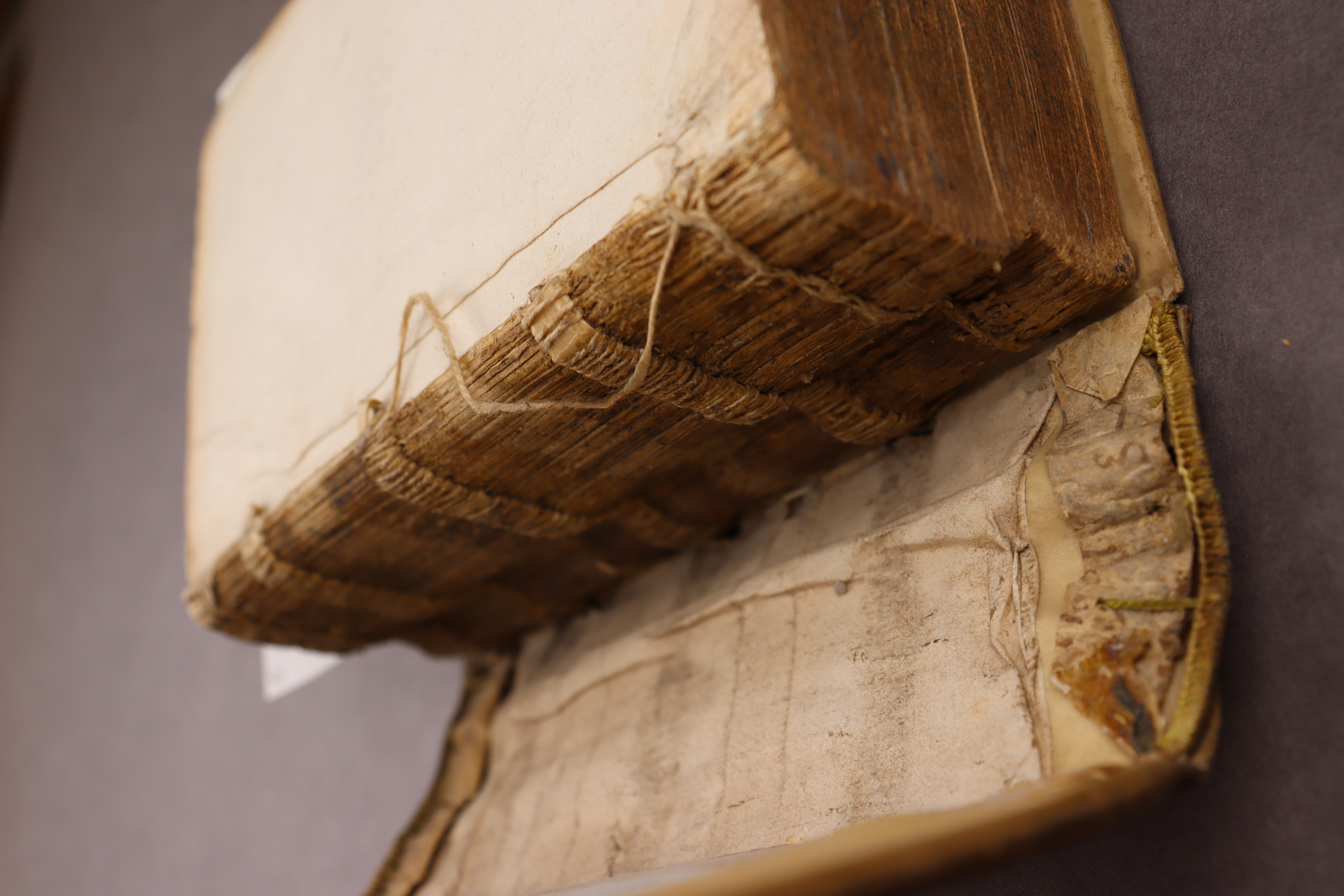
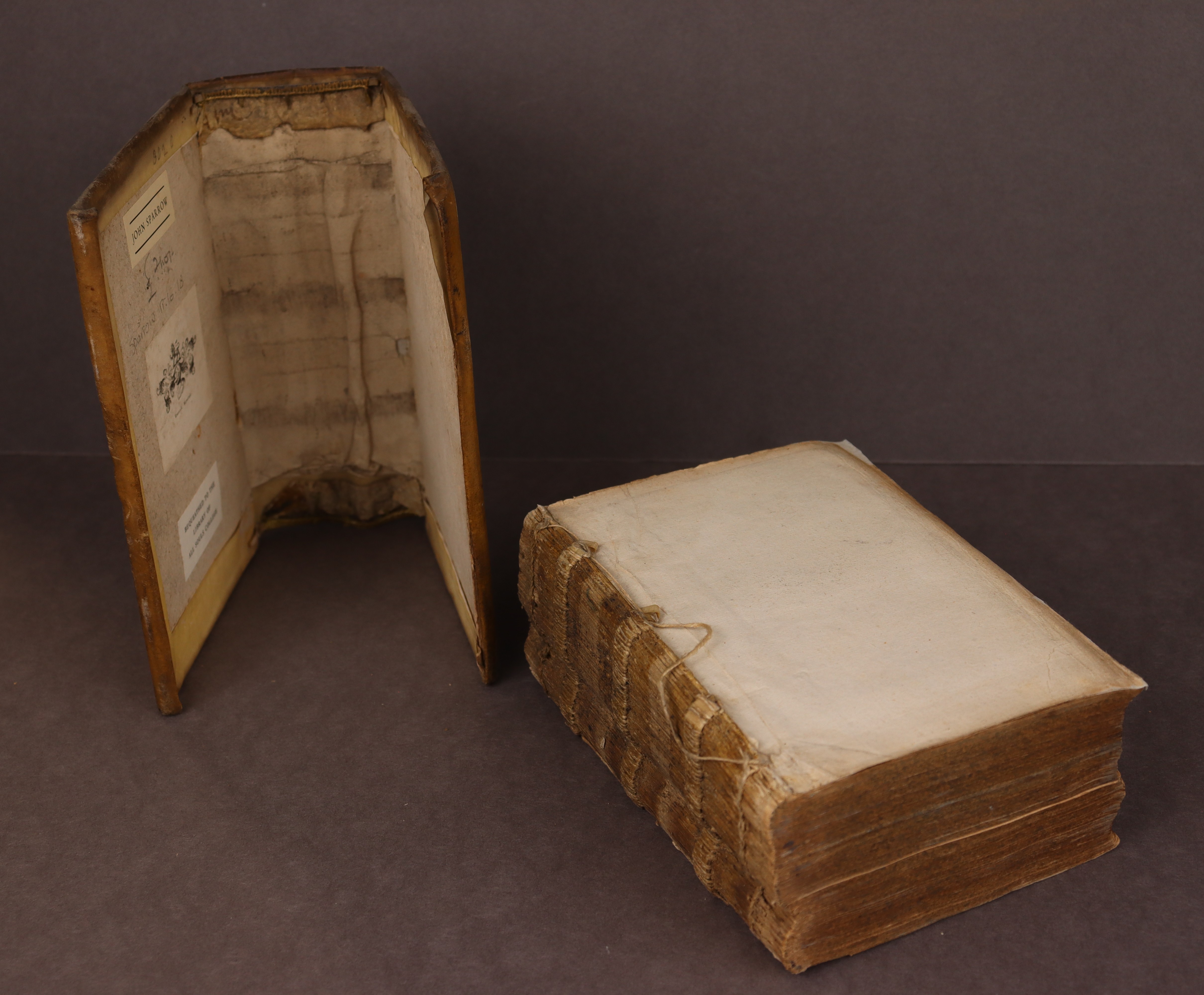
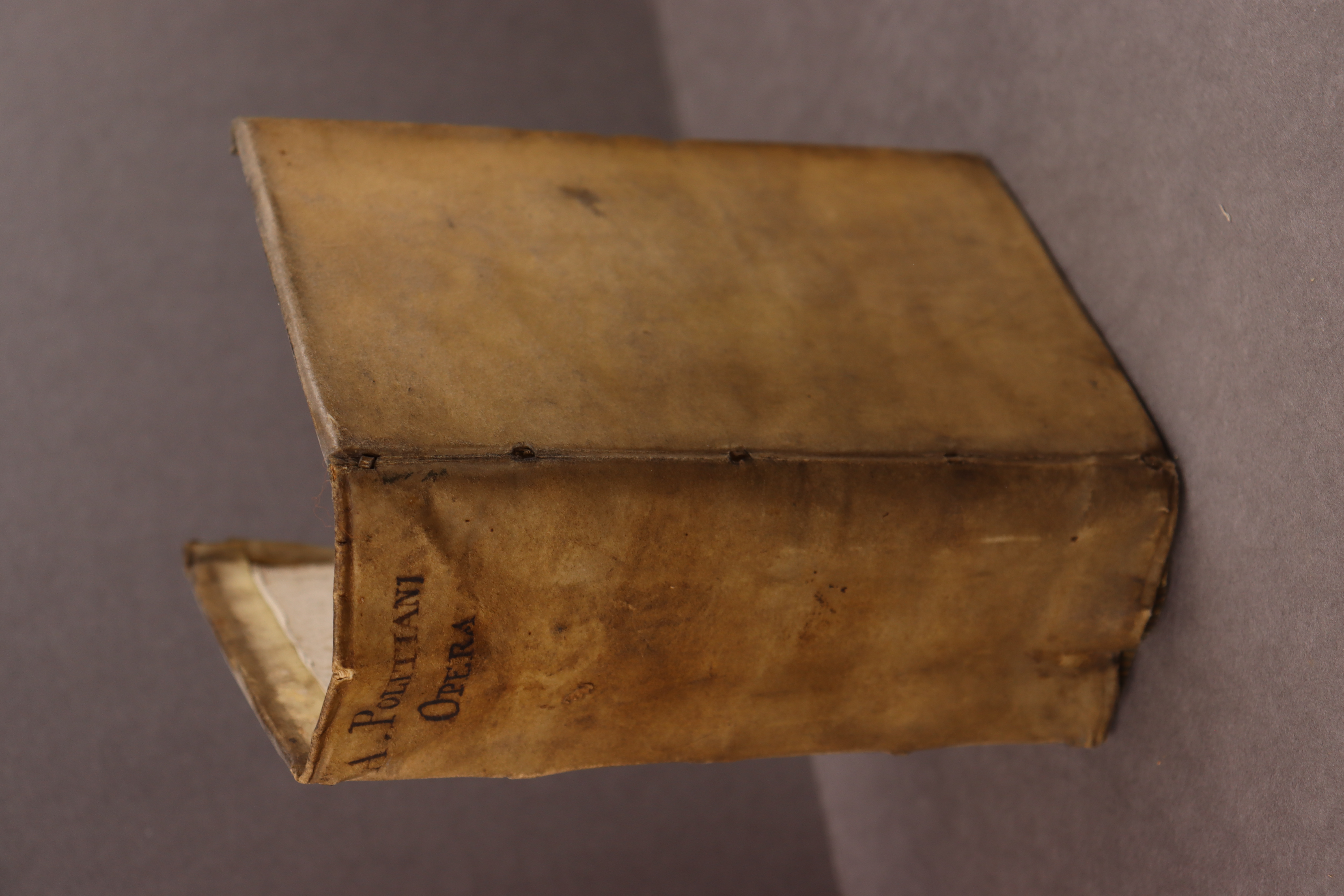
This volume of the completed works of Poliziano, a famous Italian poet, humanist, and classical scholar in Renaissance Florence, had at least four previous owners (that we know of). It was so well read that its cover became completely detached, allowing a clear understanding of its binding structure and revealing how the textblock was sewn onto three flat strips of alum-tawed leather. In situations such as this, librarians and conservators need to decide whether to have the volume rebound, and lose historical evidence, or leave it as it is, and risk further damage. The library is in the process of updating its policies to deal with similar cases based on the best available conservation advice.
Poliziano, Angelo. Angeli Politiani Operum tomus primus. ([Lyon] : Sebastianus Gryphius germanus excudebat Lugduni, anno M. D. XXVIII. [1528])
Shelfmark: Sparrow E.484
Full bibliographic record
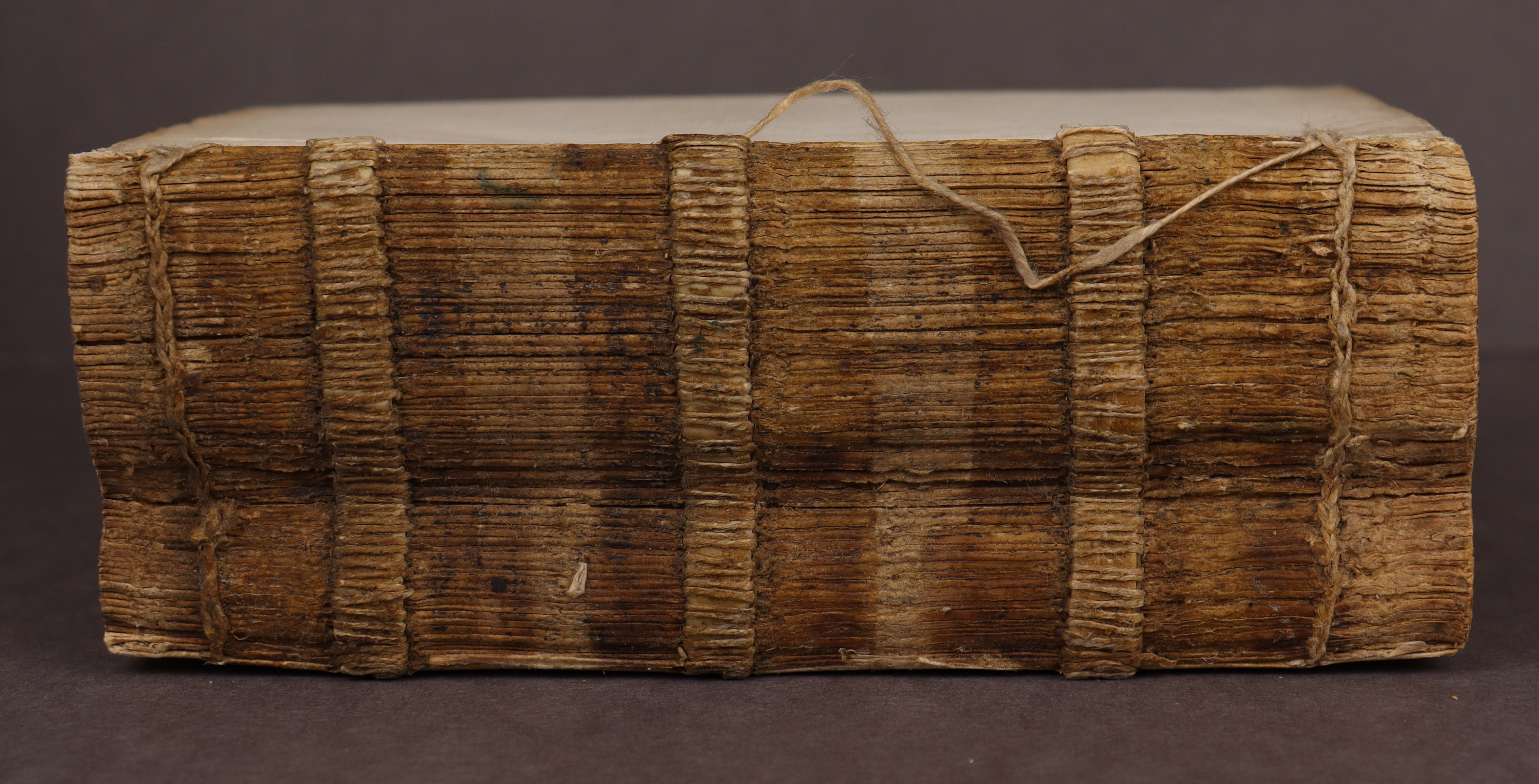
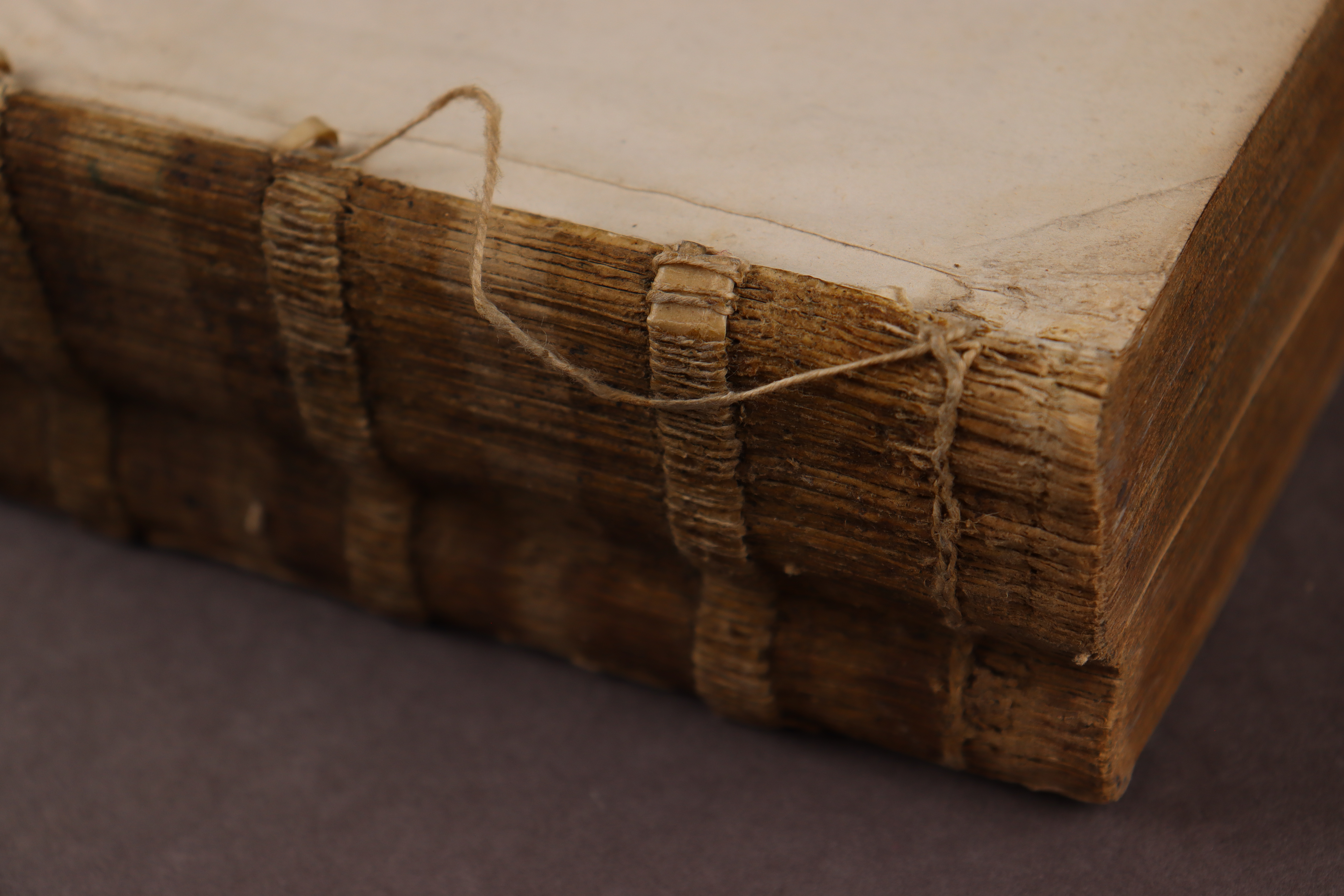
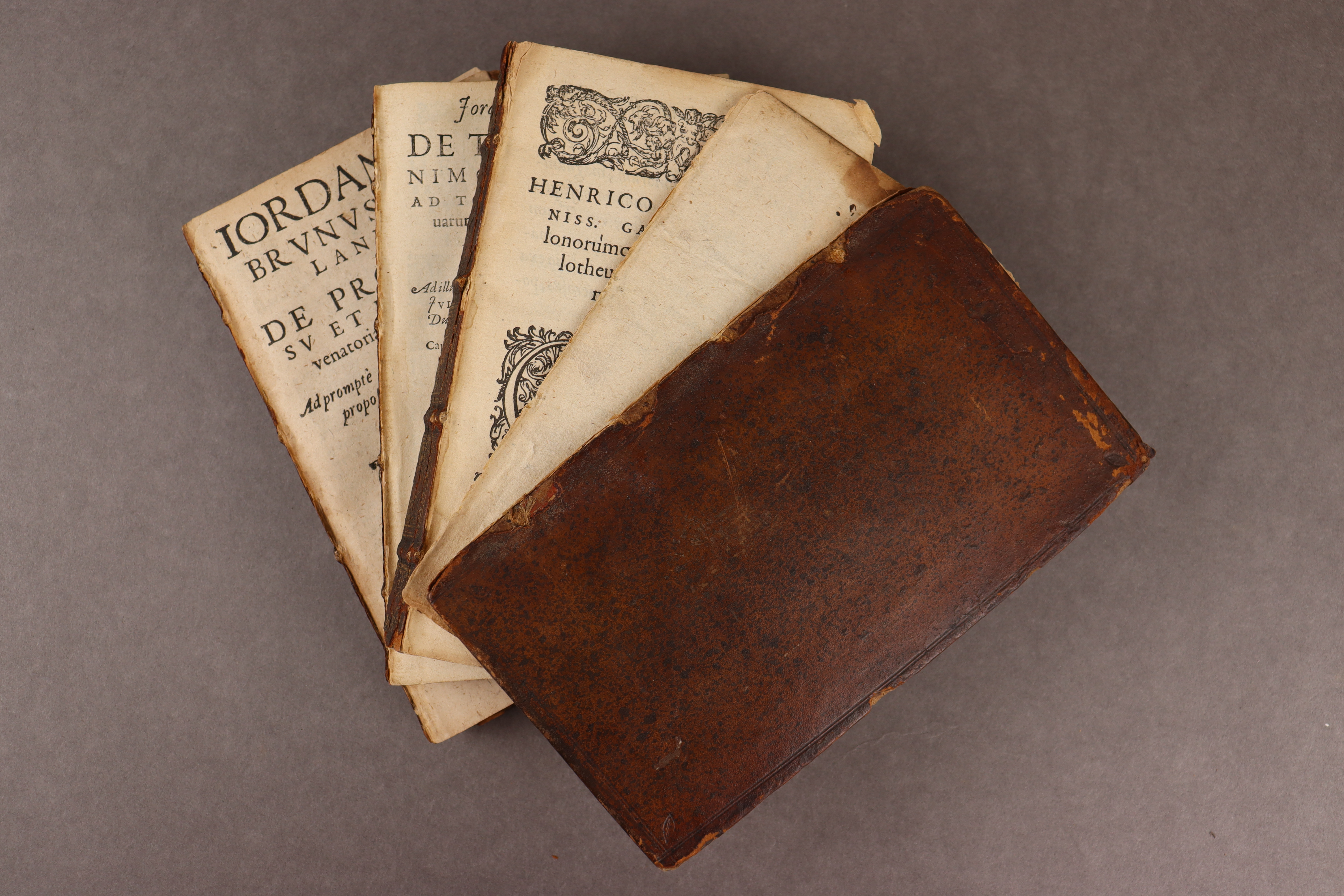
As mentioned in Case 1 of this exhibition, books used to be sold unbound, and each owner would then bind them according to their taste and their finances. To keep the price of the material down, it was not unusual to bind several works together, often (but not always) if they were thematically similar, or by the same author, which is what one previous owner decided to do with this collection of four works by the Italian Dominican priest, philosopher and cosmologist Giordano Bruno. Interestingly, this work split roughly along the lines of its individual components, suggesting that each was first sewn separately, and then put together at a later date without investing in a solid structure. In some ways, this is helpful for modern readers wishing to consult one of these items as they only need to handle the specific work they are interested in, not the entire volume. Nevertheless, from a conservation perspective this book and its various parts pose multiple concerns and challenges, as we need to make sure that no further damage is caused, and also that we don't lose any errant pieces!
Bruno, Giordano. 4 works. (1582-1591):
Iordanus Brunus Nolanus De vmbris idearum (Parisiis, : Apud Ægidium Gorbinum, sub insigne Spei, è regione Gymnasij Cameracensis., M.D.LXXXII [1582])
Shelfmark: i.13.9(1)
Full bibliographic record
Jordani Bruni Nolani De triplici minimo et mensura ad trium speculatiuarum scientiarum & multarum actiuarum artium principia, libri V. (Francofurti : Apud Ioannem Wechelum & Petrum Fischerum confortes, MDLXXXXI [1591])
Shelfmark: i.13.9(2)
Full bibliographic record
Iordanus Brunus Nolanus De progressu et lampade venatoria logicorum. (Anno 1587.)
Shelfmark: i.13.9(3)
Full bibliographic record
Iordani Bruni Nolani Camoeracensis Acrotismus. (Vitebergæ : Apud Zachariam Cratonem., Anno. 1588.)
Shelfmark: i.13.9(4)
Full bibliographic record
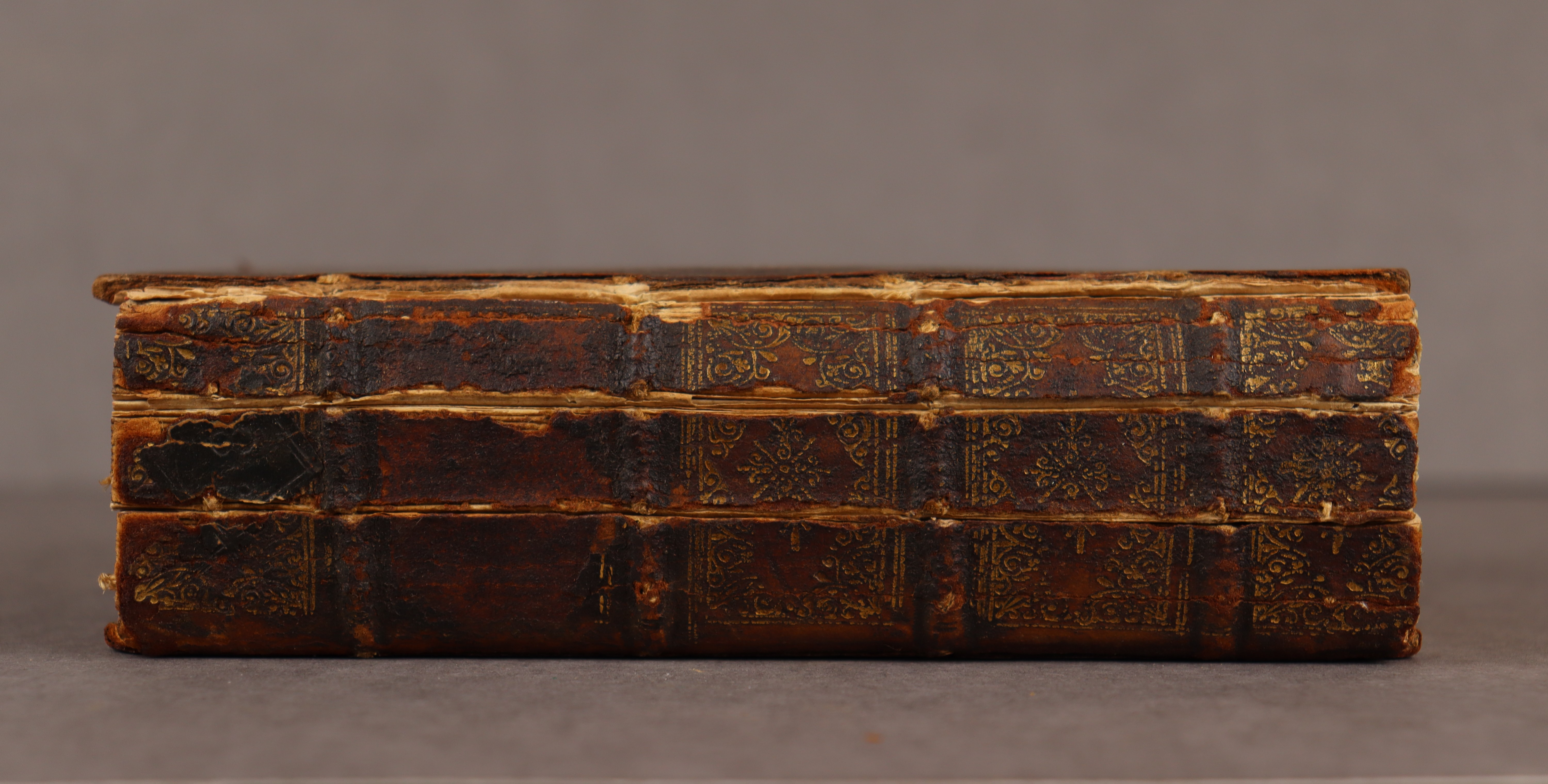
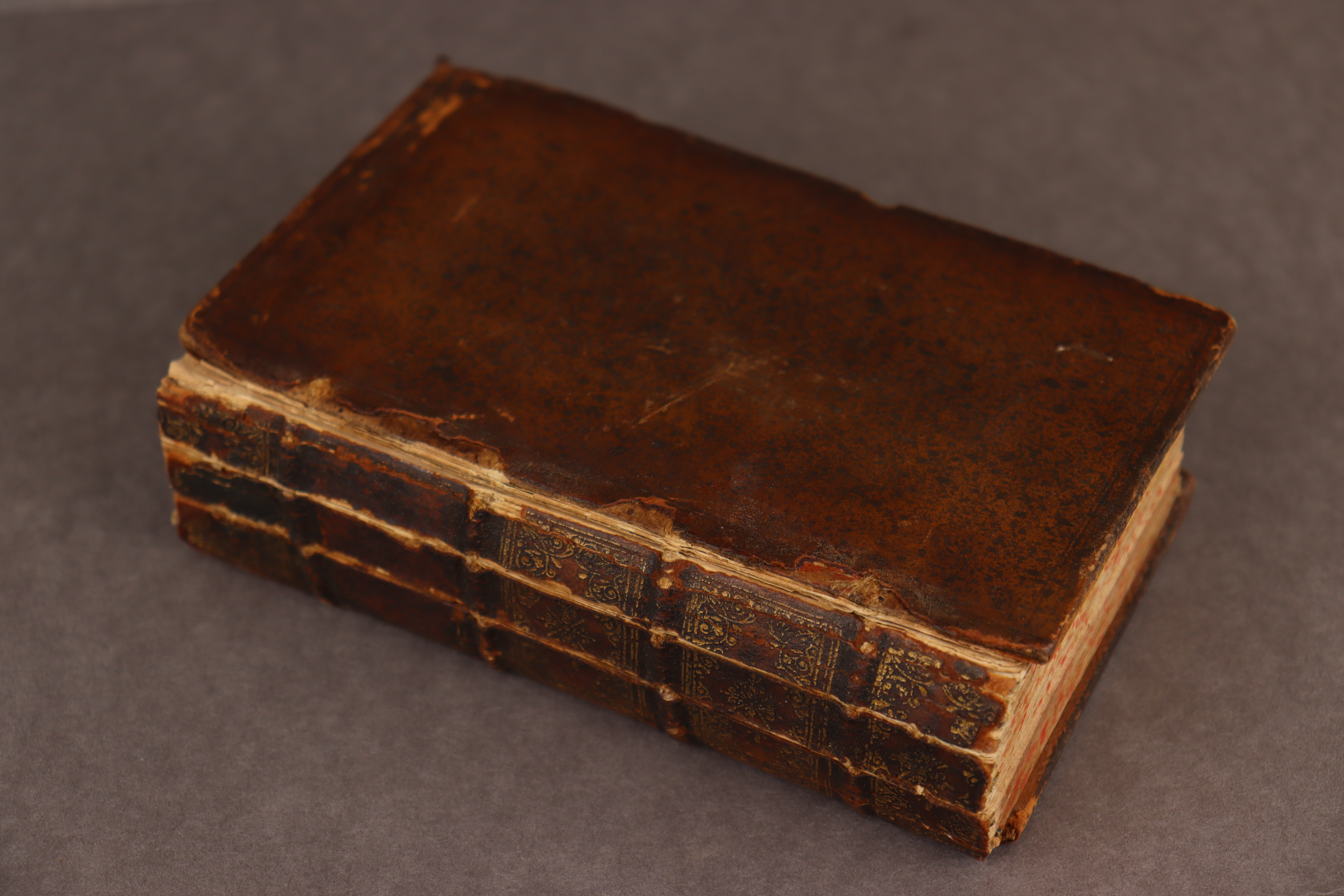
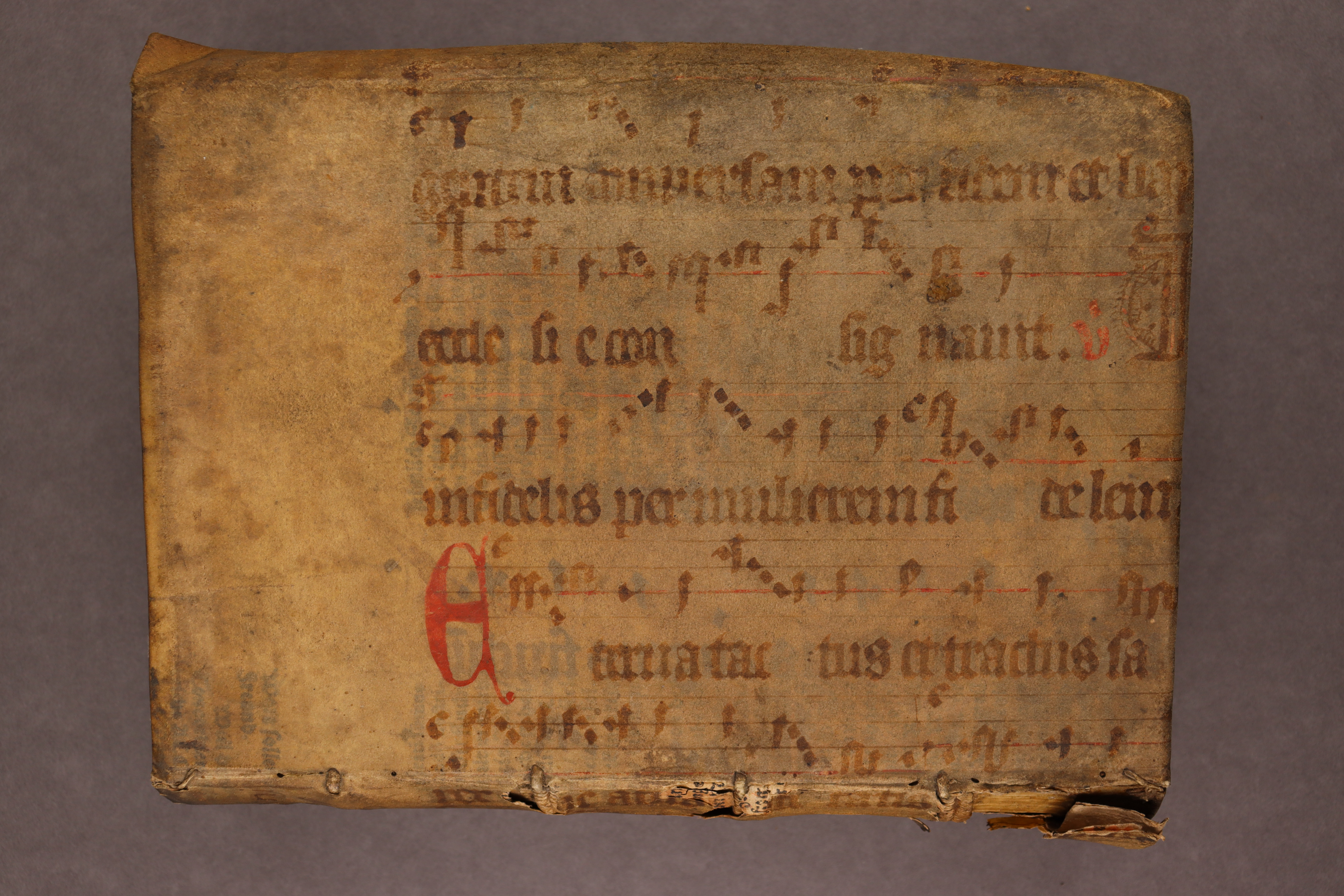
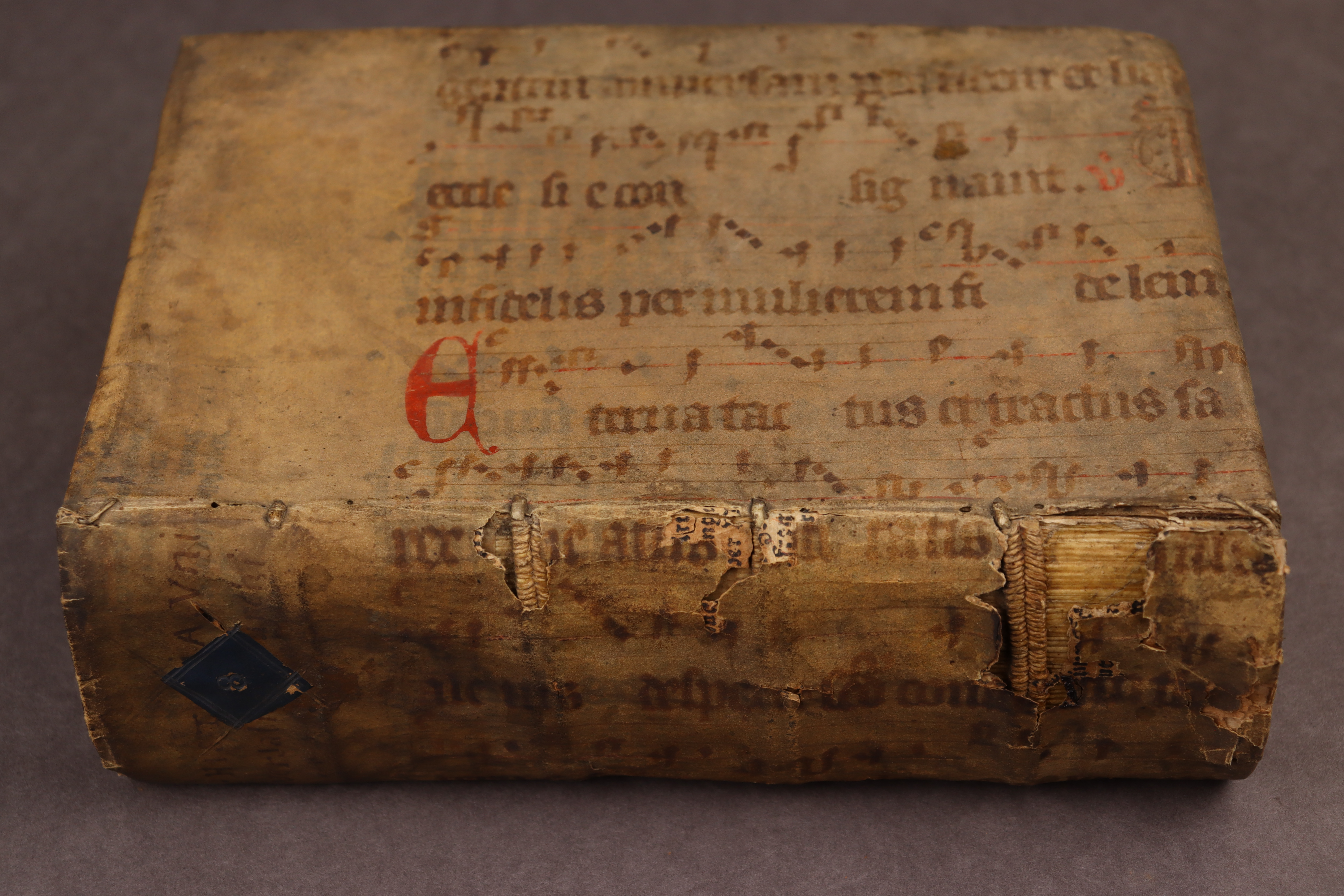
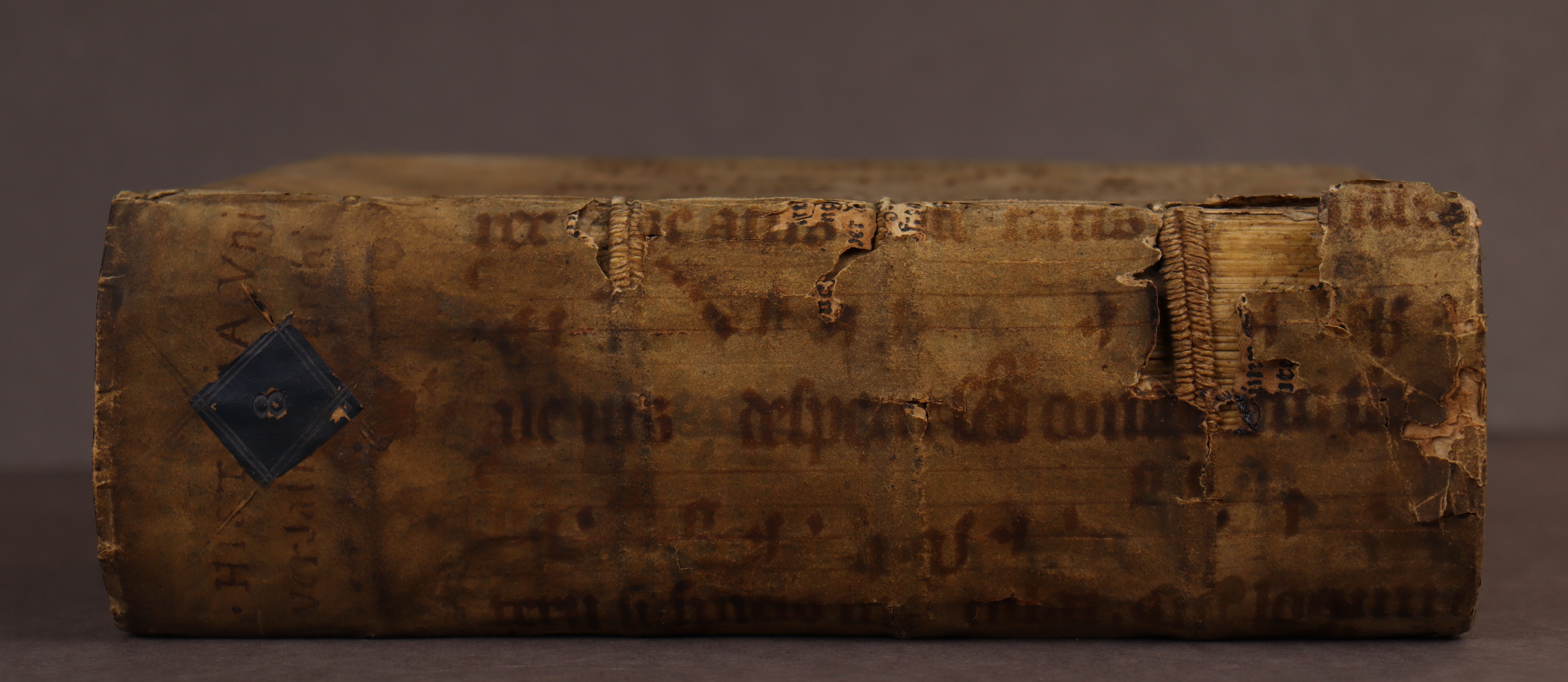
At first glance, this item might seem very similar to the book in Case 1 that is also bound in musical manuscript waste on parchment (although this one is arguably in worse condition). However, a closer look beyond the faded musical notation reveals a much more layered and interesting story. On the cover, running perpendicular to the music, a faded, much smaller blackletter script is visible beneath the notation. The binder almost certainly superimposed two different sheets of parchment waste to reinforce the binding, creating as strong a structure as possible by using whatever materials were to hand. However, several fragments of previously unknown text (or whose existence was known only through secondary sources) have been uncovered serendipitously through the examination of exactly such manuscript binding waste, giving rise to a whole new interdisciplinary field of research in manuscript studies and the transmission of texts, called fragmentology. As can be seen on the spine, the parchment has become fragile over the years, so we have to be careful with how this book is handled and opened, and the study of the manuscript waste has to be carried out through non-invasive technologies such as multispectral and hyperspectral imaging and X-rays. Facilitating this kind of research is also the work of modern librarians.
Sansovino, Francesco. Historia vniuersale dell'origine et imperio de' Turchi. (In Venetia, : Presso Alessandro di Vecchi., 1600.)
Shelfmark: 8:SR.101.b.25
Full bibliographic record
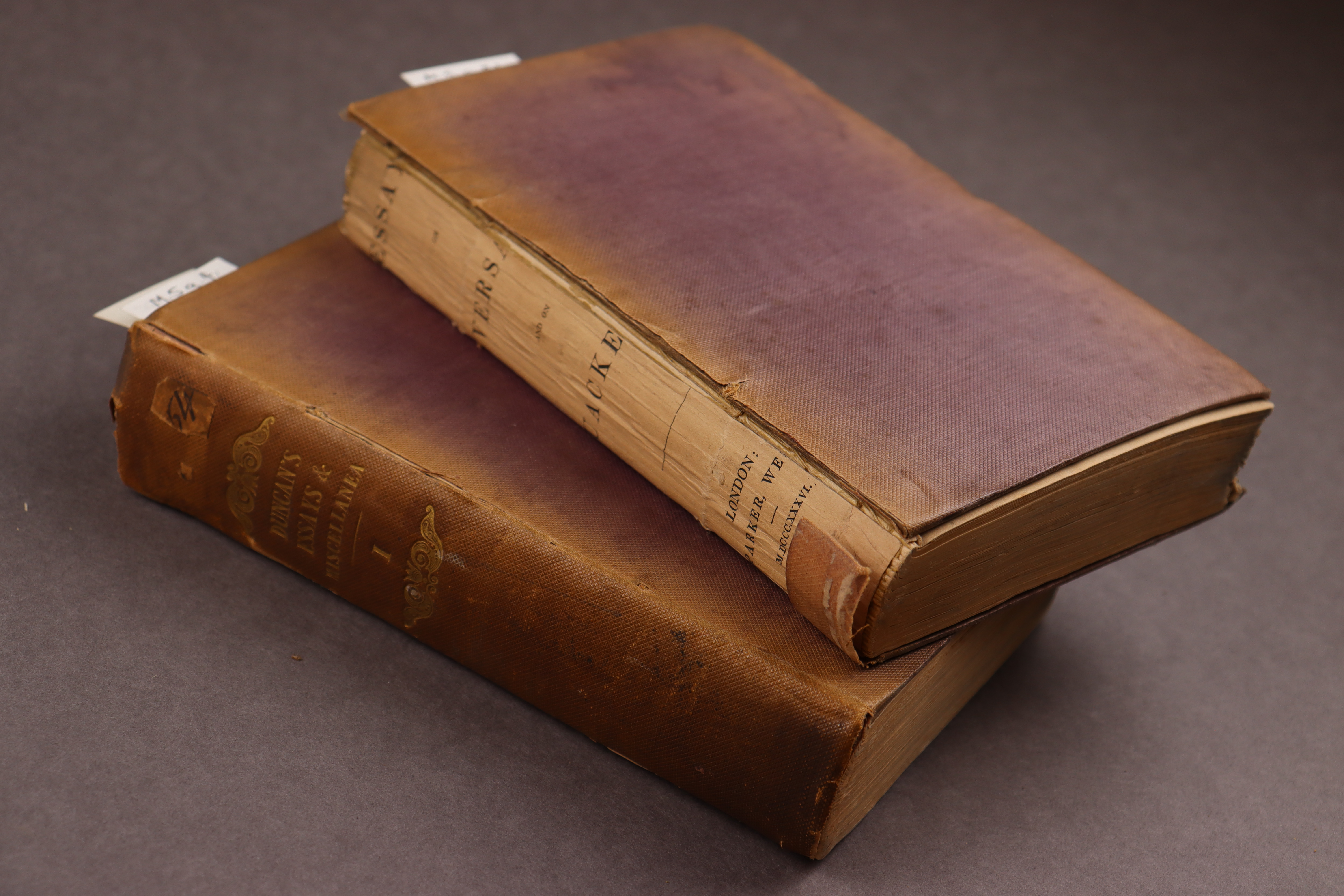
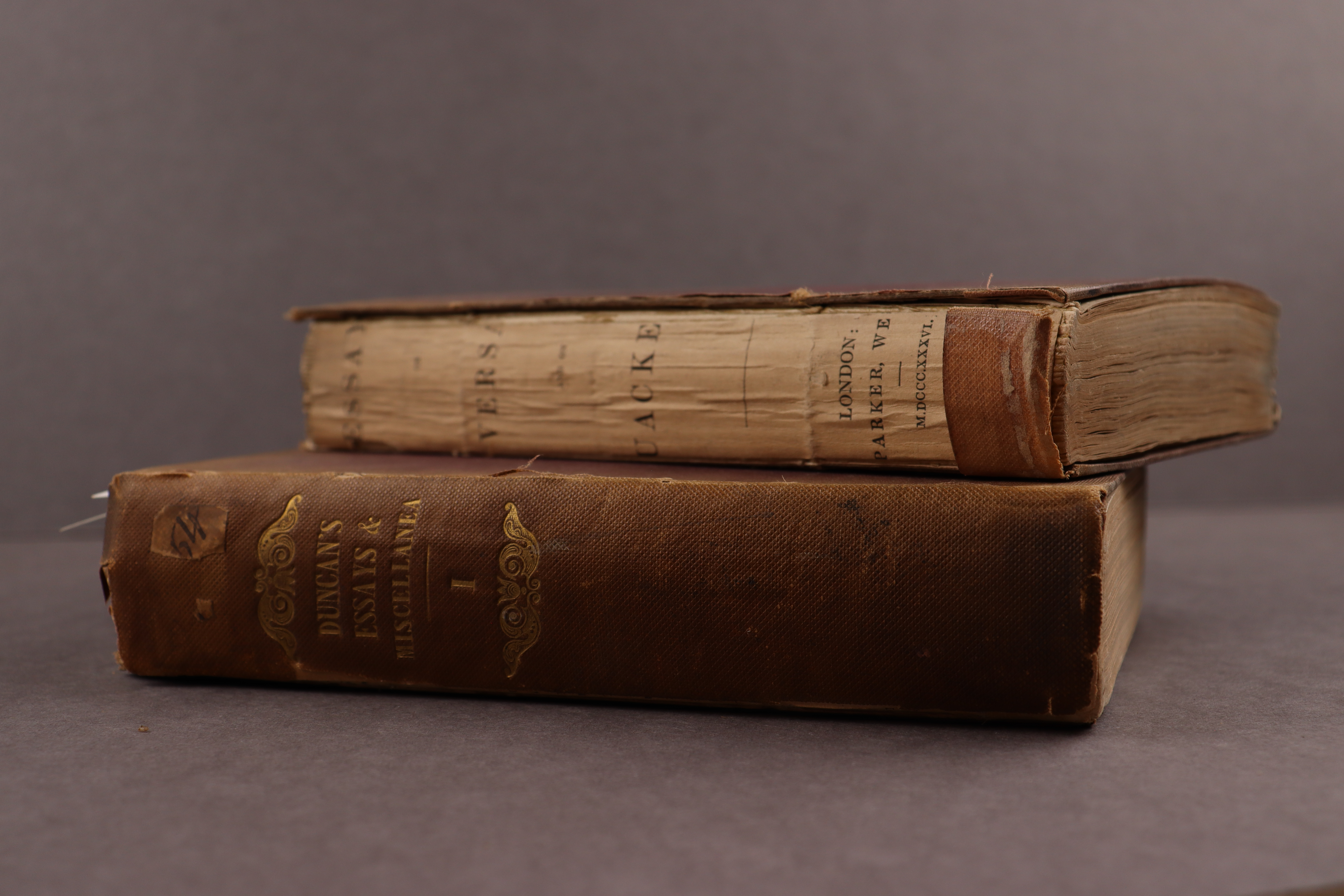
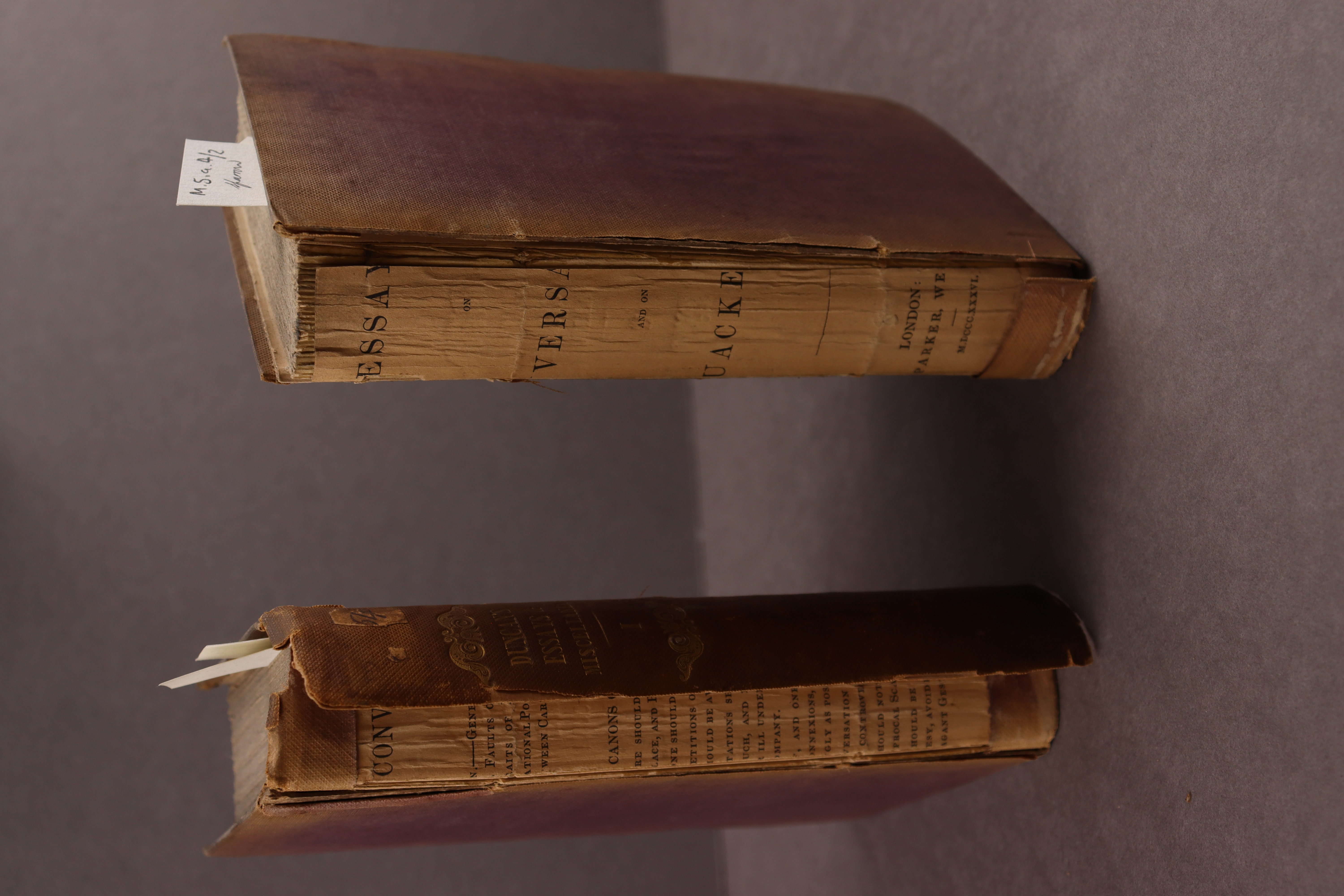
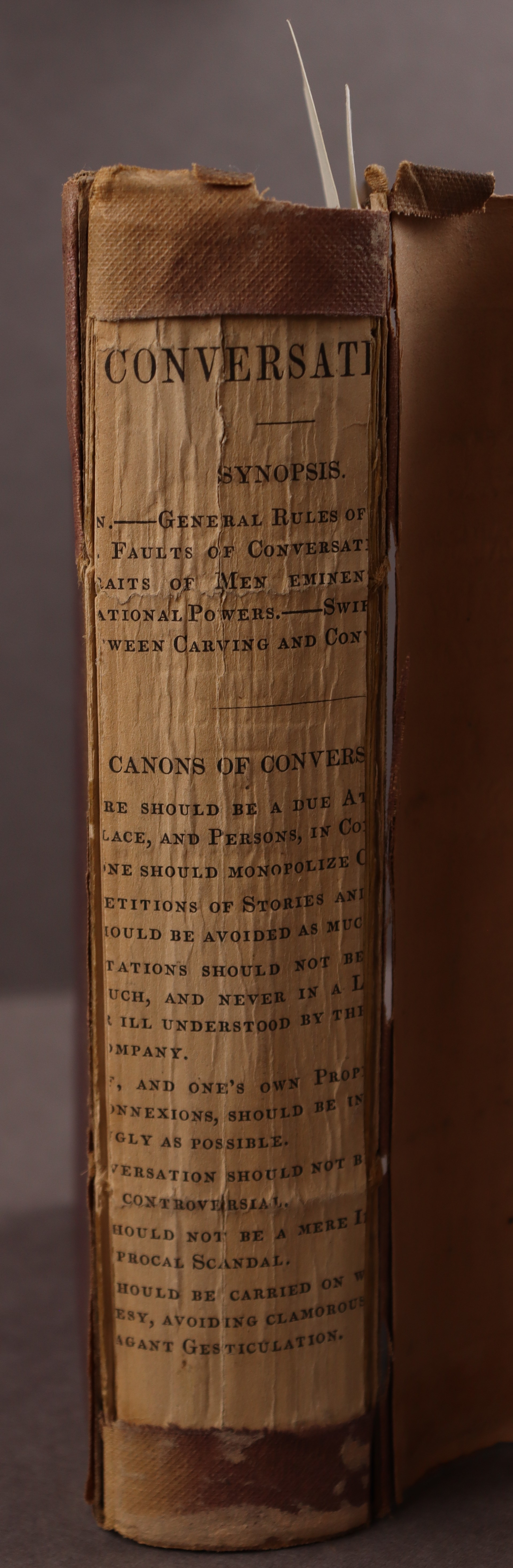
Whether you are dealing with a 1000-year-old manuscript or a 21st-century novel, the spine of a book will always be the part that undergoes the most stress during use. Even modern spines can therefore be a cause for concern in library collections, as is demonstrated by this two-volume 19th-century book. It is bound in a cloth called buckram, which is usually made of cotton (but sometimes linen was used instead) that has been strengthened by saturating it with a sizing agent. Evidently, the spines of these particular books have seen better days, since one has detached on one side and now lies open to reveal the printed binder's waste used underneath to reinforce it, and the other has been lost completely. Incidentally, this unfortunate work serves as evidence that the practice of using scrap paper as reinforcing material was not limited to the early years of printing and binding! Our concern now is to ensure that the remaining spine does not also separate from the book, by keeping it together with cotton conservation tape.
Buckram book cloth became a popular choice for bookbinding during the 19th century thanks to its stiff nature and subsequent durability. It also allowed for books to be bound in a wider variety of colours, such as the purple we see here.
The work used to stiffen the spine has been identified as the title page and an internal page of a copy of Philip Bury Duncan's own Essays; on conversation, and on quackery (London: Parker, 1836). This work can be seen online at #7 - Essays on conversation and on quackery - Full View | HathiTrust Digital Library. Philip Bury Duncan was Keeper of the Ashmolean Museum from 1826 until 1855, but, for health reasons, resided most of his life in Bath, where he delivered the essays gathered in these volumes at the Bath Literary Institution. The complete text of Essays; on conversation, and on quackery was repackaged and reissued (with a different title page and final leaves) as the beginning of the second volume of Essays and miscellanea. As such, quite a few of the now discarded original title page, half title page and final two leaves of the earlier work would have been available for stiffening the binding of the newer work, and the binder made sure that all this waste paper did not go to waste.
Duncan, Philip Bury. Essays and miscellanea.. (Oxford, : Printed by Thomas Combe., MDCCCXL. [1840])
Shelfmark: Sparrow M.5.a.4/2
Full bibliographic record
A library provides food for the mind and soul... but food in the library attracts pests! Wiggling, flying, scurrying creatures can cause a lot of damage, but so can the two-legged variety that likes to play with fire and sticky tape! The horror!
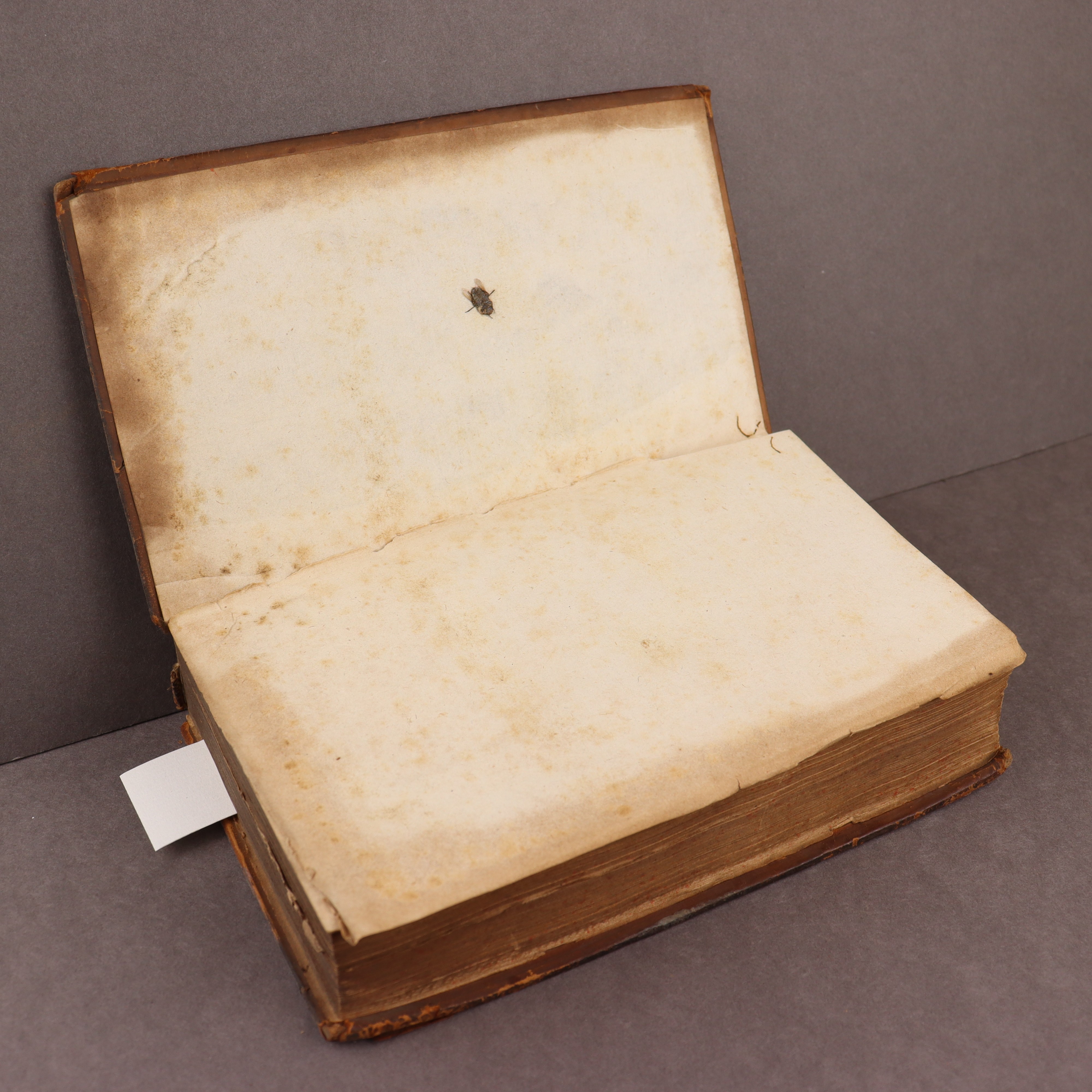
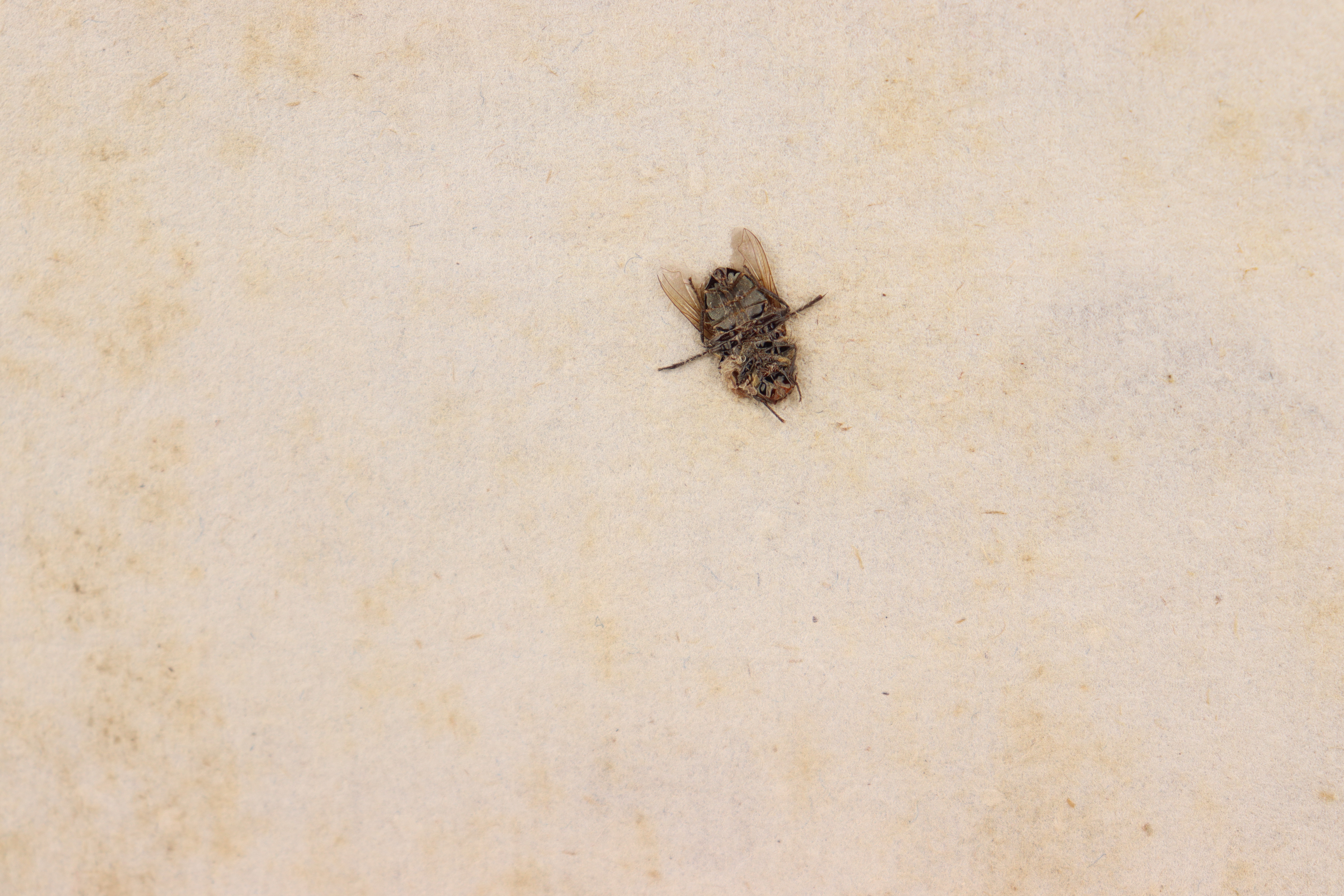
The author of this book, Captain Edward Cooke, embarked on adventures across the globe in the early 18th century which were then published in volumes like this. Unfortunately, the same cannot be said for the fly whose journey through life was cut short when it landed on the lower pastedown of this book. It is unclear exactly how, when or why it came to be crushed onto the back cover: perhaps it had been antagonising a former reader who saw it land and decided to snap the book shut; or perhaps it was simply flying in the wrong place at the wrong time. Luckily for us, the decomposition of the fly has not caused any significant damage to either the area around it or the opposite page, so it now just makes for a rather gruesome surprise for any unsuspecting readers. [The third image of the slideshow shows an extreme close-up of the fly]
Cooke, Captain Edward. A voyage to the South Sea, and round the world, perform'd in the years 1708, 1709, 1710, and 1711. : Containing a journal of all memorable transactions during the said voyage... (London : Printed by H.M. for B. Lintot and R. Gosling in Fleet-Street, A. Bettesworth on London-Bridge, and W. Innys in St. Paul's Church-Yard., M DCC XII. [1712])
Shelfmark: TX.4.22
Full bibliographic record
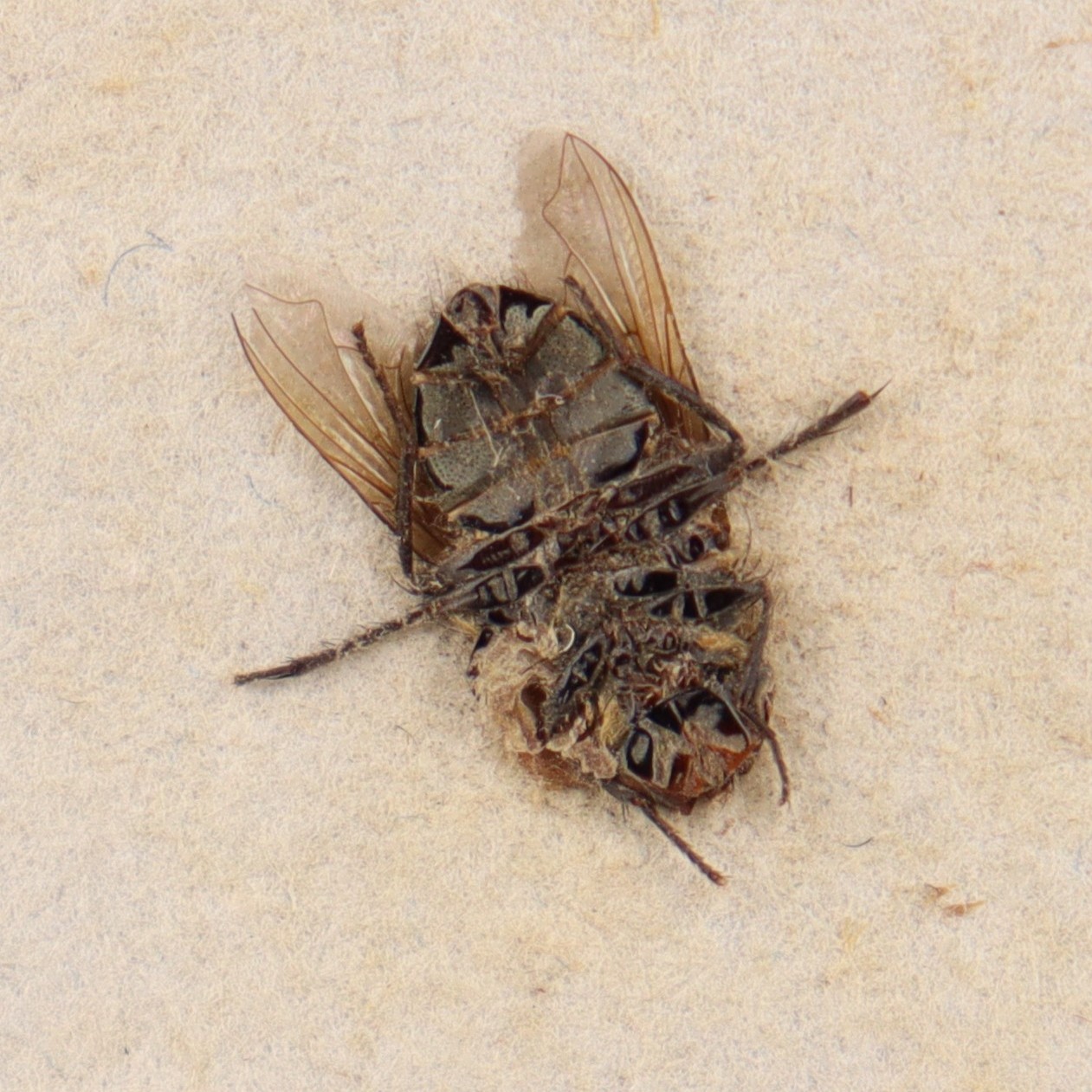
Bookworms are one of the most feared pests within a library, but the damage they cause is equally some of the most fascinating to look at. The term 'bookworm' does not actually refer to a species of worm itself, but rather to the larvae of different insects (e.g. various beetles or moths) which hatch from eggs laid on the paper of the book. The hungry larvae then chew their way through the organic material of the pages, and leave behind them intricate trails which can obscure extensive parts of the text. That is what has happened to this book, where significant bookworm damage is visible through a number of pages. Interestingly, we can see that a former owner tried to prevent the leaves from ripping by gluing thin white paper on the affected areas, in places obscuring even more of the text in the process. It would appear they subsequently thought that the repairs were more trouble than they were worth, as they stopped only a few pages into the damage. Once a bookworm has eaten a page, there is nothing we can do to fully restore it, which is why libraries have rules such as 'no food or drink': to discourage egg-laying pests from entering them in the first place.
Milhard, Pierre. La vraye guide des curez, vicaires: & confesseurs: : diuisee en trois parties. (A Paris, : chez Pierre Chevalier, au mont Sainct Hilaire, à la Court d'Albret., M. DCIII.. [1603])
Shelfmark: Briggs 10
Full bibliographic record
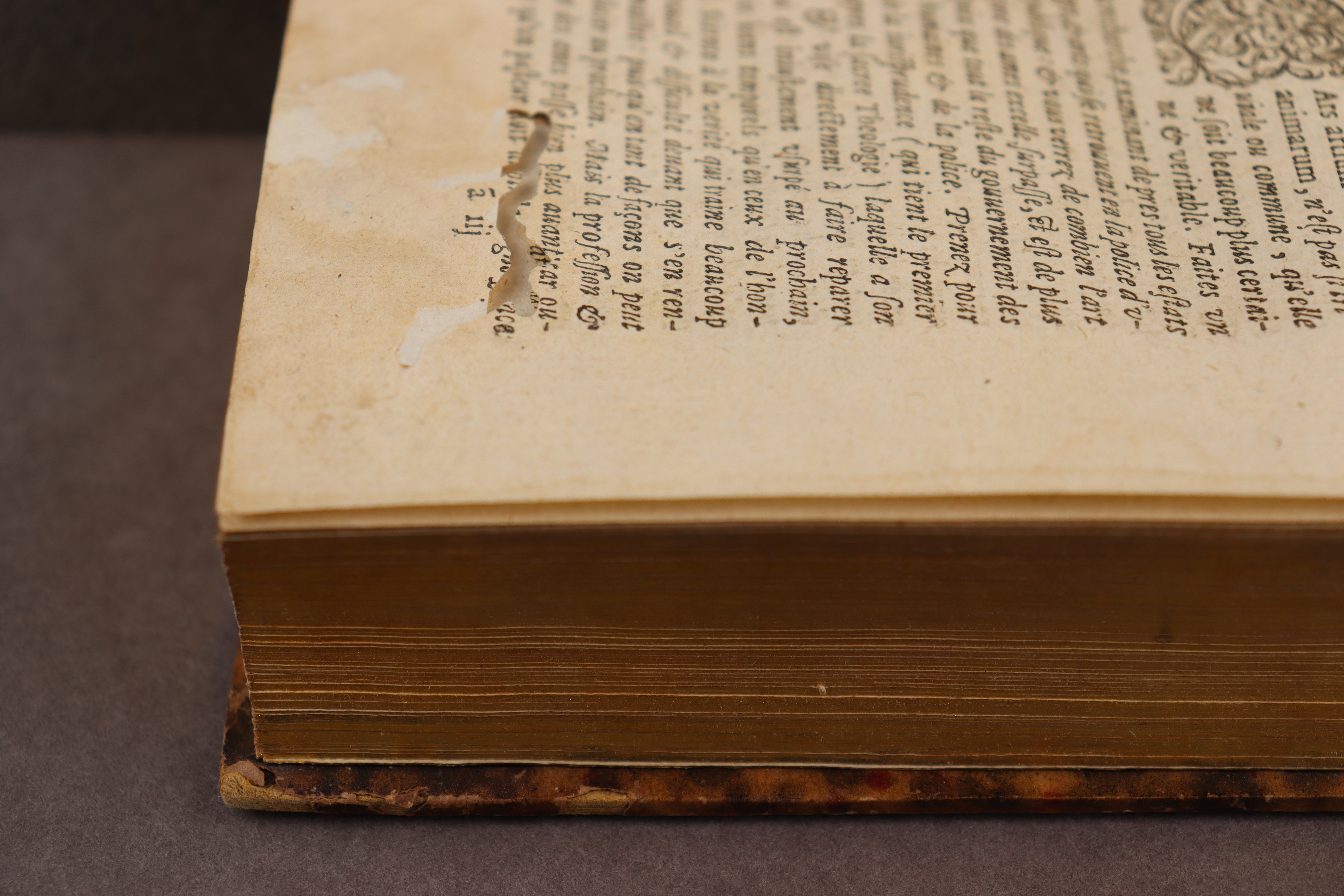
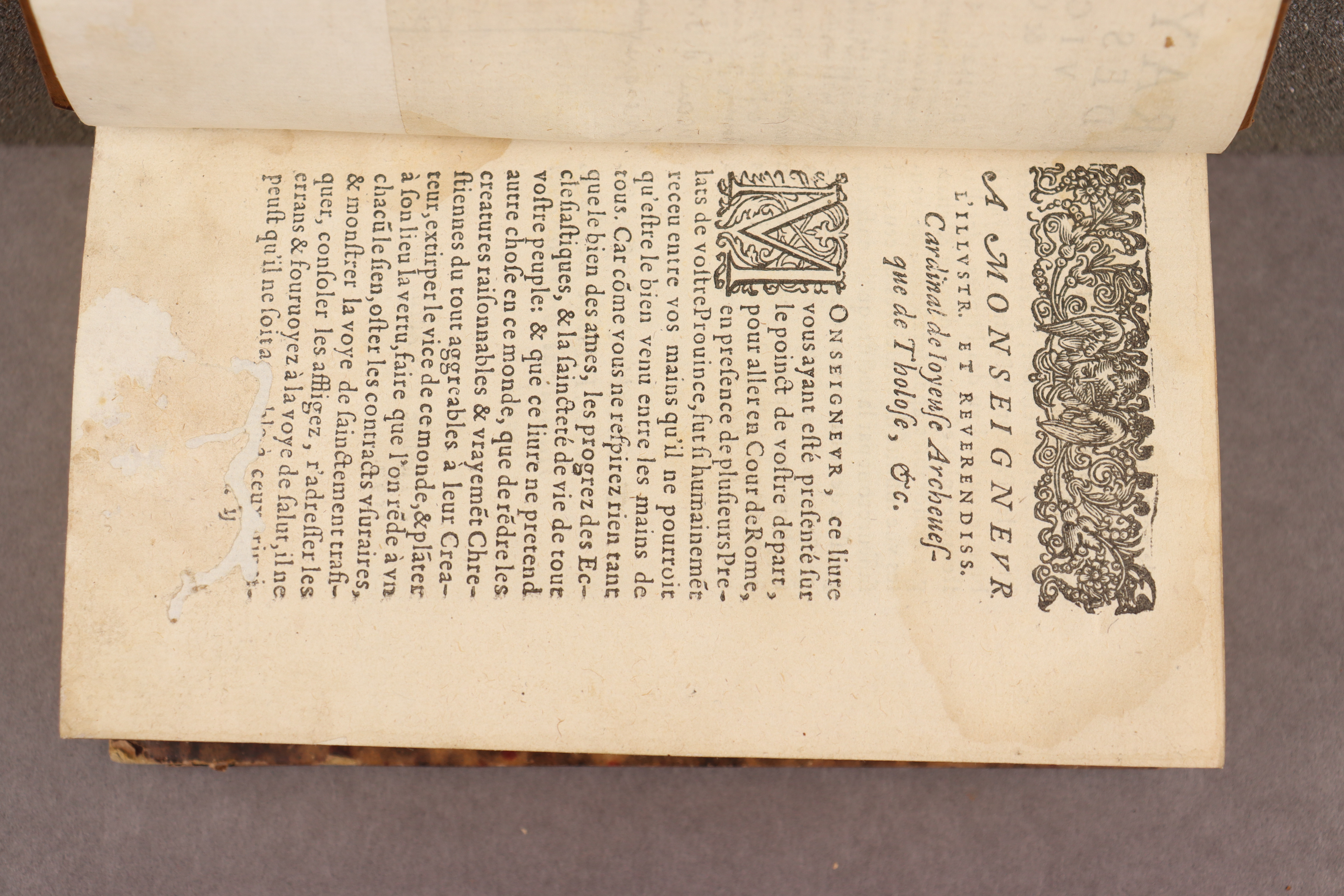
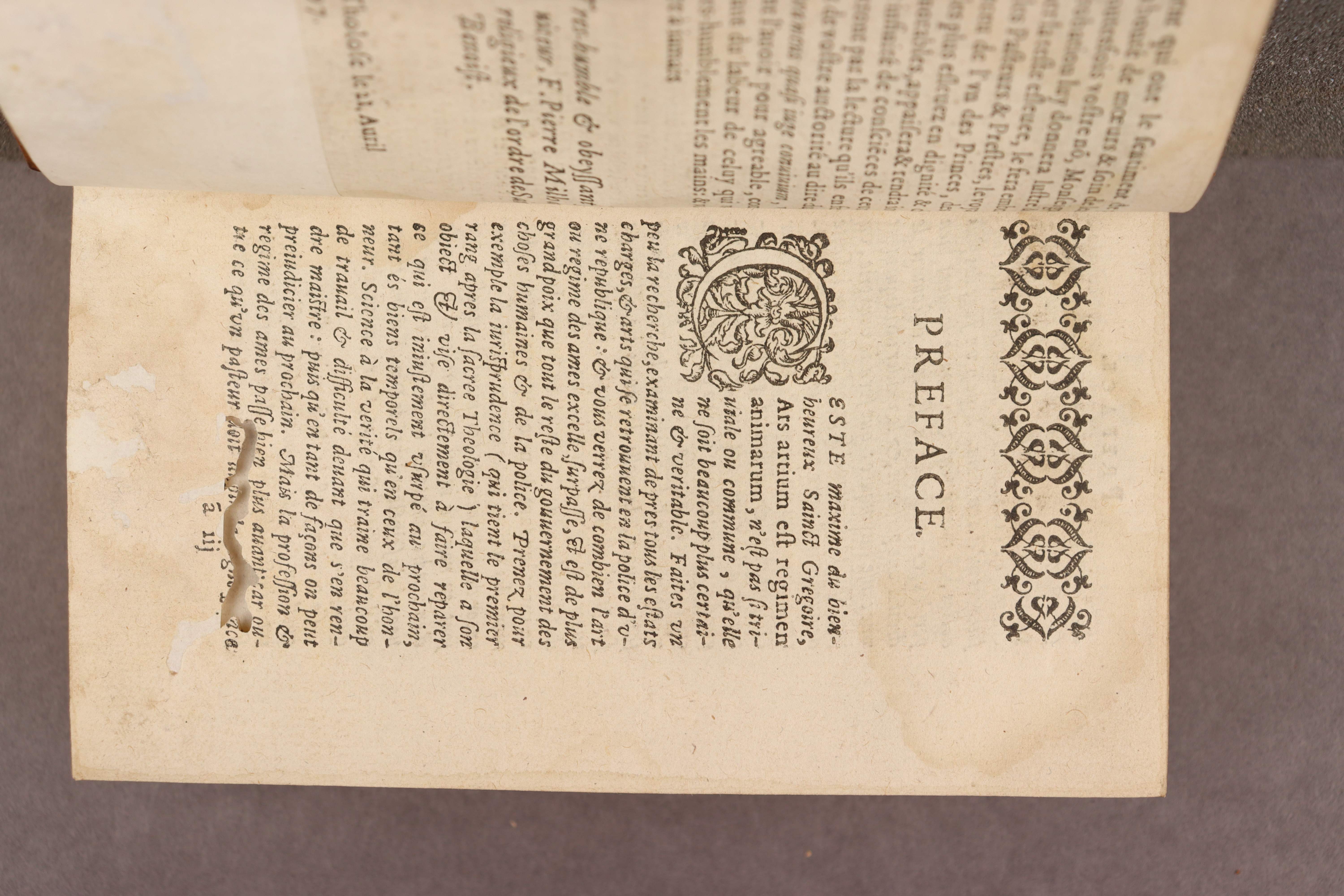
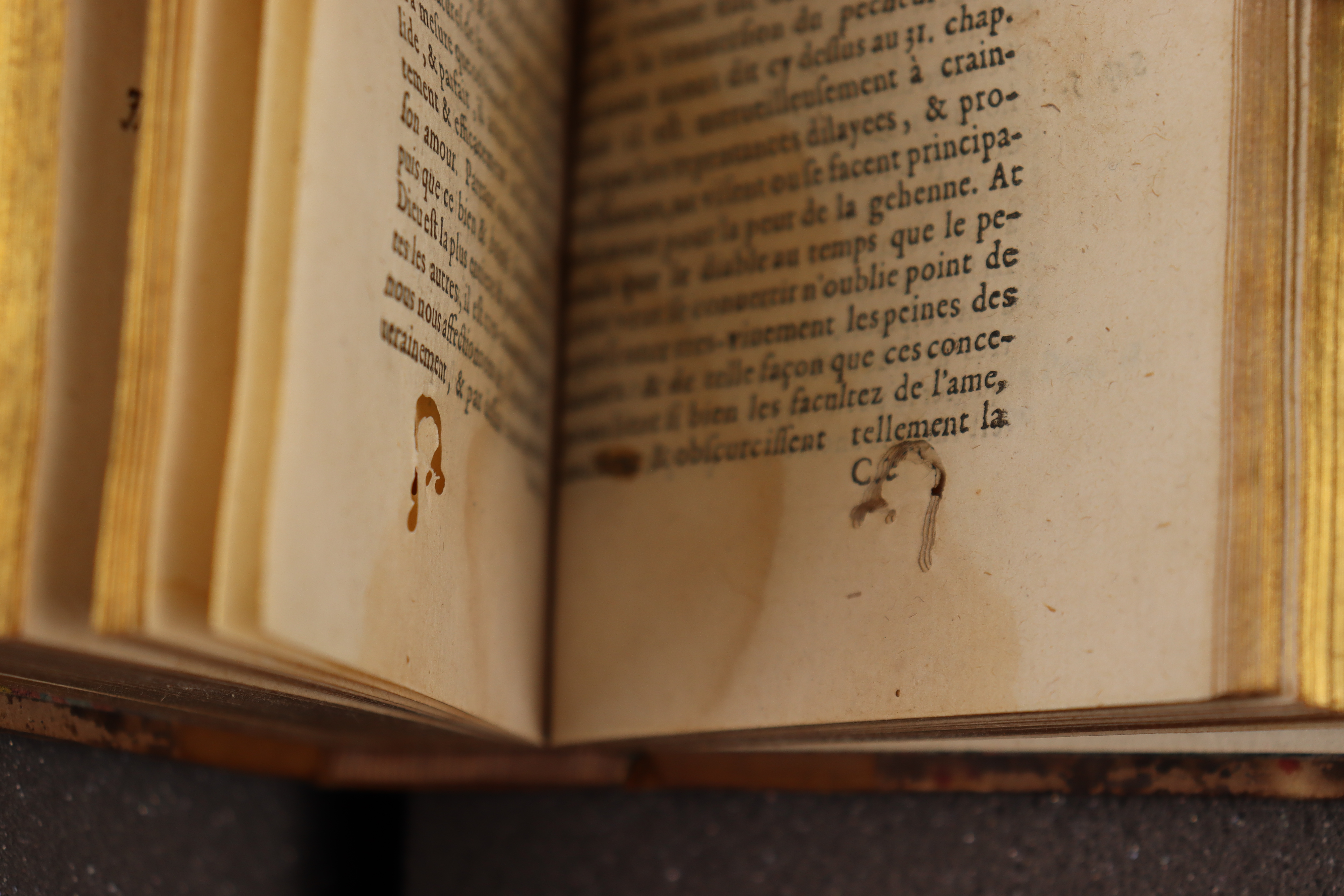

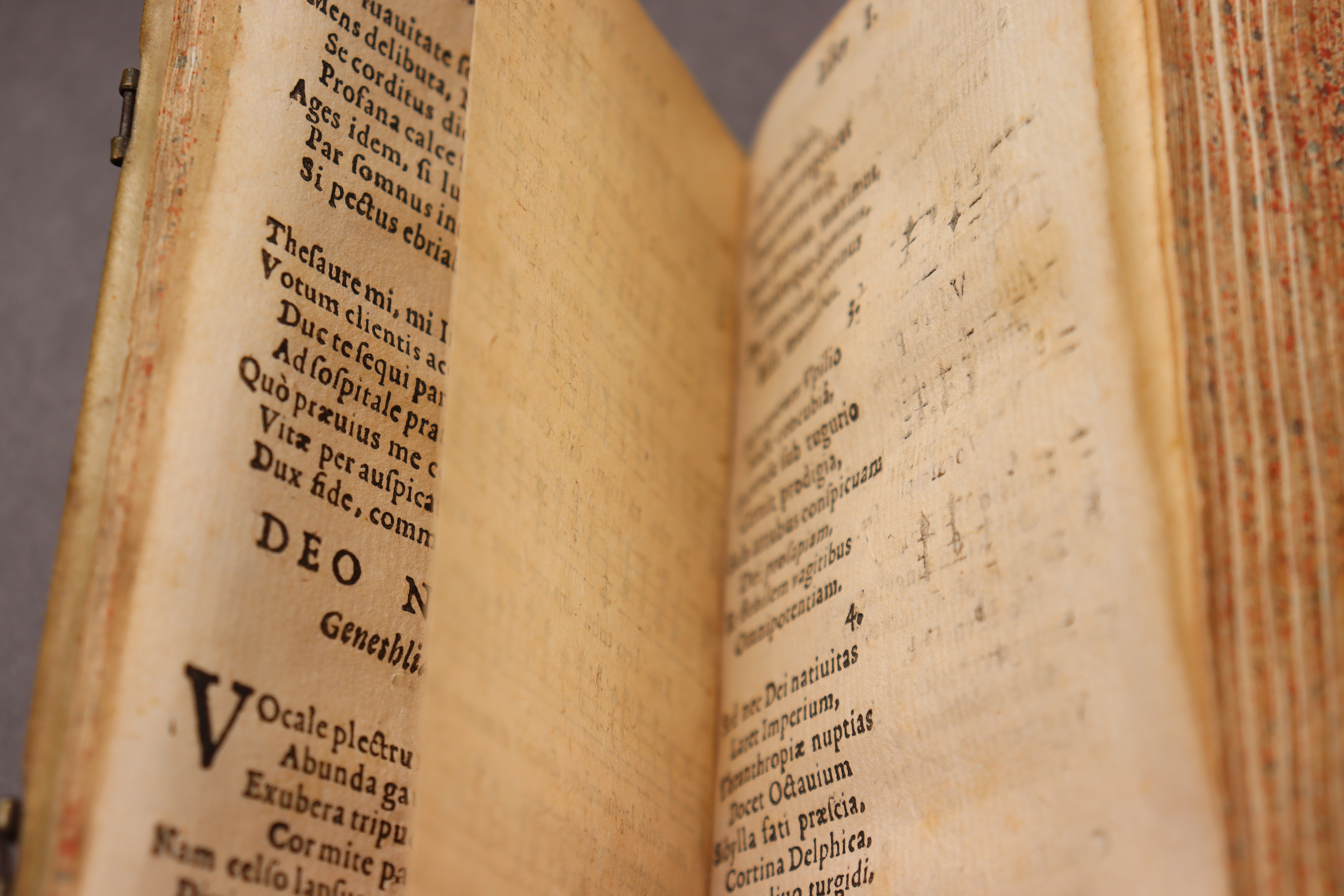
Bookworms are not the only hungry pest that threaten library collections. Rats and mice have also been known to enjoy nibbling on precious, and not so precious, books, often to shred them up to make nesting material (and make librarians cry). This may have been one rodent's plan for this unsuspecting book, but luckily, after a small taste of the binding, things did not get that far: perhaps its literary tastes did not extend to Latin poetry? Nevertheless, it did still manage to leave its mark on the foredge cover extension of the book, and if you look closely enough you can see the small, repeated semi-circle shapes made by the creature's teeth as it has eaten its way along. Where this damage now poses no threat to the item itself, it is unlikely we will look to repair it; the book will forever bear the marks of the hungry beast.
Anselmo, Giorgio. Georgij Anselmi Nepotis Epigrammaton libri septem. : Sosthyrides. Peplum Palladis. Æglogæ quattuor.. ([Venice] : Maphęus Pasinus impressit Venetijs, mense septembri. M. D. XXVIII. [1528])
Shelfmark: Sparrow E.419
Full bibliographic record
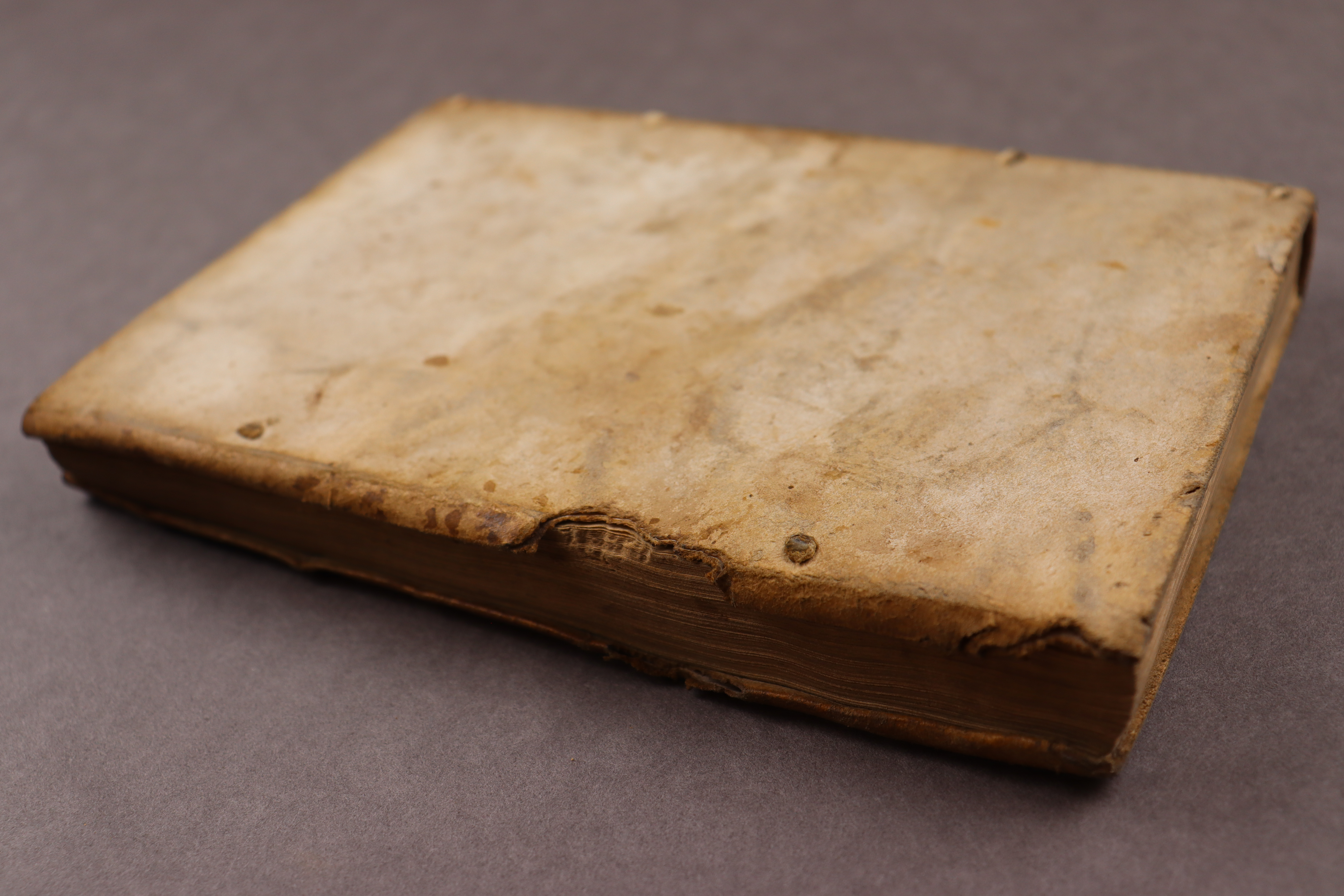
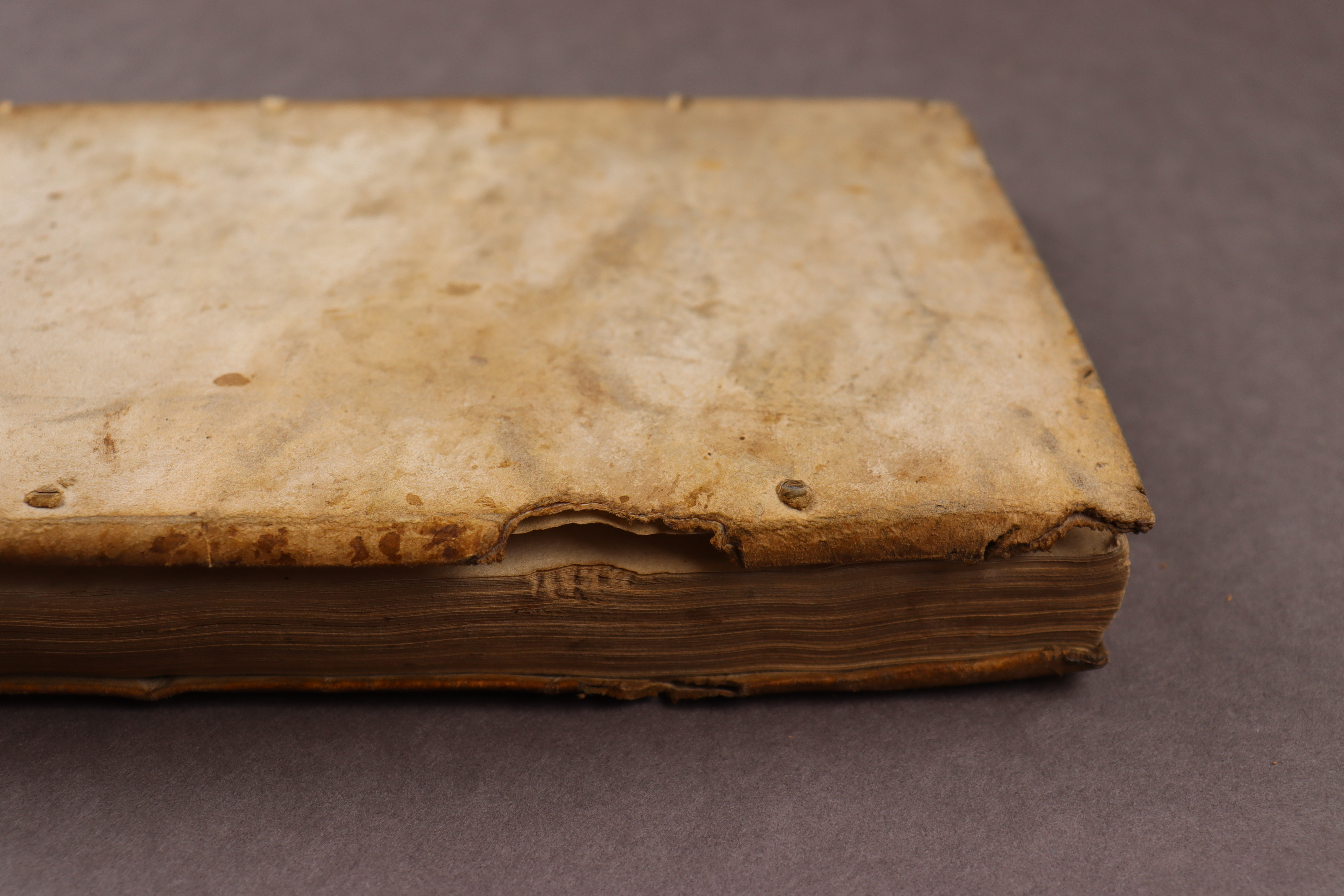
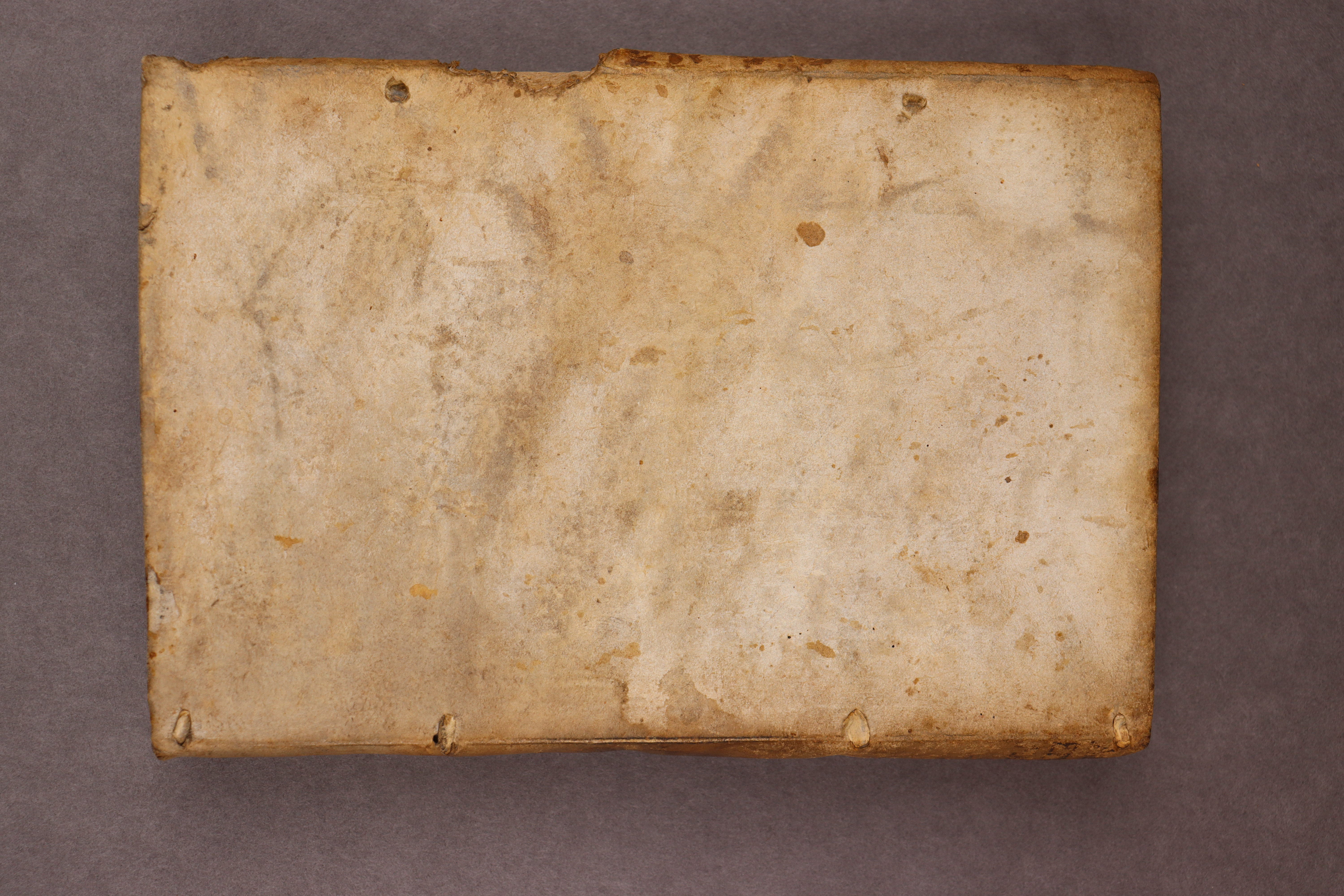
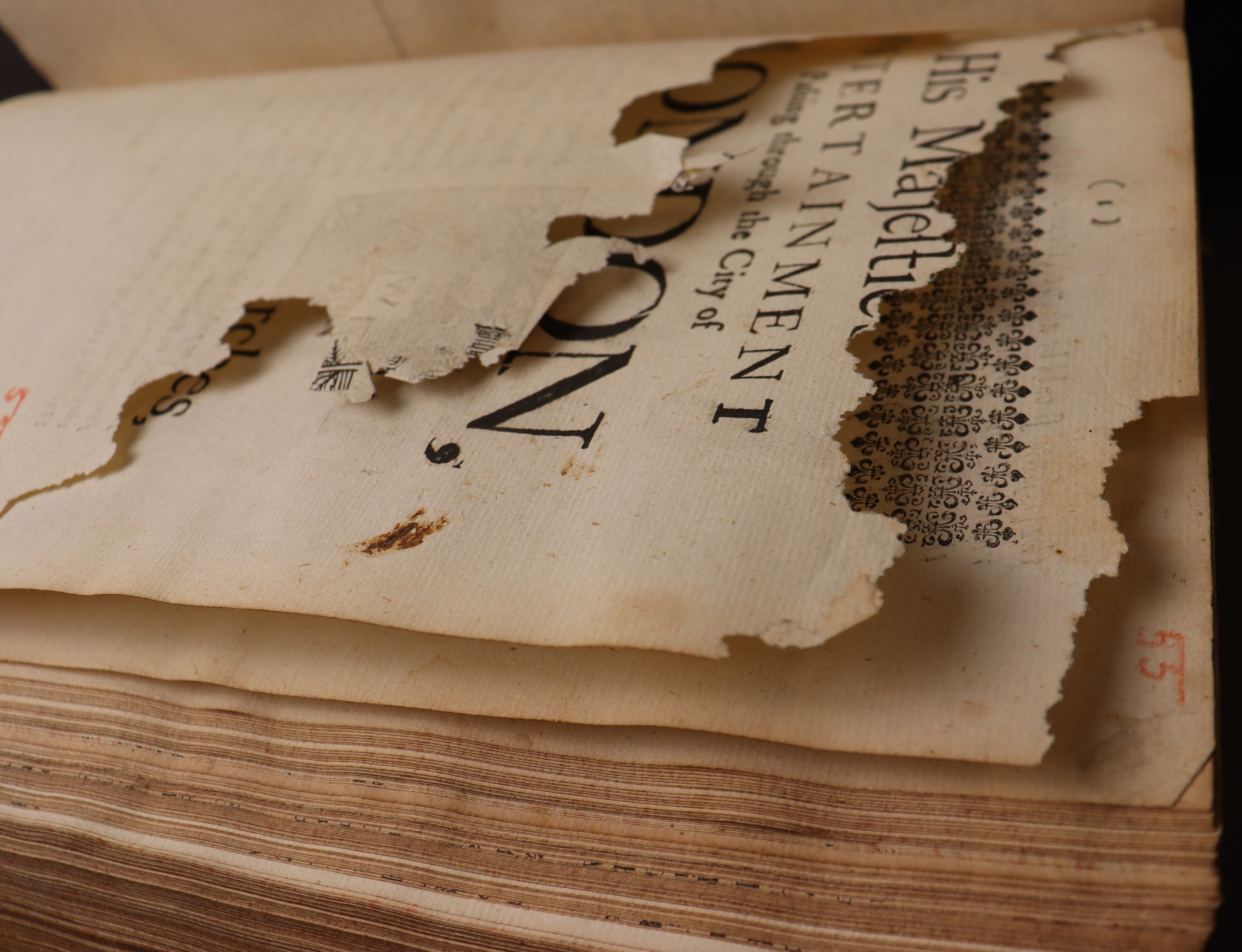
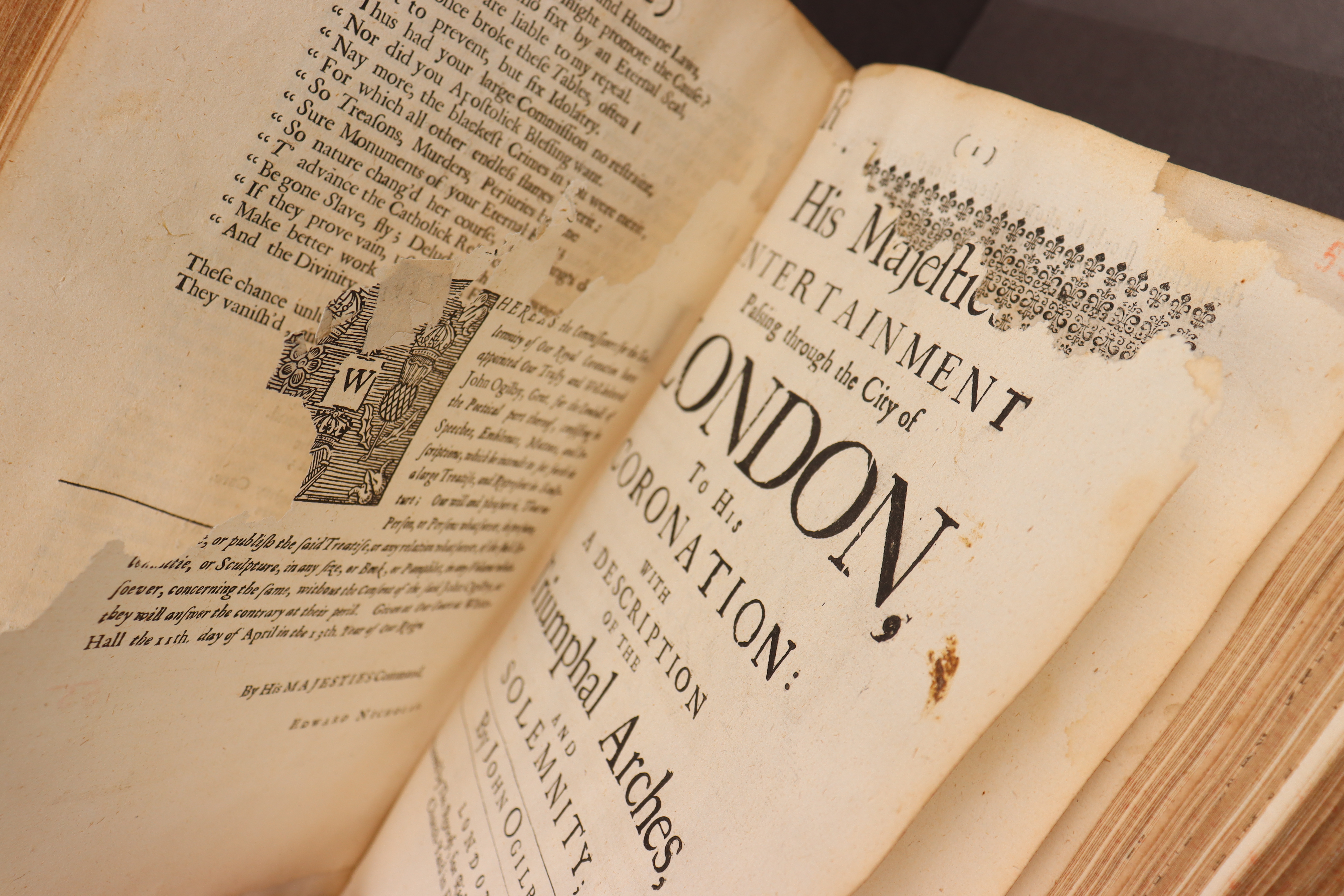
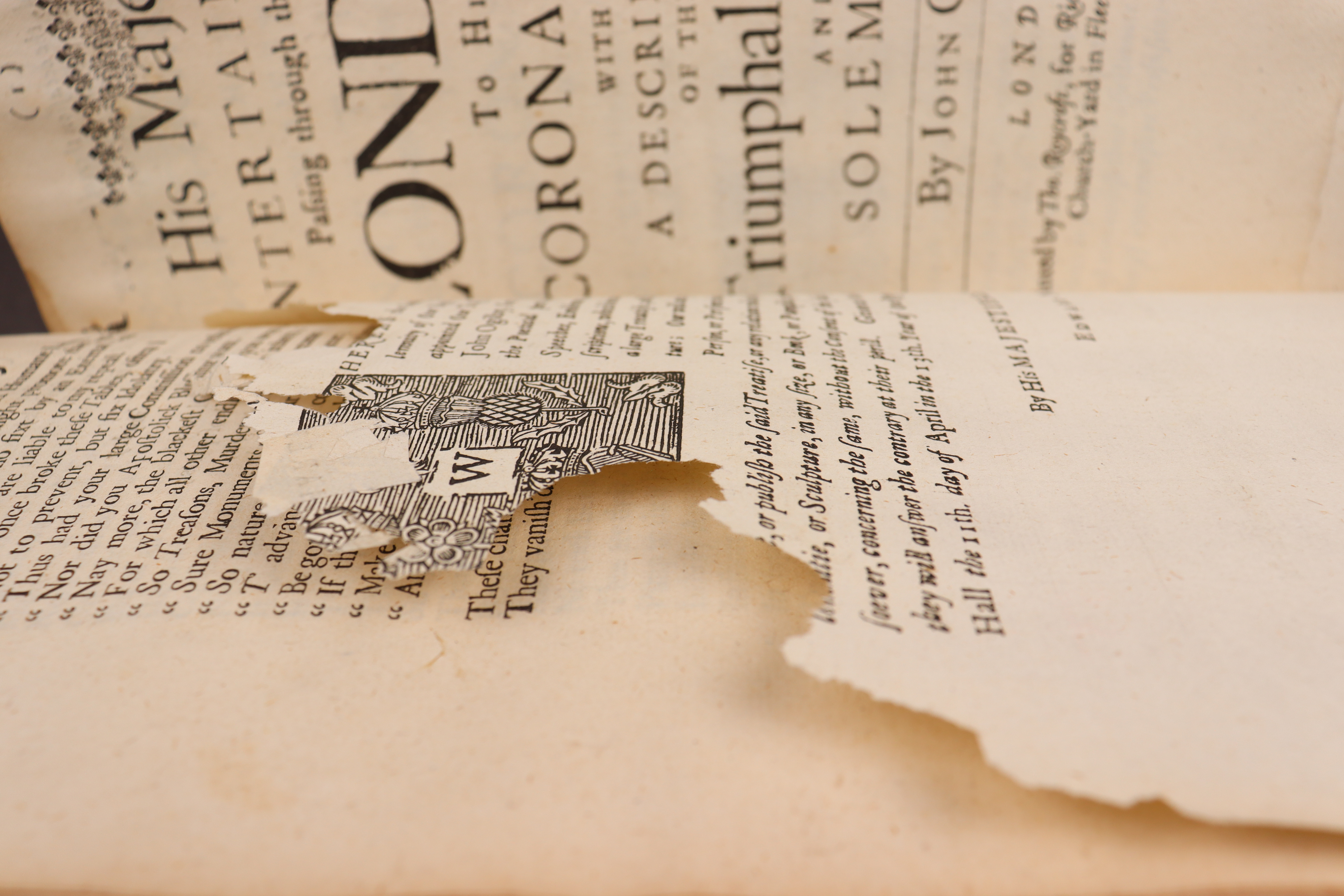
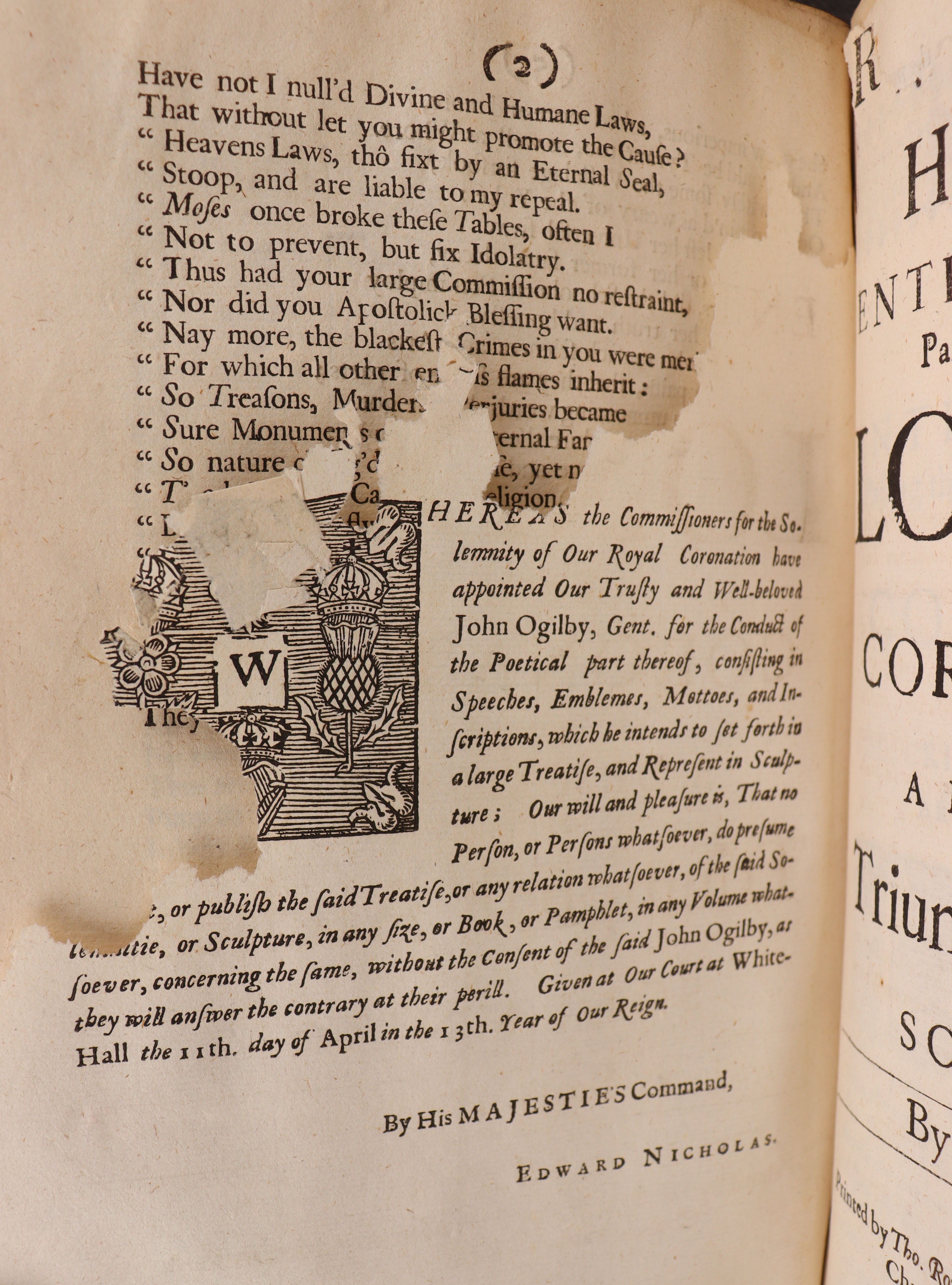
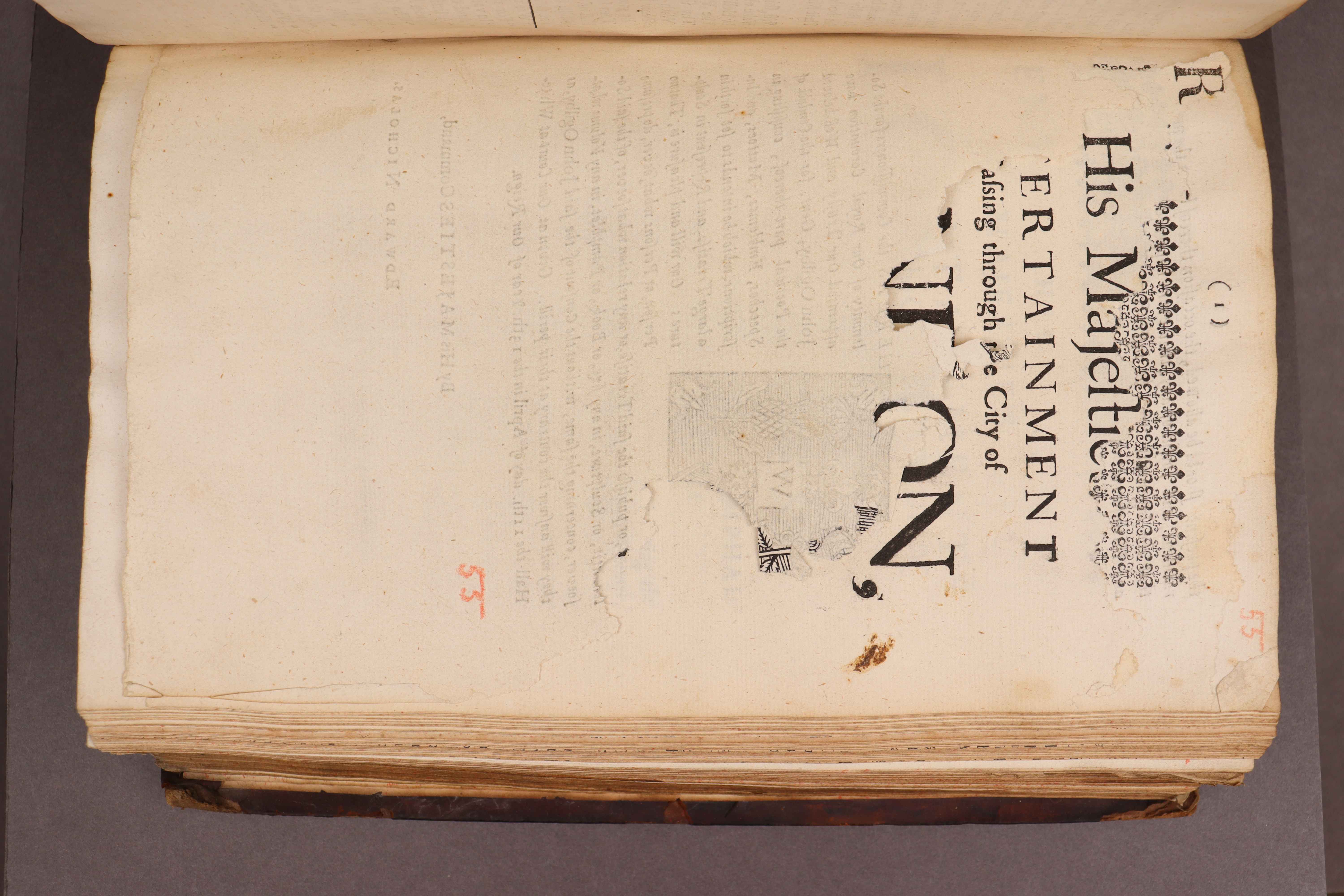
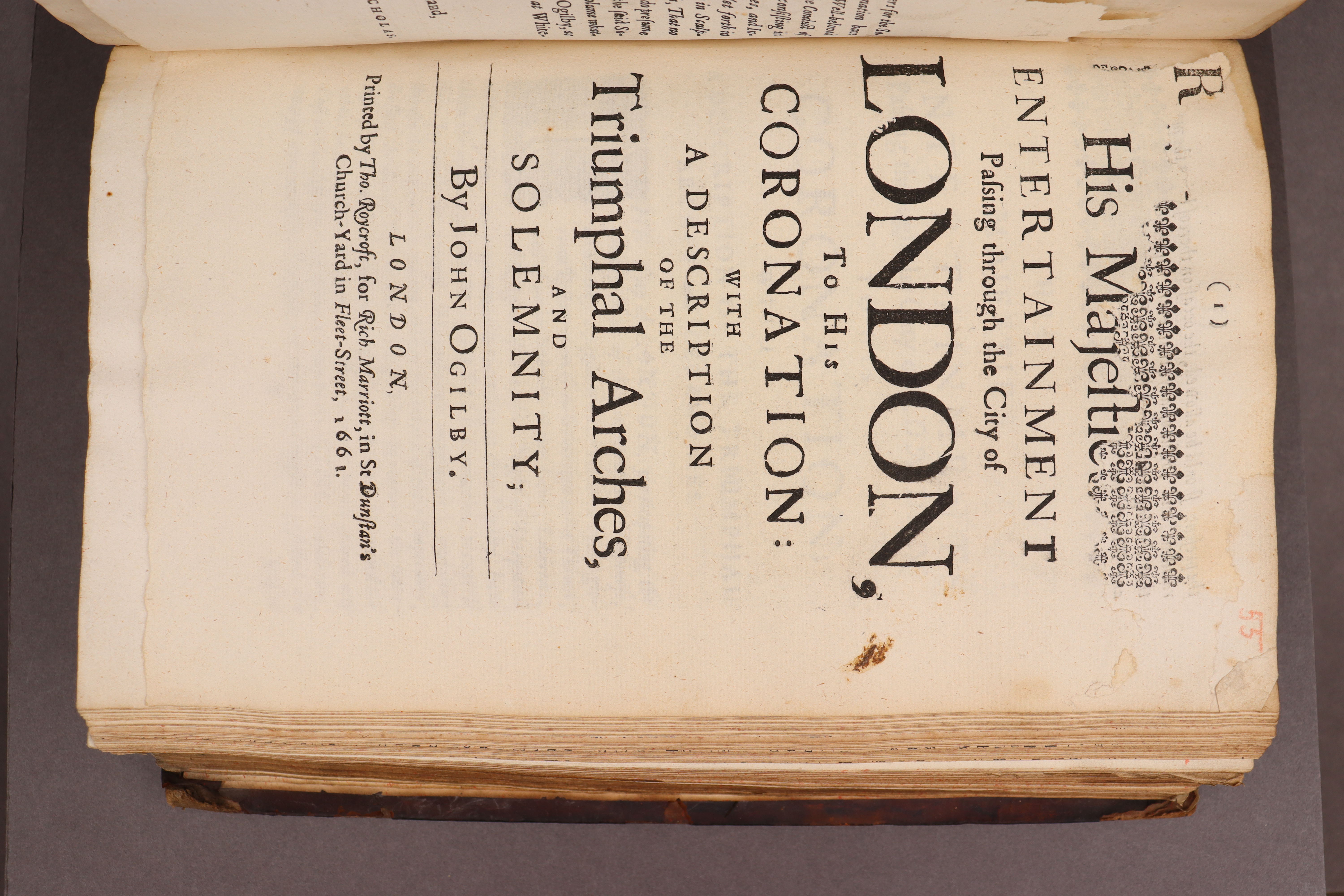
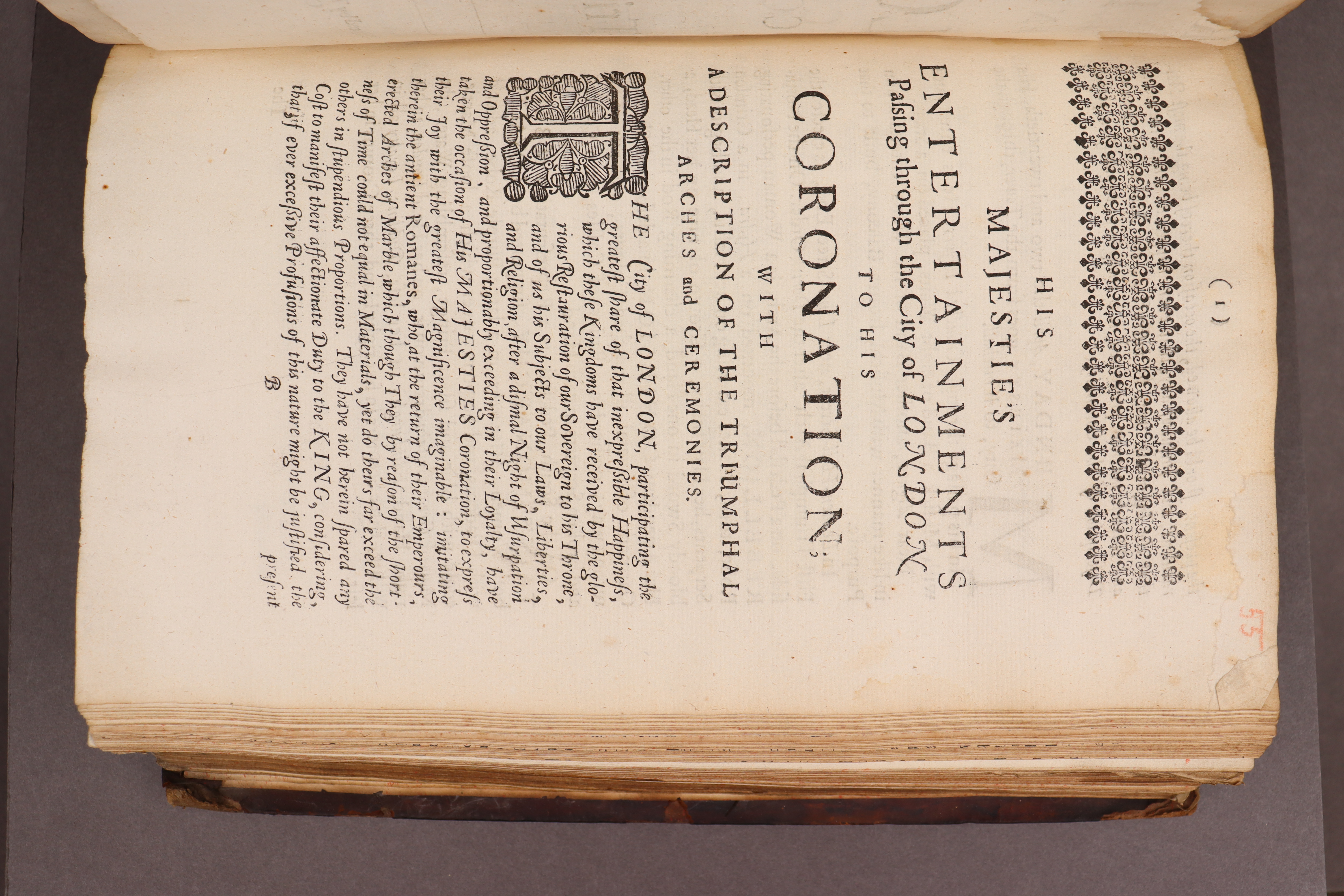
As you can see from the image of the title page of this pamphlet, one very destructive rodent was here! The fact that this damage has only affected the first few pages of this pamphlet and none of the other works around it suggests that it occurred before it was bound into this volume, and, although the amount of paper lost is clearly quite significant, the level of actual text lost is fortunately not too detrimental: most of the text remains intact and readable. Possibly this creature grew tired of eating words of celebrations, or indeed, realised a few pages in that it was risking lèse-majesté, and scurried away... Extra care must be taken when handling the damaged pages, since their structural integrity has been seriously compromised, and we do not want any further fragments to be lost.
Ogilby, John. The relation of His Majestie's entertainment passing through the city of London, to his coronation: : with a description of the triumphal arches, and solemnity. (London, : Printed by Tho. Roycroft, for Rich. Marriott, in St Dunstan's Church-Yard in Fleet-Street. 1661)
Shelfmark: BW.2.1(55)
Full bibliographic record
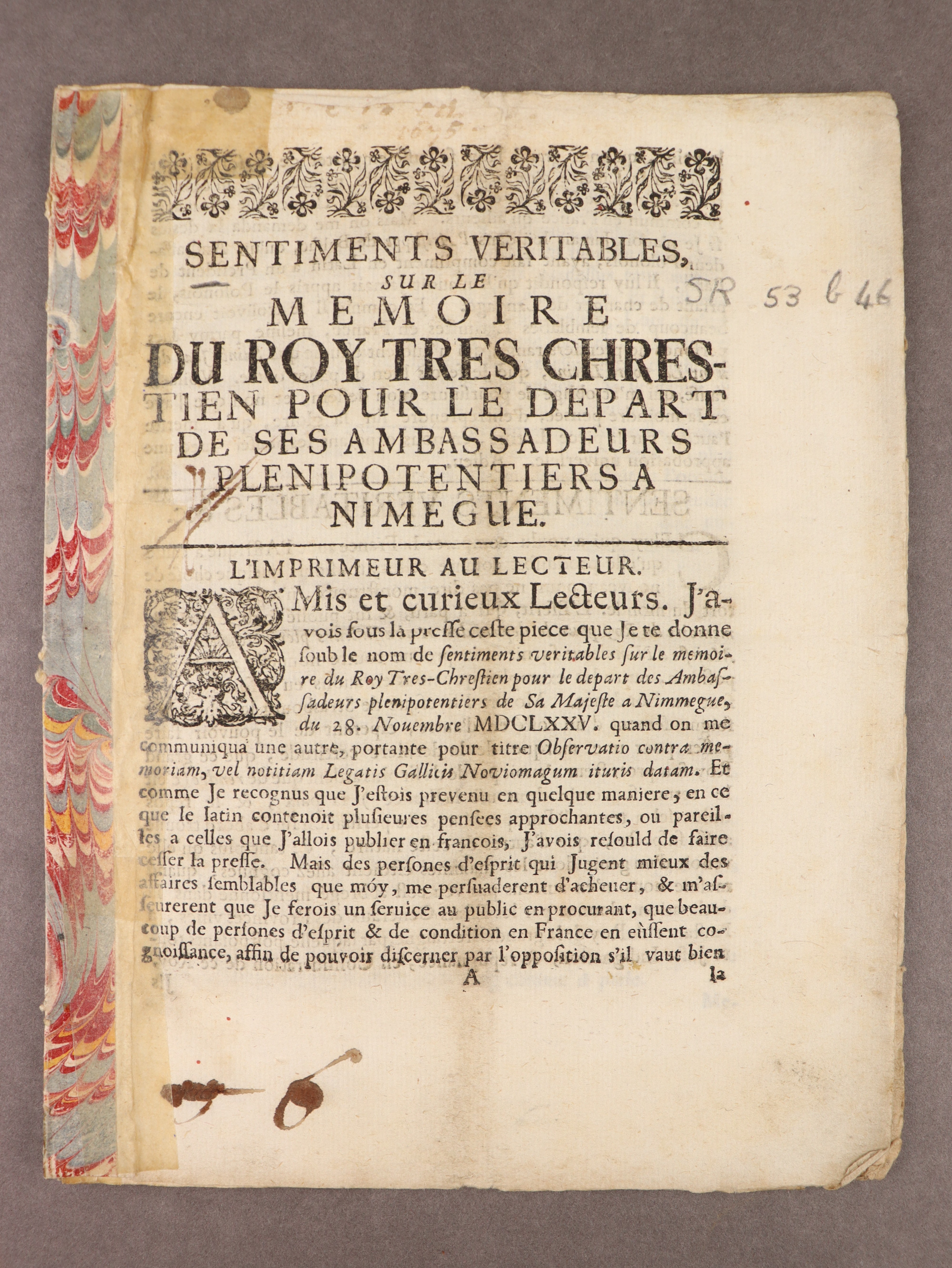
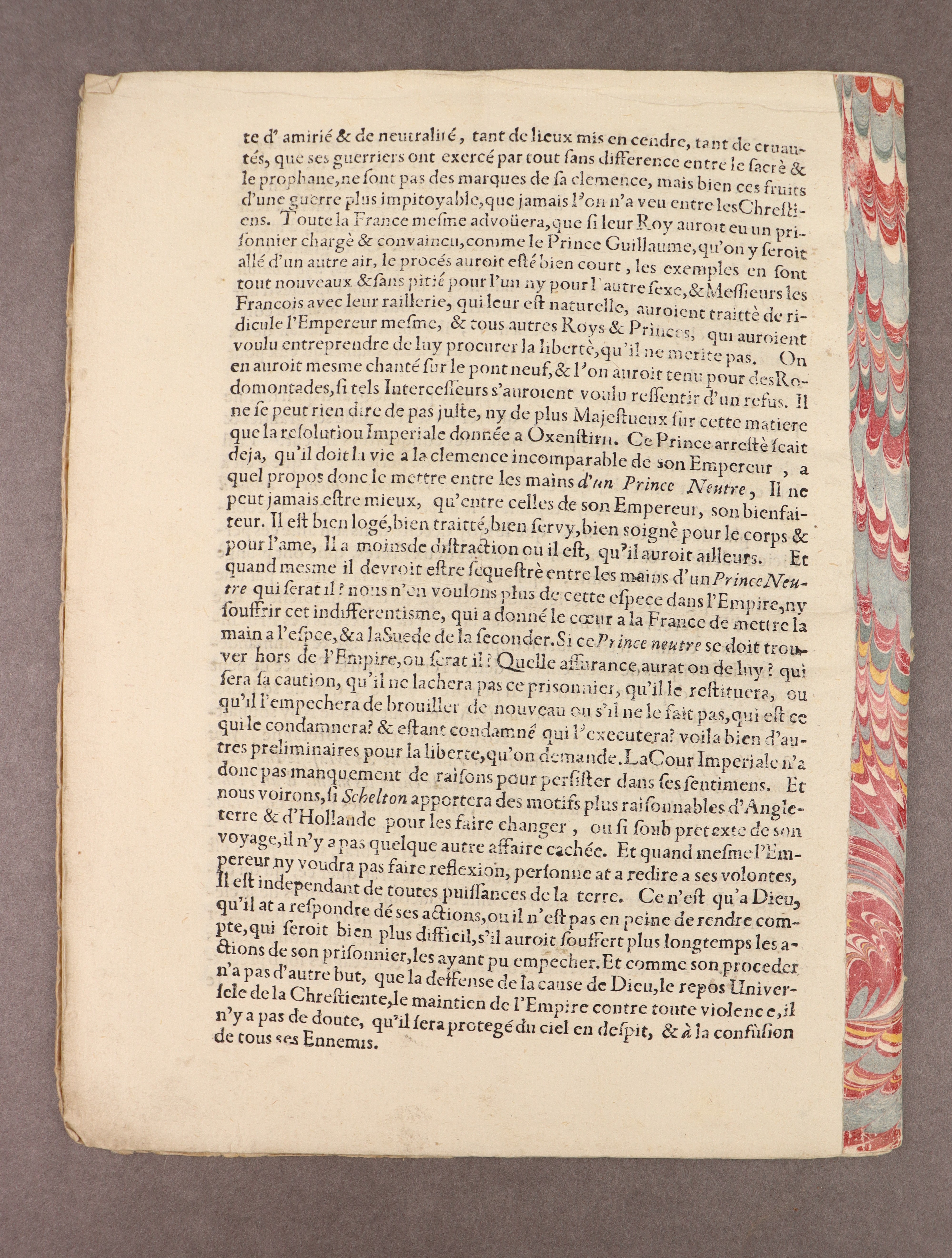
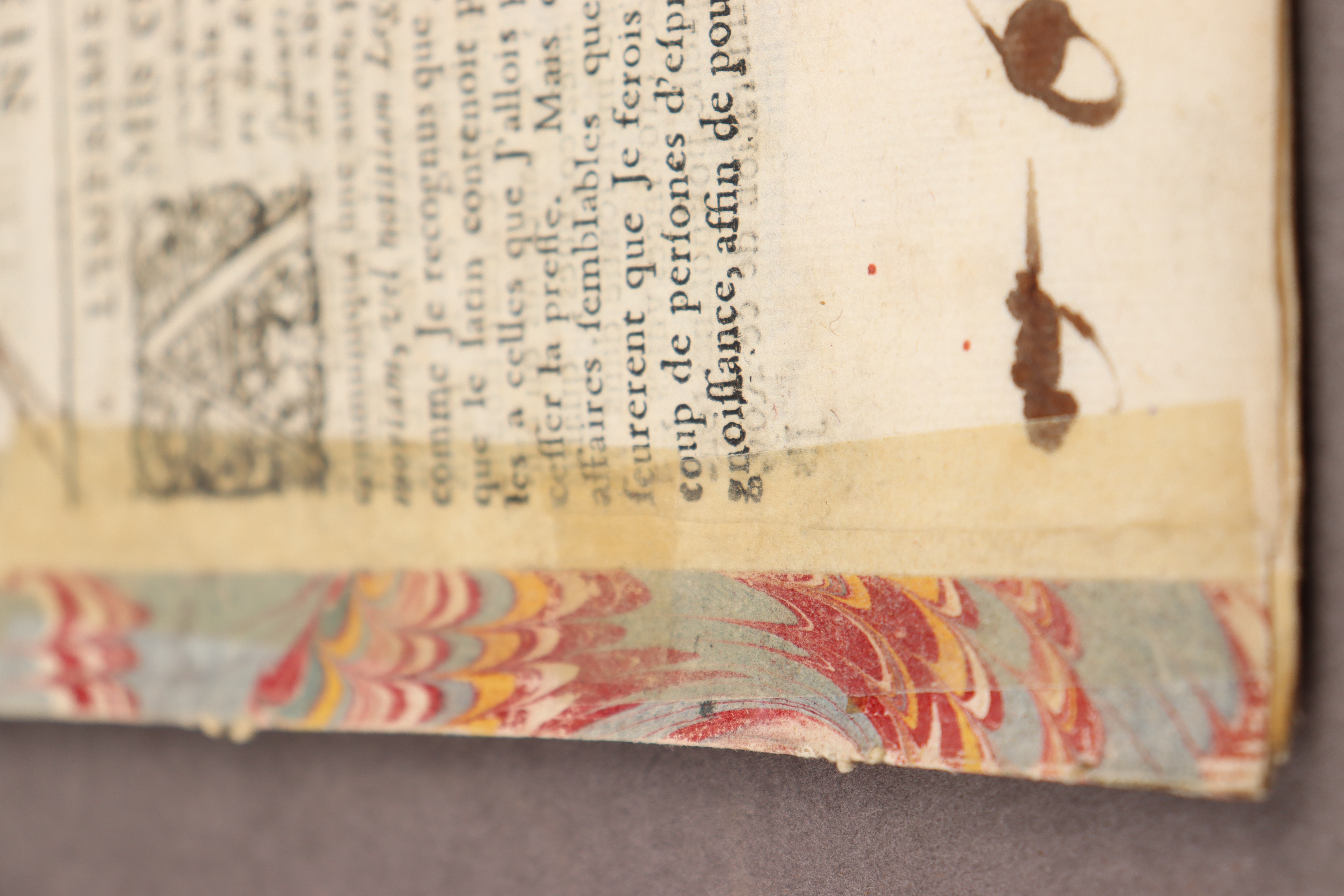
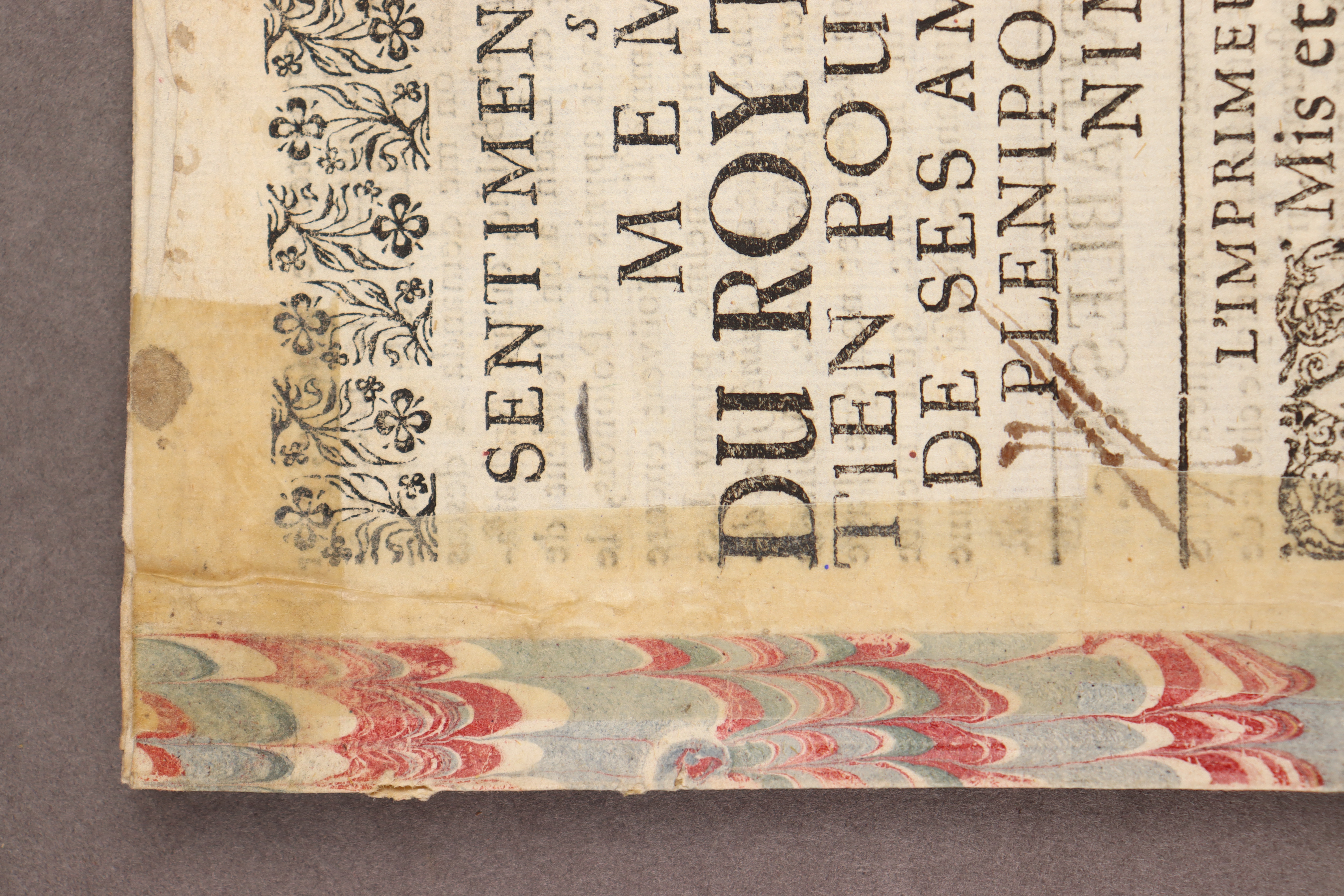
Unlike the previous items we have seen in this exhibition, where varying amounts of money have been spent on getting books bound professionally, here a former owner has taken a more DIY approach. A strip of marbled paper has been pasted over the 'spine' of this pamphlet, which they have then reinforced with glassine tape. This was an early form of 'gummed repair tape' (i.e. tape with an adhesive that requires moistening to make it tacky), made using glassine, a glossy, tan, transparent paper. Early forms of this tape became popular for repairs in the 19th century as the transparent tape enabled repairs to be made with minimal visibility. However, glassine tape is a perfect example of the importance of not using novelty materials and irreversible processes in book repairs and conservation. Unbeknownst to the well-meaning owner, the adhesive used in the tape at that time was acidic, which has been a major factor in the chemical deterioration of the early modern paper underneath. Over time, the acid of the adhesive triggers a reaction in the paper, and causes it to turn brown and, in the worst cases, brittle. The damage is irreversible, and it is a problem that libraries frequently come across in their collections. With regards to this particular example, it is now our responsibility to monitor the damage the glassine tape has already caused, and possibly intervene should the paper deteriorate any further.
Sentiments veritables, sur le memoire du Roy tres chrestien pour le depart de ses ambassadeurs plenipotentiers a Nimegue.. ([France?] : [s.n.], [1675-1678?])
Shelfmark: 6:SR.53.b.46[Pamph.] (15)
Full bibliographic record
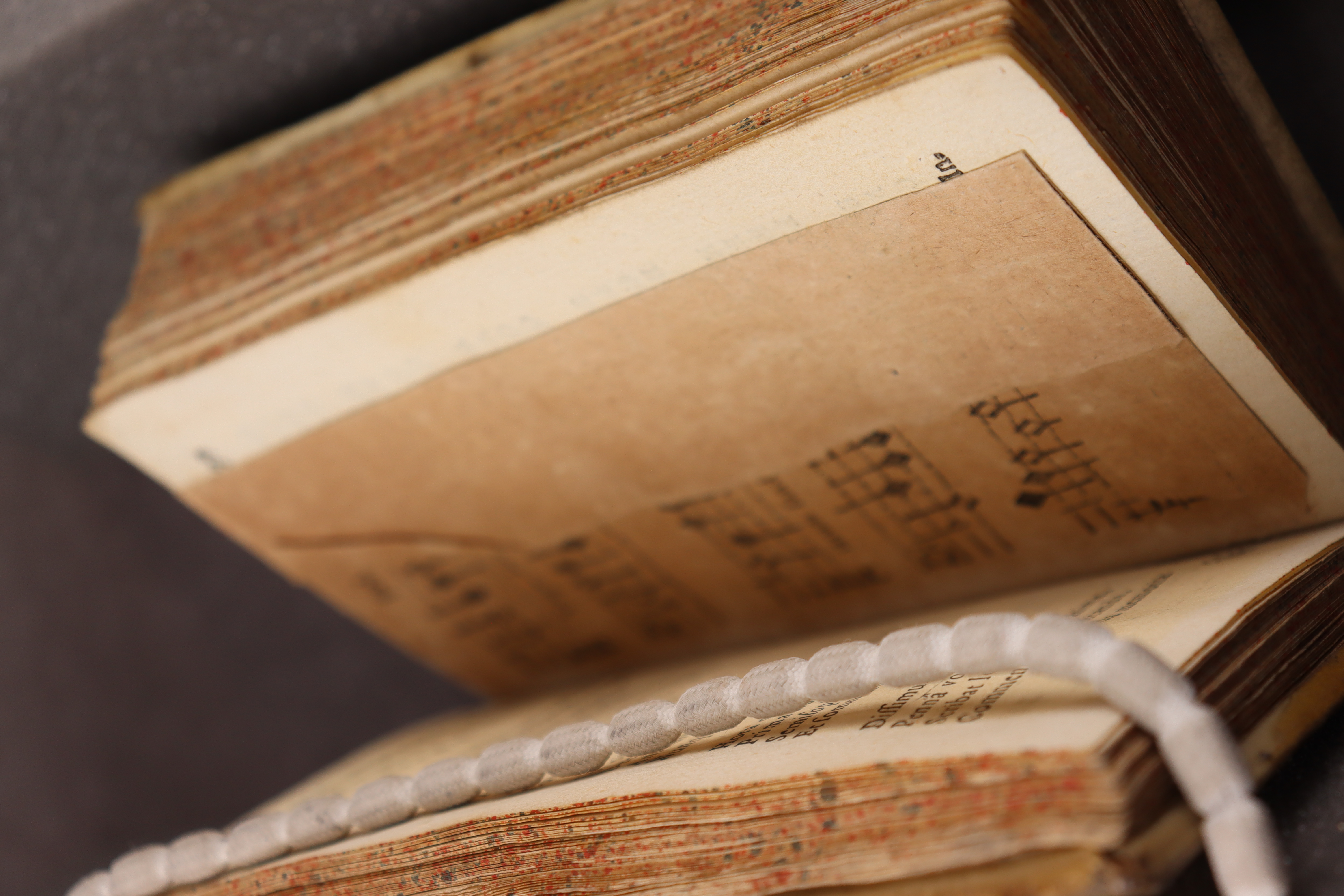
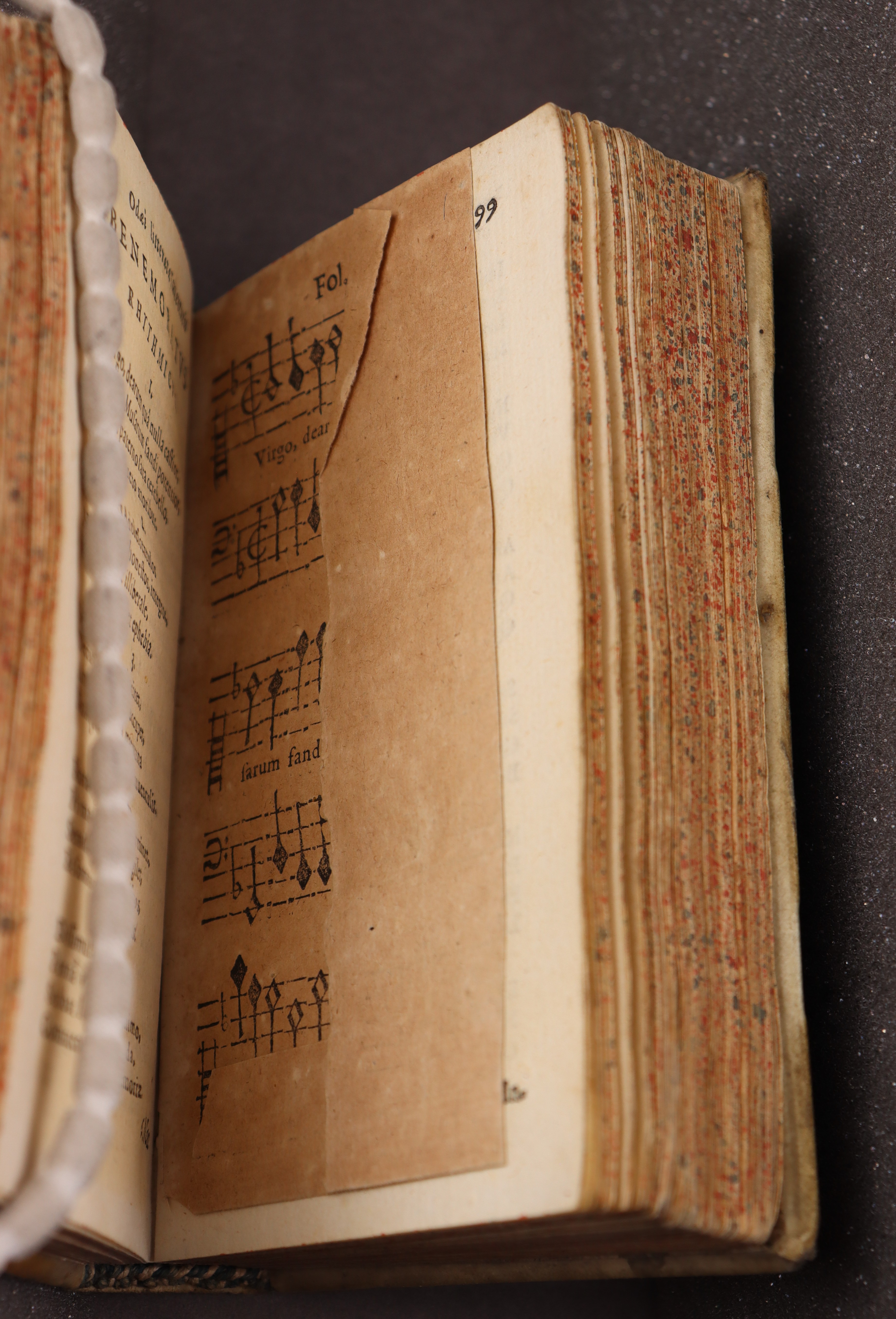
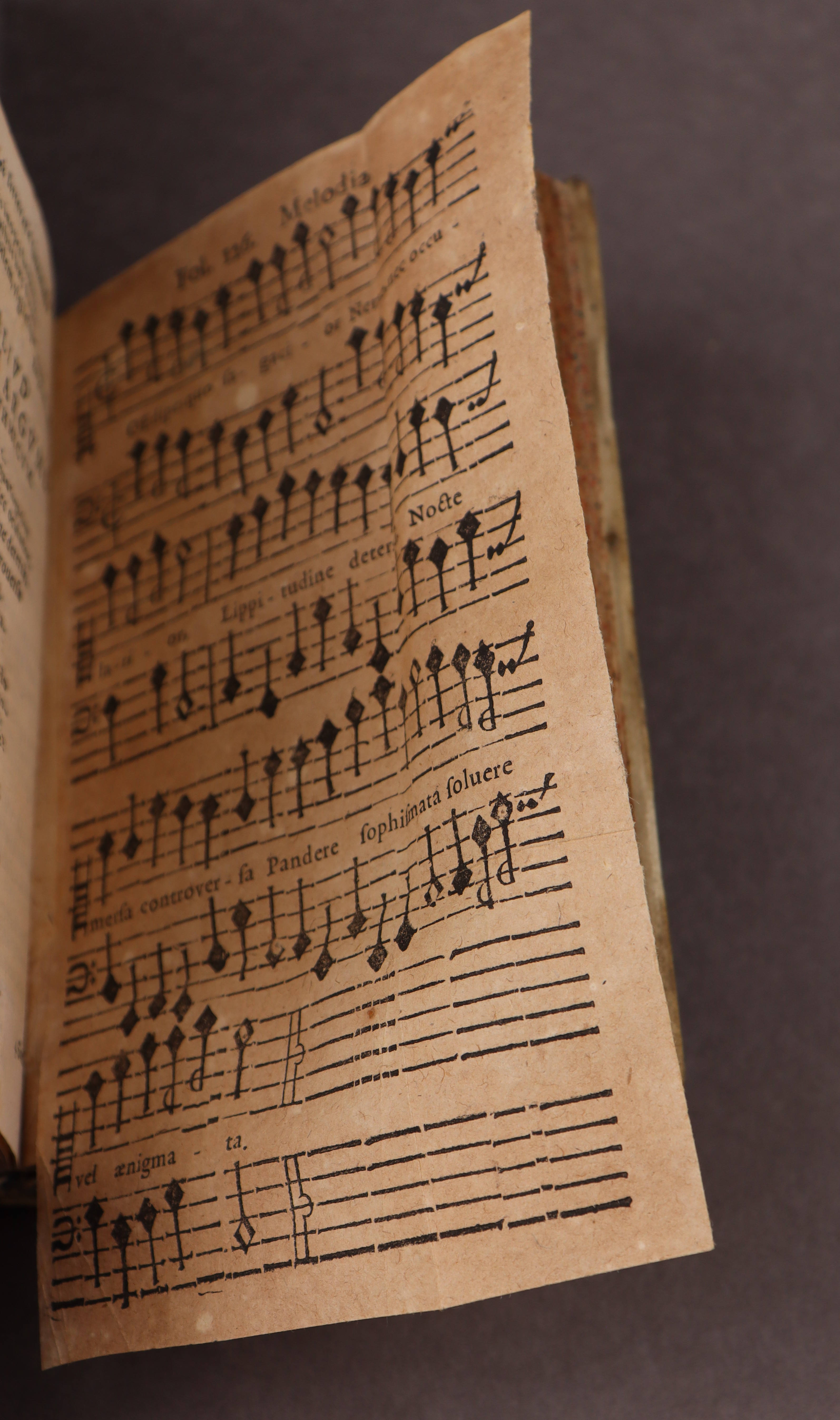
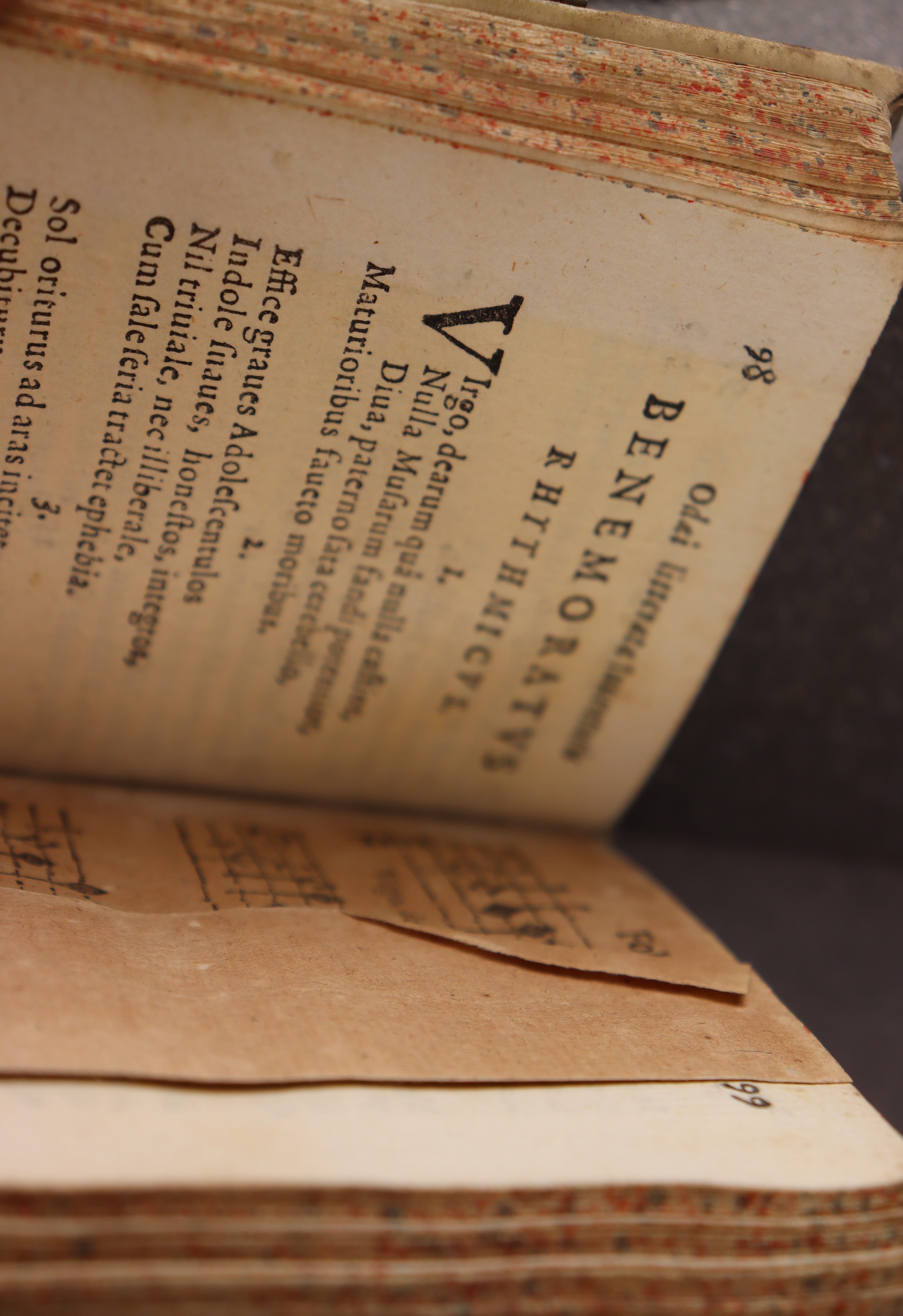
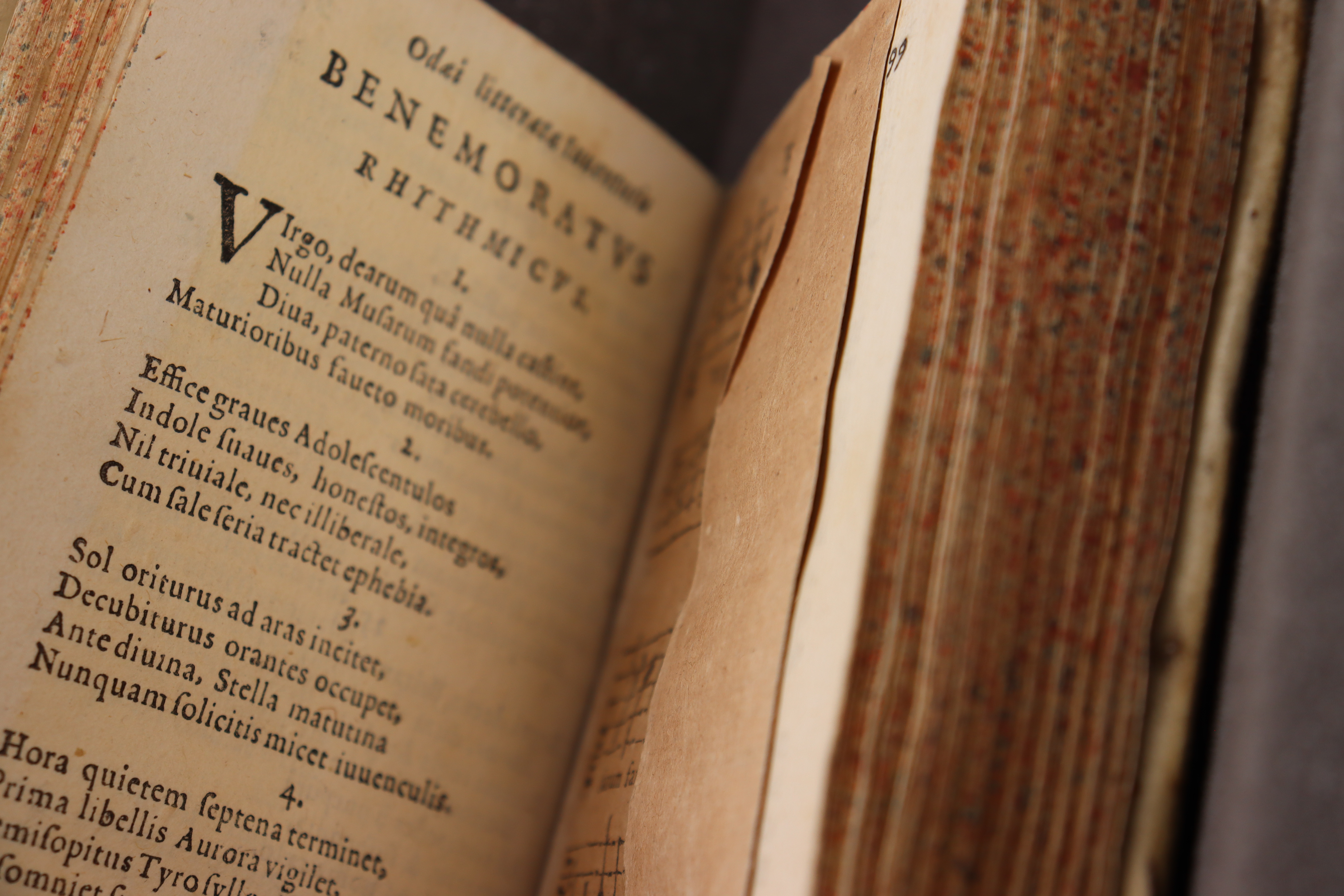
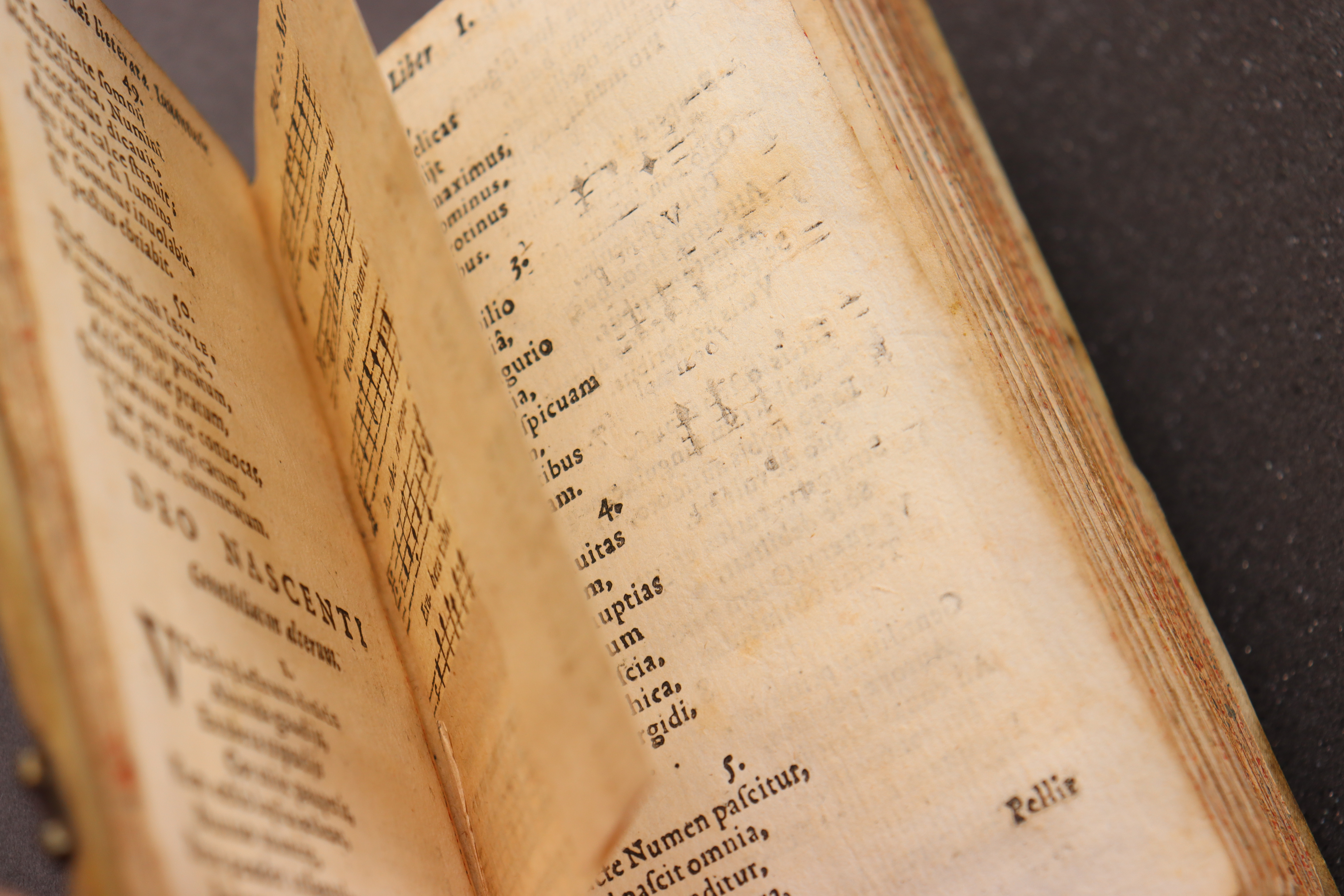
Not all damage is intentional, and not all paper is created equal. This rings even truer for hand-made paper, and many factors can impact the quality of the final product. Paper was originally made from scraps of cloth, not wood-pulp or cellulose (which only became predominant in Europe from the middle of the 19th century onwards), with cotton, linen and hemp rags delivering vastly different results. The cleanliness of the water utilised to soak the rags or wash them, and the length of the fermentation and beating stages could also affect the quality of the paper. Here you can see a clear example of this truth. As mentioned in Case 2, plates were often printed separately from the body of the text, and inserted where needed at the binding stage. They were frequently used for illustrations, but could also be used for music, as seen here. Evidently the paper used for these plates was of noticeably lower quality than the one used for the rest of the text: it is both thinner, and, because of its intrinsic acidity, browner. With time, the acidity of the plates has been damaging the white page of the text, and as the plate is usually folded, you can clearly see the areas affected and not affected by the browning.
Offsetting refers to the accidental transfer of ink from a page to an adjacent one. This happened when the newly printed sheets were piled on top of each other with the ink still wet, or, in the few extreme cases in which the book or pamphlet needed to be circulated as fast as possible, when the book was bound as soon as the sheets were off the press and the ink was not yet completely dry. In these images you can see both kinds of offsetting: on the plate itself you can see music and words from another plate (we have not yet identified whether it is the same or a different one); more curiously, you can see some music and words on the page behind the plate, suggesting that another one was leant face down against the text while still drying. It is hard to know exactly what happened, but whatever did, we can safely say that the workshop was not having a good day!
Mezler, Thomas. Odæum litteratæ iuuentutis in sex libros tributum. (Friburgi Brisgoiæ : Ex typographia Theodori Meyeri., M. DC. LI. [1651])
Shelfmark: Sparrow E.611
Full bibliographic record
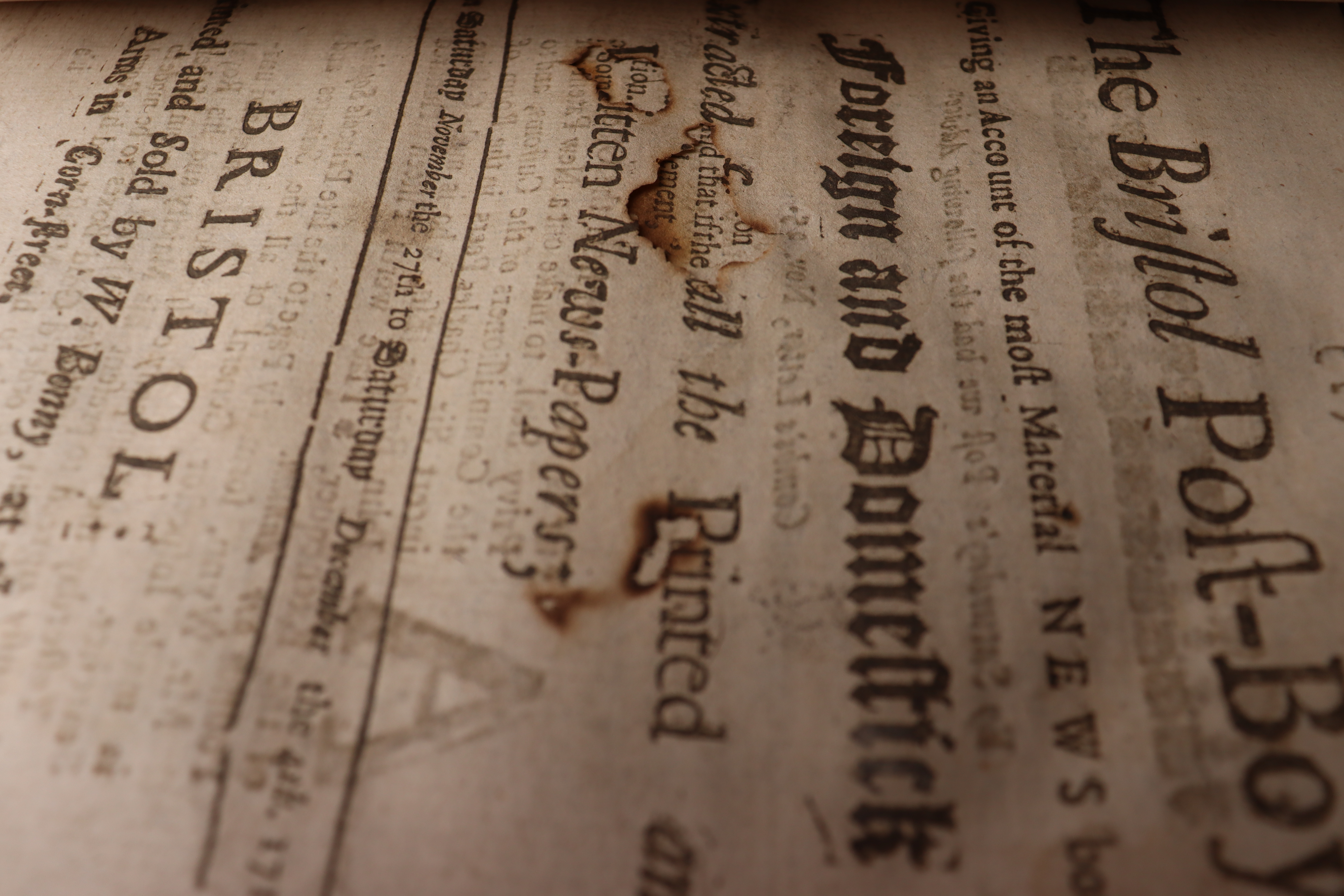
The English newspaper printing industry first developed in and around London, where the majority of national and international news concentrated, and where there was the most interest in acquiring information. From there, it trickled through the rest of England. Soon, however, increasing competition in the printing industry in the capital saw trained printers try their fortunes in provincial towns, following the lift of the ban on printing presses there (the Government exercising a rather strict control on publications until at least 1695). The first provincial newspapers were simple two-sheet publications, chiefly reproducing intelligence from London, with, increasingly, the addition of local notices and advertisements. One such publication was Bristol Post-Boy, established by William Bonney. The earliest surviving issue is number 91, dated Saturday 5th of August 1704, held at Bristol Public Library together with 3 other issues (281, 287, and 340). At All Souls Library, we hold 68 issues covering the period from March 1712 (Lady Day dating; March 1713 in the modern calendar) to December 1715. Counting back, if we assume Bonney published it regularly and weekly, the first issue would fall on November 1702. However, comparing the publication dates of the issues we have with the calendar, we see that the Bristol Post Boy was not actually all that regular: at times there were two issues in a week, and sometimes a week was skipped. The difficulty of establishing the date of the first issue, and subsequently whether this is the oldest English provincial newspaper, is therefore evident. This problem is also faced by the other contender for the position, the Norwich Post, which calculates its first issue back from the earliest known copy, dated 1708, to 1701. Aside from the 4 issues held in Bristol and our 68 issues, there are currently no other known copies surviving of this very early newspaper, making this volume an important source of knowledge about life and commerce in Bristol in the early 18th century.
Another curiosity: this volume also contains three coeval issues of the Bristol Post-boy's main competitor, and likely cause of its demise: Sam. Farley's Bristol post man: or, Weekly intelligence, from Holland, France, Spain, &c. with general occurrences, foreign and domestick. Evidently our early readers were not too faithful to their source of news.
The Bristol post-boy, : giving an account of the most material news both foreign and domestick.. (Bristol : Printed and sold by W. Bonny in Corn-Street, [1704?-1715?])
Shelfmark: XX.6.16(1)
Full bibliographic record
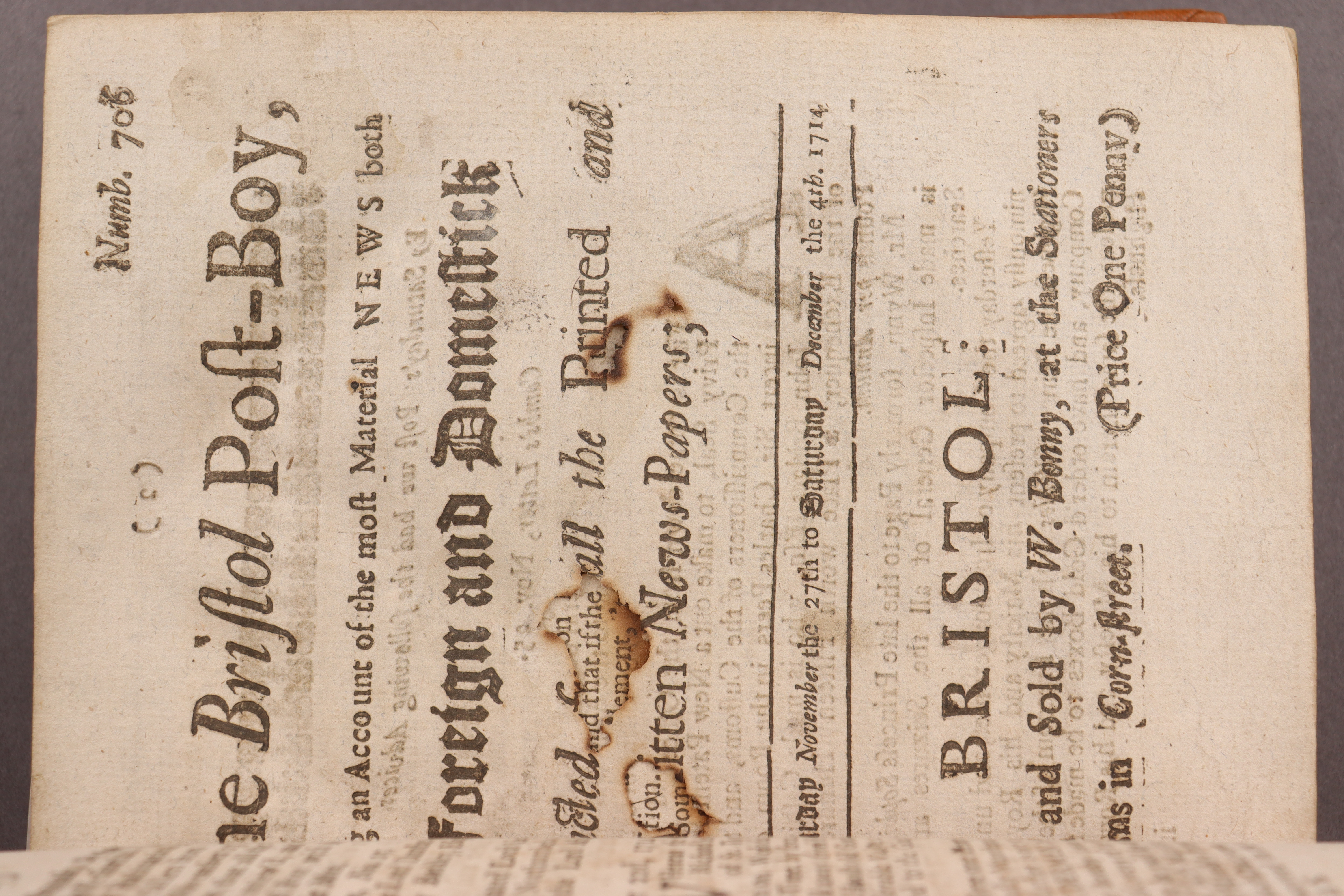
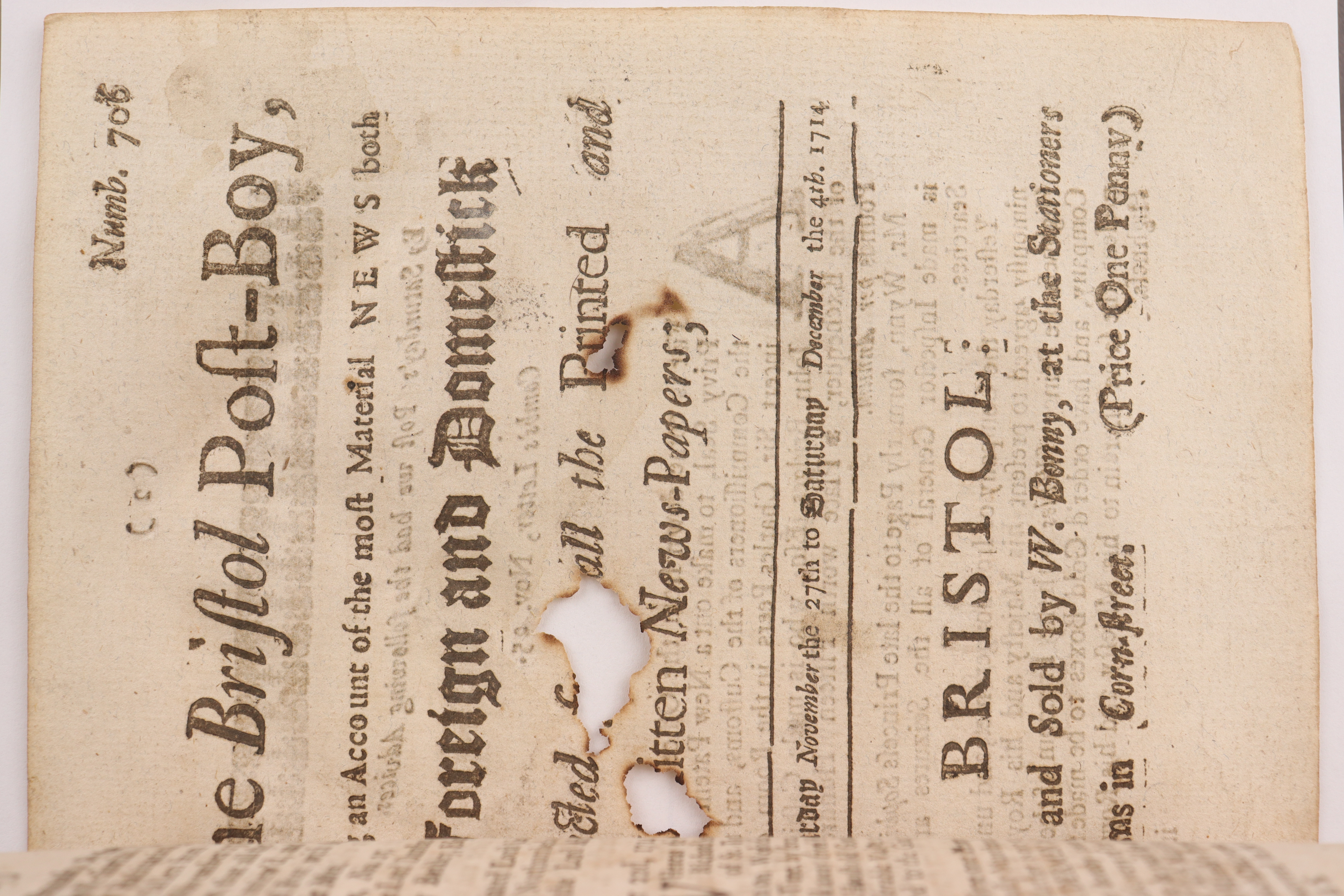
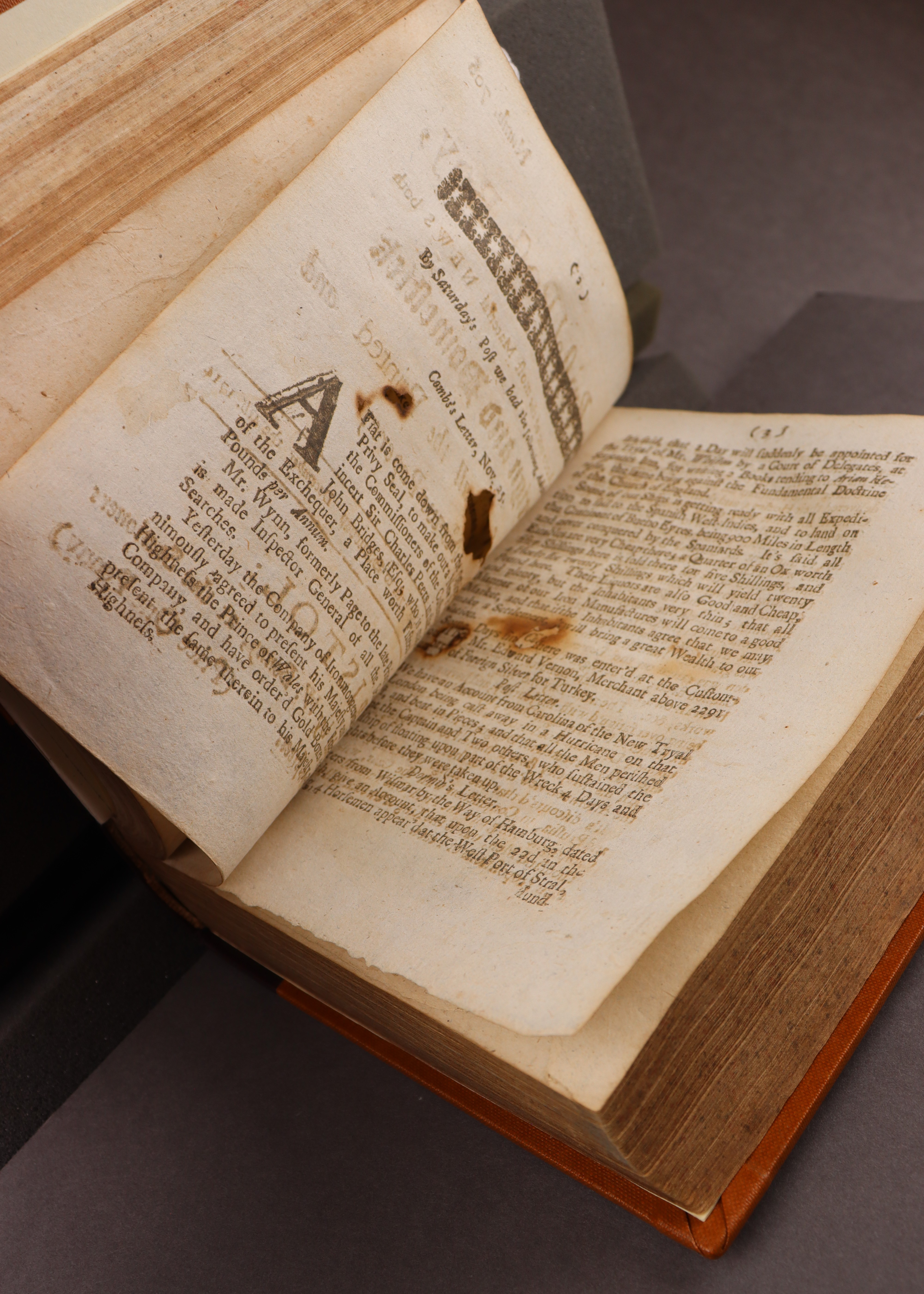
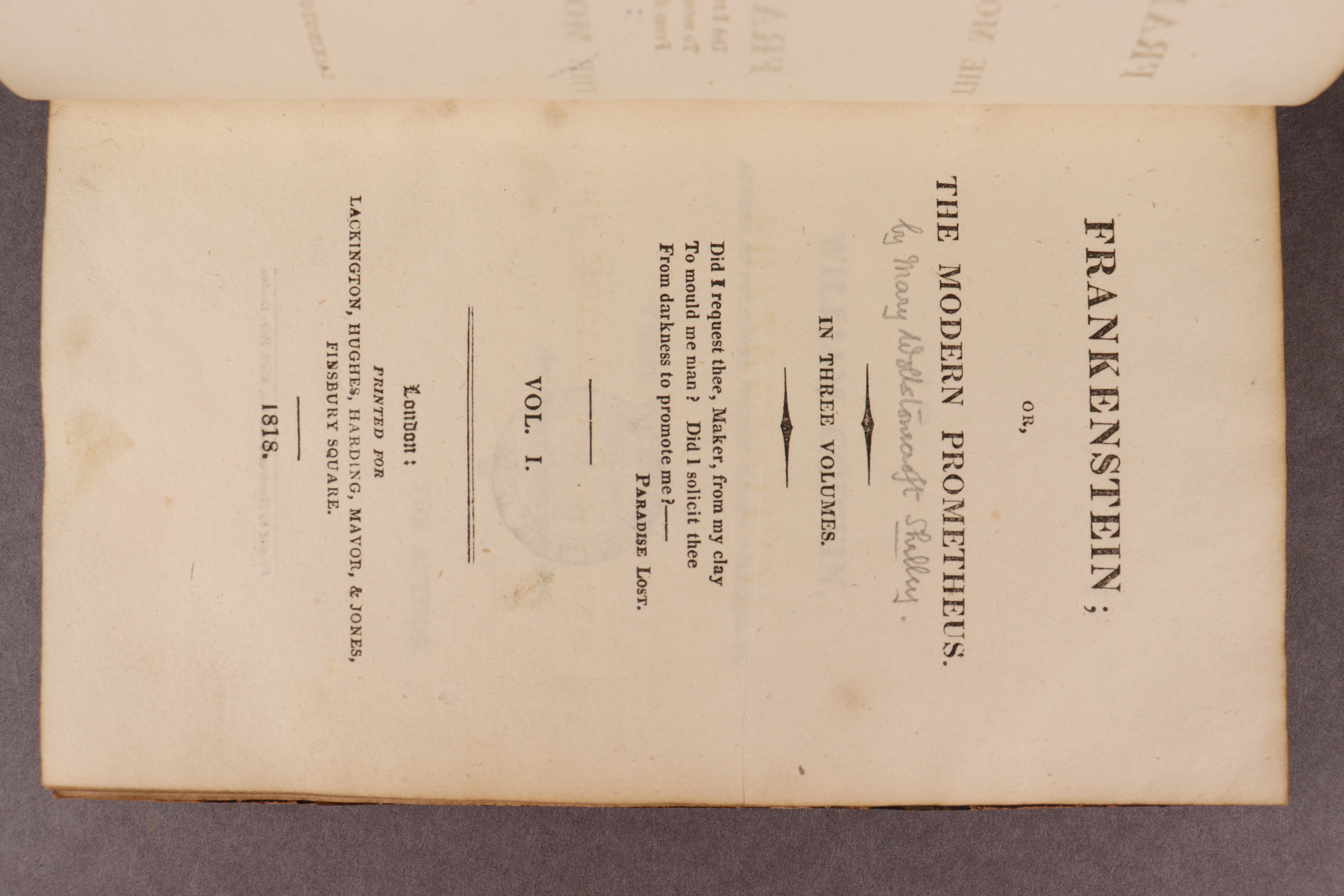
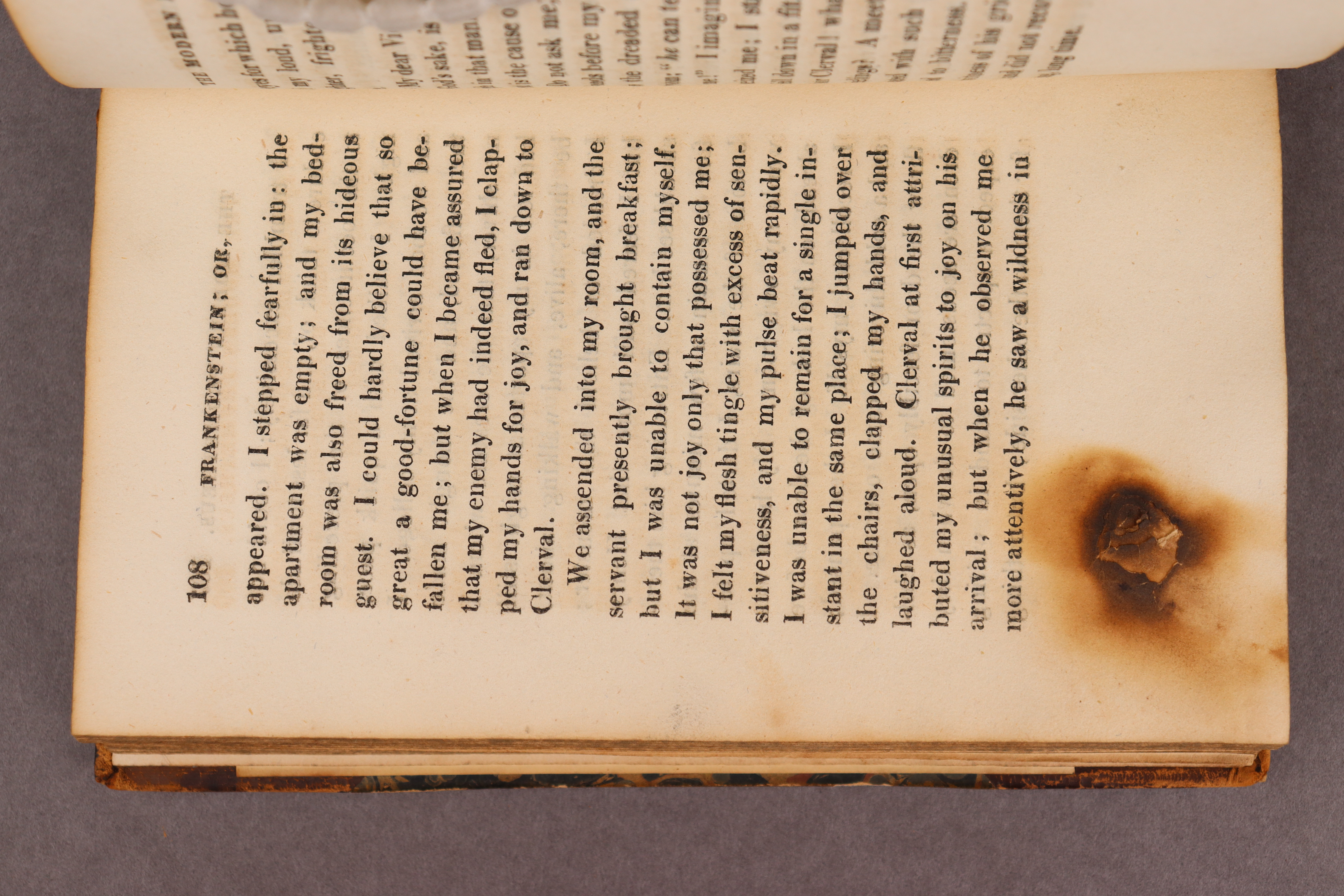
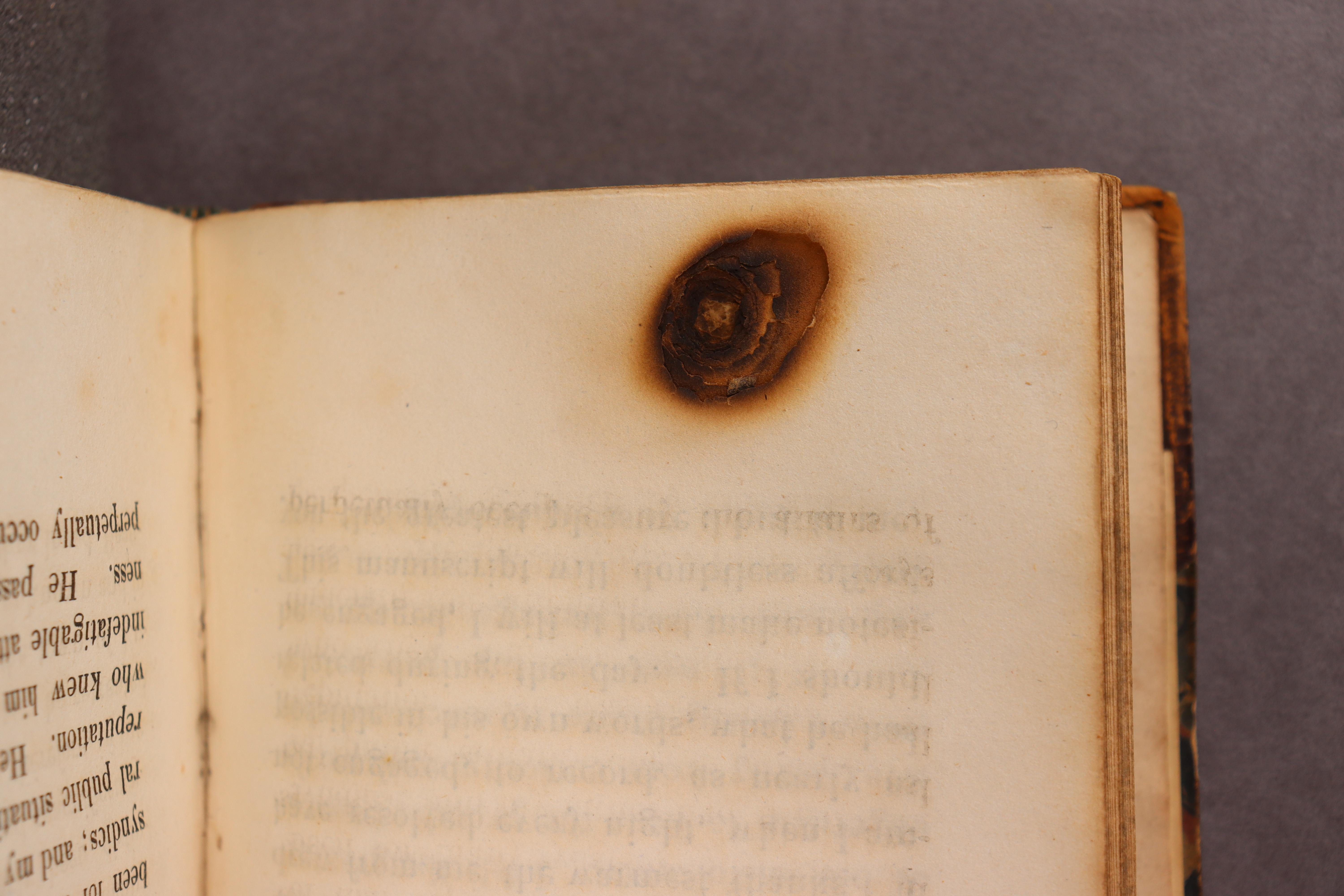
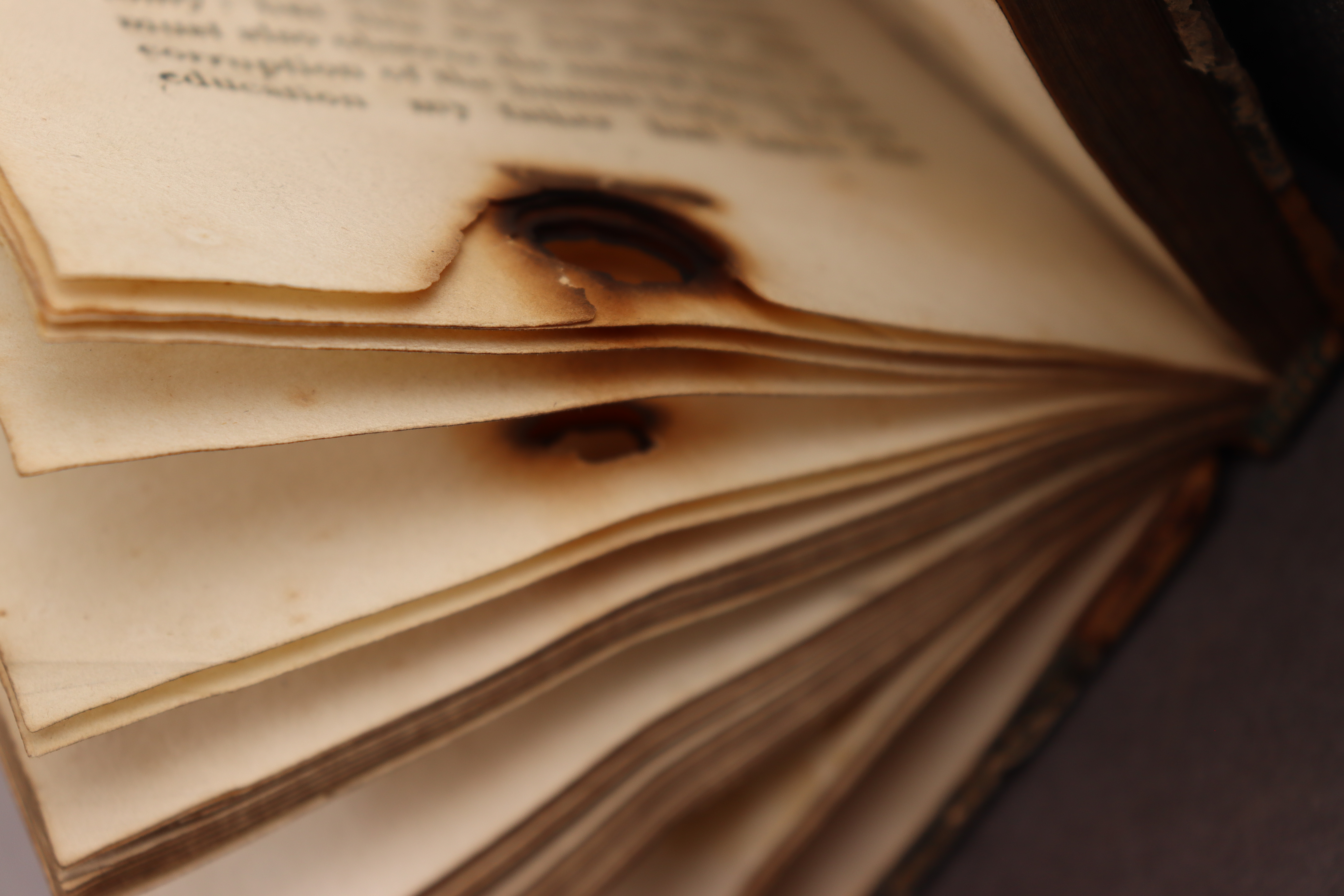
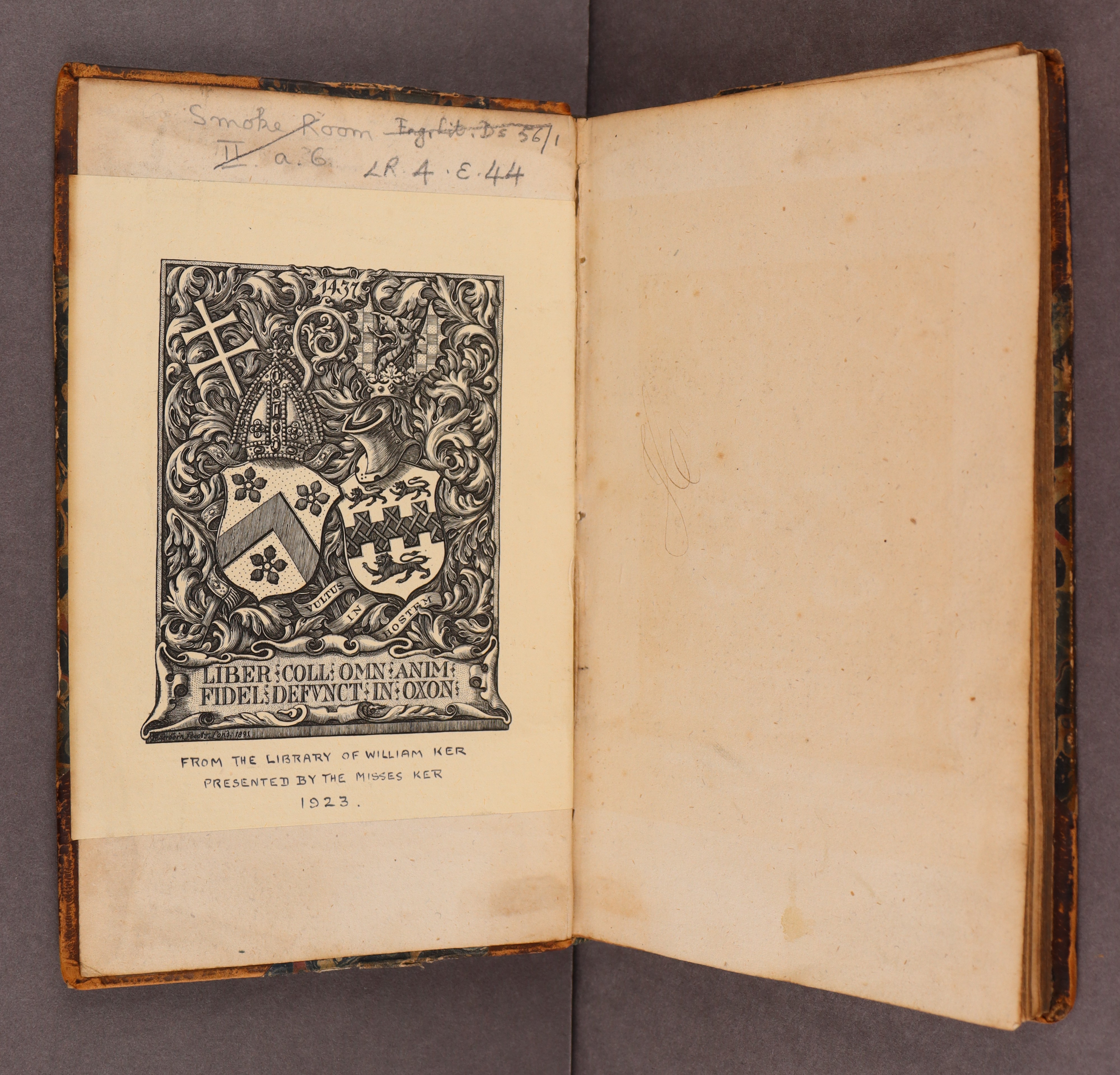
This three-volume first edition of Mary Shelley's Frankenstein came from the library of William Paton Ker (1855-1923), Fellow of All Souls College (1879) and professor of literature and poetry. The set was formerly held in the College's Smoke Room, and it was undoubtedly in this location that the first volume suffered the terrible damage that can be seen in the images. We believe that the hole, which descends through multiple pages, and the surrounding burn marks were caused by a previous reader using the book to stub out their cigarette or cigar! The general level of disrespect towards books this behaviour displays is enough to make any librarian shiver with equal horror and rage, but it also displays a fascinating insight into how literature is valued differently over time. Today, this book is considered highly valuable and collectable, as well as a work of great literary genius; you would never stub your cigar out on it. A hundred years ago, some people clearly had a very different opinion!
Shelley, Mary Wollstonecraft. Frankenstein, or, The modern Prometheus : in three volumes (London : Printed for Lackington, Hughes, Harding, Mavor, & Jones ... ; Printed by Macdonald and Son ... 1818)
Shelfmark: LR.4.e.44
Full bibliographic record